The short version — Most small businesses don’t fail at marketing because they pick the wrong tactic. They fail because they spread a small budget across ten things instead of going deep on two or three that actually compound.
Plan to spend somewhere between 5% and 10% of your revenue on marketing. Put the early money where the math is friendliest — your website, local SEO, and email — then layer in paid ads and social once you have something worth amplifying. Email still returns roughly $36 for every $1 spent, and SEO is one of the few channels that keeps paying you after you stop.
Here’s an uncomfortable truth we run into all the time: a plumber, a boutique gym, and a SaaS startup will all Google “digital marketing for small businesses,” read the same generic checklist, and walk away more confused than when they started. The advice online is either written for Fortune 500 budgets or so vague it’s useless on a Monday morning.
So this guide to digital marketing for small businesses is the version we wish existed — written for an owner who has a real business, a finite budget, and zero patience for buzzwords. We’ll cover what it actually costs, which channels return the most per dollar, and the order to do things in so you’re not lighting cash on fire. Every number here is sourced, and we’ve flagged where the data gets fuzzy so you know what to trust.
Why digital marketing for small businesses isn’t optional anymore
The case for showing up online stopped being theoretical years ago. Roughly 81% of consumers research a business online before they buy (GE Capital / multiple consumer-behavior studies), and a lot of them quietly disqualify you if there’s nothing to find. One survey found that 31% of U.S. shoppers chose not to use a small business specifically because it had no website.
And plenty of businesses still don’t. Depending on the survey, somewhere between 17% and 27% of small businesses have no website at all in 2025 — a number that’s improved a lot (only 64% had one back in 2018, per moneyzine’s compilation) but still represents a wide-open door for the ones who do show up properly.
Meanwhile the money is moving online fast. Global digital marketing spend is projected to clear $730 billion in 2025 and top $800 billion in 2026, and around 72% of marketing budgets now go to digital channels rather than print, TV, and radio. Nearly half of small businesses — 49% — said they planned to increase their marketing budgets heading into 2025. Translation: your competitors are spending more here, not less.
How much does digital marketing cost for a small business?
This is the question everyone actually wants answered, so let’s not bury it. Most small businesses spend between $1,000 and $5,000 per month on digital marketing, with the average landing around $2,000/month. If you’re starting lean and local, you can do meaningful work with $500–$1,000 a month focused on a tight scope.
There are really two ways to set the number, and we recommend doing both and sanity-checking one against the other:
- The percentage-of-revenue method. The common rule of thumb is 5–10% of gross revenue for steady growth. Businesses chasing aggressive growth often push to 15–20%. So a shop doing $500,000 a year would budget roughly $25,000–$50,000 annually, or about $2,000–$4,000 a month.
- The goals method. Work backwards from what you need. If a new customer is worth $1,500 to you and you want ten more a month, you can afford a real budget — the spend is an investment with a known payback, not an expense.
Here’s a rough picture of what budgets buy at different stages. Treat these as ranges, not promises — pricing varies wildly by market and by whether you hire an agency, a freelancer, or do it in-house.
| Stage | Typical monthly budget | Where it usually goes |
|---|---|---|
| Just starting / local | $500 – $1,500 | Website basics, Google Business Profile, local SEO, a little paid search |
| Growing | $1,500 – $5,000 | Content + SEO, email, managed social, ongoing paid ads |
| Scaling | $5,000 – $15,000+ | Multi-channel paid media, conversion optimization, automation, analytics |
One caution from experience: a budget split into tiny slivers across six channels almost always underperforms the same money concentrated on two. Below roughly $1,500/month, pick a lane.
Which channels actually return the most? (Digital marketing ROI, ranked)
If budget is finite — and for a small business it always is — you should care less about what’s trendy and more about return per dollar. The channel ROI benchmarks below come up again and again in industry research. Read them as directional averages, not guarantees; your own results depend on your offer, your margins, and your execution.
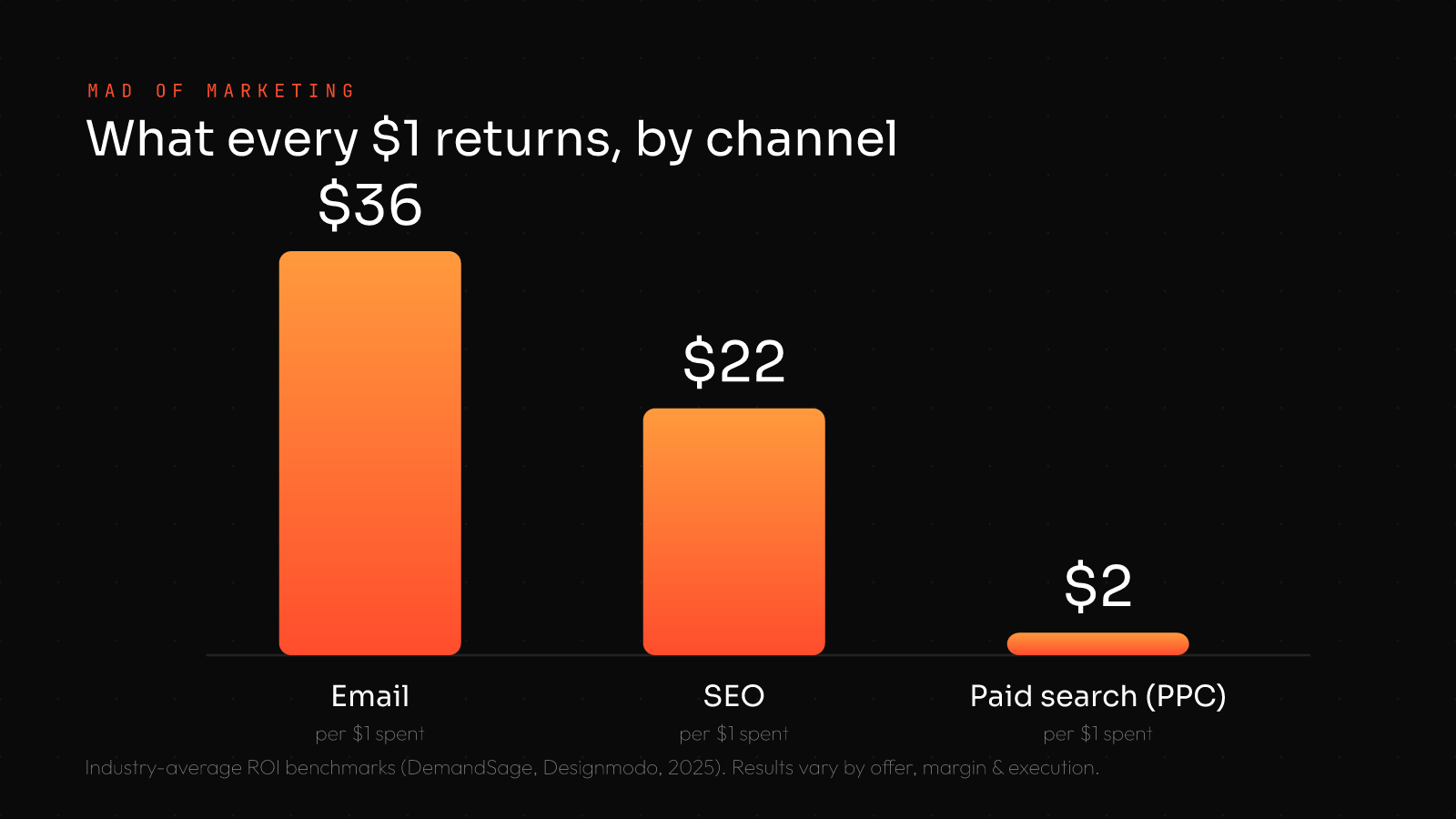
- Email marketing — about $36 back for every $1 spent. Year after year, email tops the ROI charts (Litmus / DMA figures widely cited across 2025 reports). It’s cheap, you own the list, and it prints money once you have an audience to send to. The catch: you need traffic and signups first, which is why it pairs with everything else.
- SEO — roughly $22 back for every $1 over time. SEO is a slow build, but it’s the closest thing to an appreciating asset in marketing. A page that ranks keeps pulling in visitors months and years later without ongoing ad spend.
- Paid search (PPC) — about $2 back for every $1, often more. A 200% return is a solid, reliable baseline, and the big advantage is speed: ads can drive qualified traffic this week, not next quarter. The trade-off is that the moment you stop paying, the traffic stops.
The pattern is worth internalizing. Paid channels rent you attention; owned channels (SEO, email, your site) build equity. The smart play for most small businesses is to use a little paid spend to buy time while the slower, compounding channels catch up.
The order of operations: a small business marketing strategy that holds up
Strategy isn’t a 40-page deck. Effective digital marketing for small businesses is mostly about sequence — doing the right things in the right order so each step makes the next one cheaper. Here’s the order we actually use.
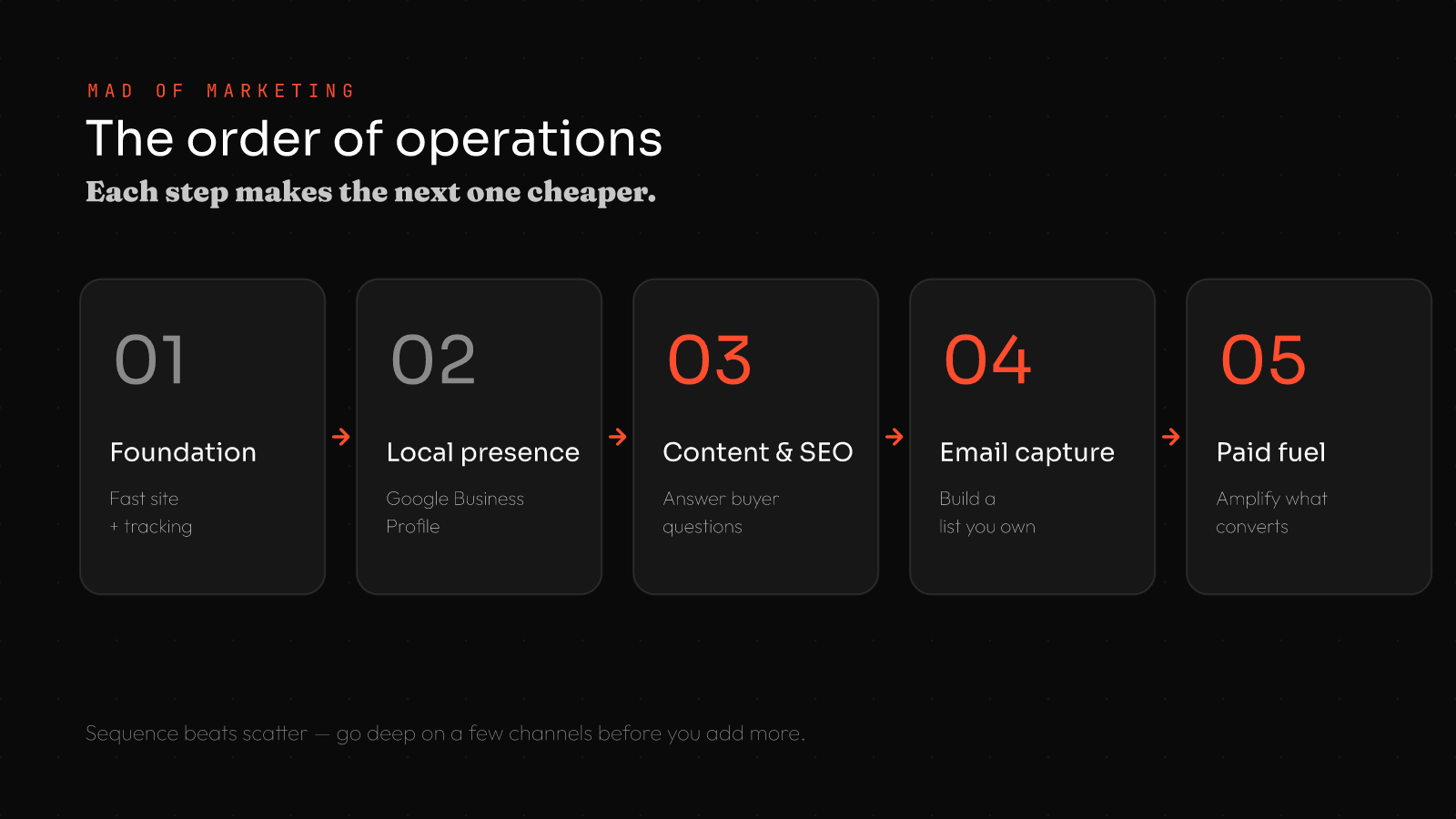
1. Fix the foundation (your website and tracking)
Every dollar you spend driving traffic is wasted if the destination is broken. Before you boost a single post, make sure your site loads fast on a phone, makes it obvious what you do, and has a clear next step — a call button, a booking link, a quote form. Then install basic tracking (Google Analytics 4 and the Google/Meta pixels) so you can actually tell what’s working. You can’t optimize what you don’t measure.
2. Claim your local presence
If you serve a geographic area, this is the highest-leverage free thing you can do. More on the numbers below, but the headline is simple: a complete, active Google Business Profile is one of the best returns in all of marketing, and it costs nothing but attention.
3. Build one content engine (SEO)
Pick the questions your best customers ask before they buy, and answer them better than anyone else ranking for them. This is exactly the kind of article you’re reading now. Publishing consistently — even one strong piece a month — compounds into a library of pages that earn traffic on autopilot.
4. Start capturing, not just attracting (email)
Turn the traffic you’re earning into a list you own. An offer as simple as a checklist, a discount, or a useful guide in exchange for an email address means you’re no longer renting access to your audience from an algorithm.
5. Add paid fuel
Once you know your site converts and your offer lands, paid ads stop being a gamble and become a dial you can turn up. Now you’re amplifying something proven instead of hoping.
Local SEO for small business: the unfair advantage
If there’s one section to act on today, it’s this one. Local search has quietly become one of the most powerful — and most underused — channels for small businesses, and the data is genuinely striking.
- “Near me” searches are booming. They’ve grown roughly 150% faster than general searches in recent years, and Americans run hundreds of millions of “near me” style searches every month. Close to 46% of consumers say they “always” or “often” add “near me” to local searches.
- Local intent converts fast. Studies put the share of local mobile searches that lead to an offline purchase within 24 hours at around 78%. People searching locally aren’t browsing — they’re buying.
- A complete profile wins. Businesses with fully filled-out Google Business Profiles reportedly get about 70% more location visits than those with incomplete ones. Photos, hours, services, and a steady drip of reviews all move the needle.
Here’s a quick example of how that compounds. The average small business shows up in roughly 1,000 local searches a month. Apply even a conservative purchase-intent conversion rate and that’s hundreds of high-intent impressions you may be leaving on the table simply because your profile is half-finished or you’ve stopped asking happy customers for reviews. Fixing it costs an afternoon.
Small business social media marketing: do less, better
Social is where most small businesses overextend — five platforms, posting into the void, burning out. The truth is you don’t need to be everywhere. You need to be good in the one or two places your customers actually are.
The discovery numbers explain why it’s worth the effort at all: somewhere around 57–58% of consumers say they discover new brands on social media, and DataReportal’s Digital 2025 report found that close to 30% discover new products through social ads specifically. On Instagram, the platform’s own data has long claimed that 83% of users discover new products and services there.
A few principles that keep small-business social sane and effective:
- Pick one or two platforms, not five. A B2B consultancy belongs on LinkedIn; a restaurant or salon belongs on Instagram and TikTok. Go where your buyers already scroll.
- Lead with short-form video. It’s the format platforms push hardest right now and the one audiences use most for discovery. You don’t need a studio — a phone and a clear point are enough.
- Repurpose relentlessly. One good blog post becomes five social posts, three short videos, and an email. Create once, distribute many times.
- Measure leads, not likes. Followers are a vanity metric. Track clicks, DMs, bookings, and sales — the things that pay the bills.
The mistakes that quietly drain small business budgets
After enough audits, the same handful of leaks show up over and over:
- Chasing tactics instead of a strategy. Jumping on whatever’s trending this week — a new platform, a viral format — without a plan to tie it back to revenue.
- No tracking. Spending money and genuinely not knowing which half is working. (You can fix this for free in an afternoon.)
- Quitting too early on SEO. Killing a content program at month three because it “isn’t working,” right before the part where it starts to compound. SEO typically takes 3–6 months to show real traction.
- Boosting a broken funnel. Pouring ad spend into a slow website with no clear call to action — sending more people to a leaky bucket.
- Trying to do everything alone. Owners who spread themselves across SEO, ads, design, and content usually do all of them at 60%. Pick what to own and get help with the rest.
Should you DIY, hire a freelancer, or work with an agency?
There’s no universally right answer — it depends on your budget and how you value your time.
- DIY makes sense at the very beginning when budgets are tight and you’re still learning what works. The cost is your time, which is rarely as free as it feels.
- A freelancer is great for a single, well-defined channel — someone to run your ads or write your content — once you know what you need.
- An agency earns its keep when you want a coordinated strategy across channels, senior expertise without a senior salary, and someone accountable for the whole picture rather than one slice of it.
The honest test: if marketing is eating the hours you should be spending running your business, the “cheap” DIY route is quietly the most expensive option you have.
Frequently asked questions
How much should a small business spend on digital marketing?
A common benchmark is 5–10% of gross revenue, rising to 15–20% for businesses pursuing aggressive growth. In practical terms, most small businesses spend $1,000–$5,000 per month, and you can start meaningfully at $500–$1,000/month if you keep the scope tight.
What is the best digital marketing channel for a small business?
For return on investment, email marketing leads (around $36 per $1), followed by SEO (around $22 per $1). But the best channel depends on your goals: local SEO and Google Business Profile are usually the fastest wins for local businesses, while paid search is best when you need traffic immediately.
How long does digital marketing take to work?
It depends on the channel. Paid ads can drive results within days or weeks. SEO and content marketing typically take 3–6 months to build momentum, then compound from there. A healthy strategy uses paid channels for quick wins while the organic channels mature.
Is digital marketing worth it for a very small business?
For most, yes. With 81% of consumers researching online before they buy, even a one-person operation benefits from a basic website, a complete Google Business Profile, and a few reviews. Done right, digital marketing for small businesses doesn’t require a big budget to start — it requires a focused one.
The bottom line on digital marketing for small businesses
Digital marketing for small businesses isn’t about doing more. It’s about doing the few things that compound — a site that converts, a local presence people can find, content that earns traffic for free, and a list you own — and being patient enough to let them stack up. Spend a sensible slice of revenue, put the early money where the ROI math is friendliest, and resist the urge to chase every shiny tactic.
That’s exactly the kind of work we do at Mad of Marketing — bold creative backed by real data, run by senior strategists who’ll tell you the truth about where your budget should go. Take a look at our services, and if you’d like a straight answer about what would move the needle for your business, book a free strategy call and we’ll map it out with you.
Related guides in this series
- How Much Does Digital Marketing Cost? — real 2026 pricing by service and budget.
- Small Business Marketing Strategy — a proven 5-step framework.
- Local SEO for Small Business — win the “near me” moment.
- Digital Marketing ROI — benchmarks and how to measure return.
- Small Business Social Media Marketing — the do-less-better playbook.
- Content Marketing for Small Business — earn traffic that compounds.
- Google Ads for Small Business — buy high-intent traffic profitably.
- Email Marketing for Small Business — the highest-ROI channel you own.
- Lead Generation for Small Business — capture and convert more leads.
- Branding for Small Business — build trust and recognition.
- Website Design for Small Business — turn visitors into customers.
- SEO for Small Business — earn organic traffic that compounds.
- Facebook Ads for Small Business — reach Meta’s billions profitably.
- Marketing Automation for Small Business — do more with less.
- Conversion Rate Optimization — turn more visitors into customers.
- Instagram Marketing for Small Business — turn the feed into customers.
- Video Marketing for Small Business — the format that sells.
- Google Business Profile Optimization — win the local map pack.
- Online Reputation Management — your reviews are your storefront.
- YouTube Marketing for Small Business — the world’s #2 search engine.
- LinkedIn Marketing for Small Business — the B2B growth engine.
- SMS Marketing for Small Business — 98% open rates.
- Customer Retention Strategies — keep customers, grow profit.
- How to Get More Customers for a Small Business — a proven system.
- Low Budget Marketing Ideas — big results, small spend.
- How to Get More Google Reviews — build trust that ranks.
- How to Increase Website Traffic — more visitors, more customers.
- How to Advertise a Small Business — reach more customers profitably.
- How to Write a Marketing Plan — a one-page plan that works.
- Best Marketing Channels for Small Business — ranked by ROI.
- How to Market a New Business — launch and win first customers.
- Digital Marketing Agency for Small Business — what they do and cost.
- How to Choose a Digital Marketing Agency — questions and red flags.
- When to Hire a Marketing Agency — the honest signs.
- Marketing Agency vs Freelancer — which is right for you.
- Restaurant Marketing Ideas — fill more tables.
- Real Estate Marketing Ideas — win more listings and leads.
- How to Promote Your Business on Social Media — turn scrolls into customers.
- Landing Page Best Practices — turn clicks into customers.
- Dental Marketing Ideas — fill your appointment book.
- Gym Marketing Ideas — grow membership and cut churn.
- Salon Marketing Ideas — keep every chair full.
- Google Ads vs Facebook Ads — which channel deserves your budget.
Sources & further reading: Consumer research behavior and small-business website data — Moneyzine, Wix, Clutch; budget and spend benchmarks — DesignRush, LYFE Marketing, Big Leap; channel ROI — DemandSage, Designmodo; local search — BrightLocal, OnTheMap; social discovery — DataReportal Digital 2025, HubSpot. Figures are industry averages and vary by source, market, and methodology.