Local SEO for small business is how you show up when someone nearby searches for what you sell. It’s the highest-return free channel most local businesses have: 78% of local mobile searches end in a purchase within 24 hours, and a complete Google Business Profile gets 70% more visits. Claim your profile, earn reviews, stay consistent — and you’ll out-rank competitors who haven’t bothered.
If you run a business people visit or hire locally a clinic, a salon, a plumber, a restaurant, a law firm local SEO for small business is the single most cost-effective thing you can do this month. It’s mostly free, the intent is red-hot, and most of your competitors are doing it badly. That’s a rare combination.
This guide is part of our wider playbook on digital marketing for small businesses. Here we focus on winning the local search moment.
What is local SEO for small business?
Local SEO for small business is the practice of optimizing your online presence so you appear when people search for products or services “near me” or in your area. It covers your Google Business Profile, the local map pack, location-based keywords, reviews, and consistent business listings across the web.
The difference from regular SEO is intent and geography. Someone typing “emergency electrician near me” isn’t browsing, they’re ready to call. Local SEO makes sure that call comes to you.
Why local SEO for small business converts so well
The numbers are hard to argue with:
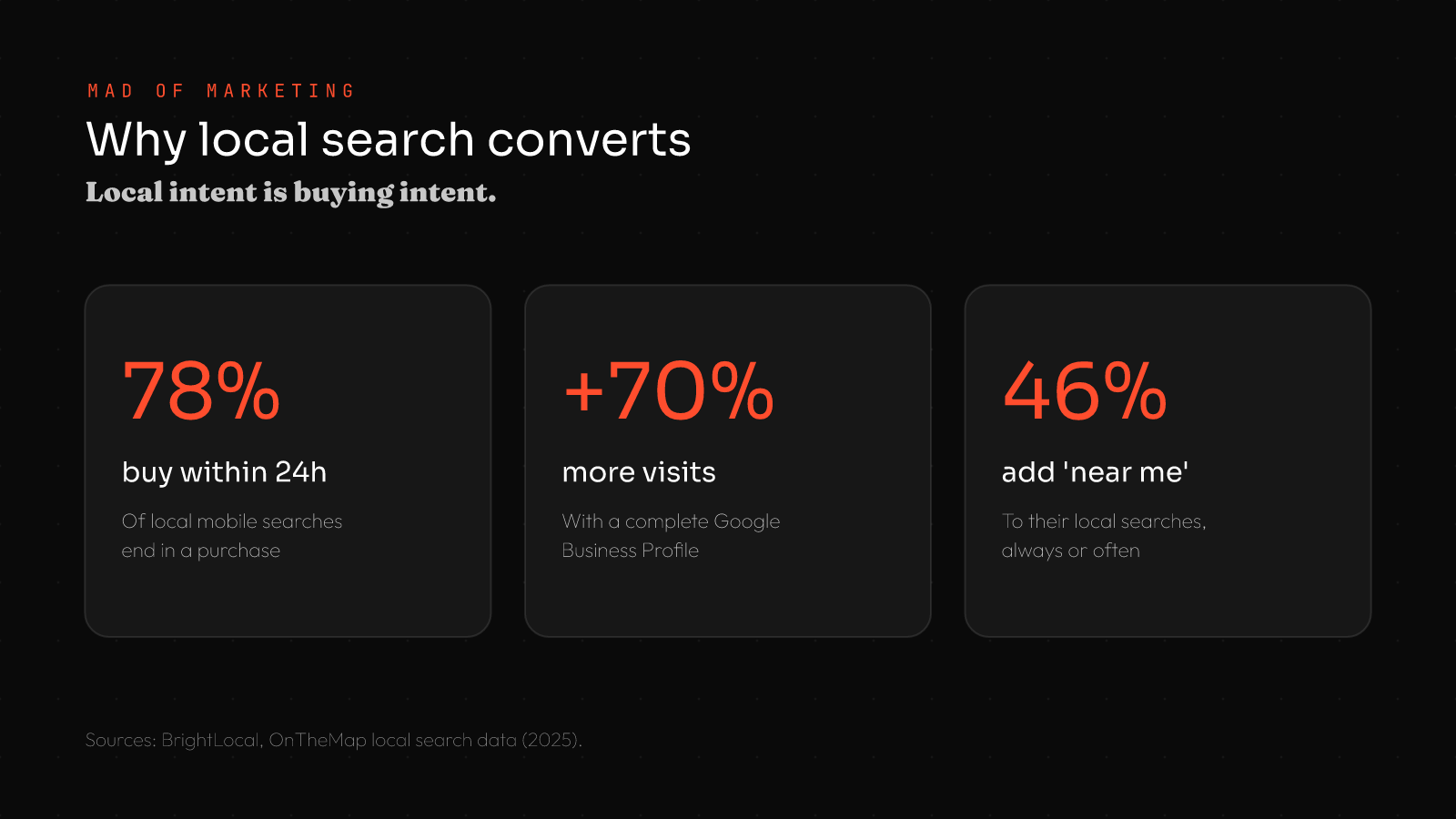
- “Near me” searches are exploding — growing roughly 150% faster than general searches, with hundreds of millions run every month. About 46% of people say they “always” or “often” add “near me” to a search.
- Local intent is buying intent — around 78% of local mobile searches lead to an offline purchase within 24 hours.
- A complete profile wins — businesses with fully filled-out Google Business Profiles get about 70% more location visits than those with incomplete ones.
The local SEO checklist (in priority order)
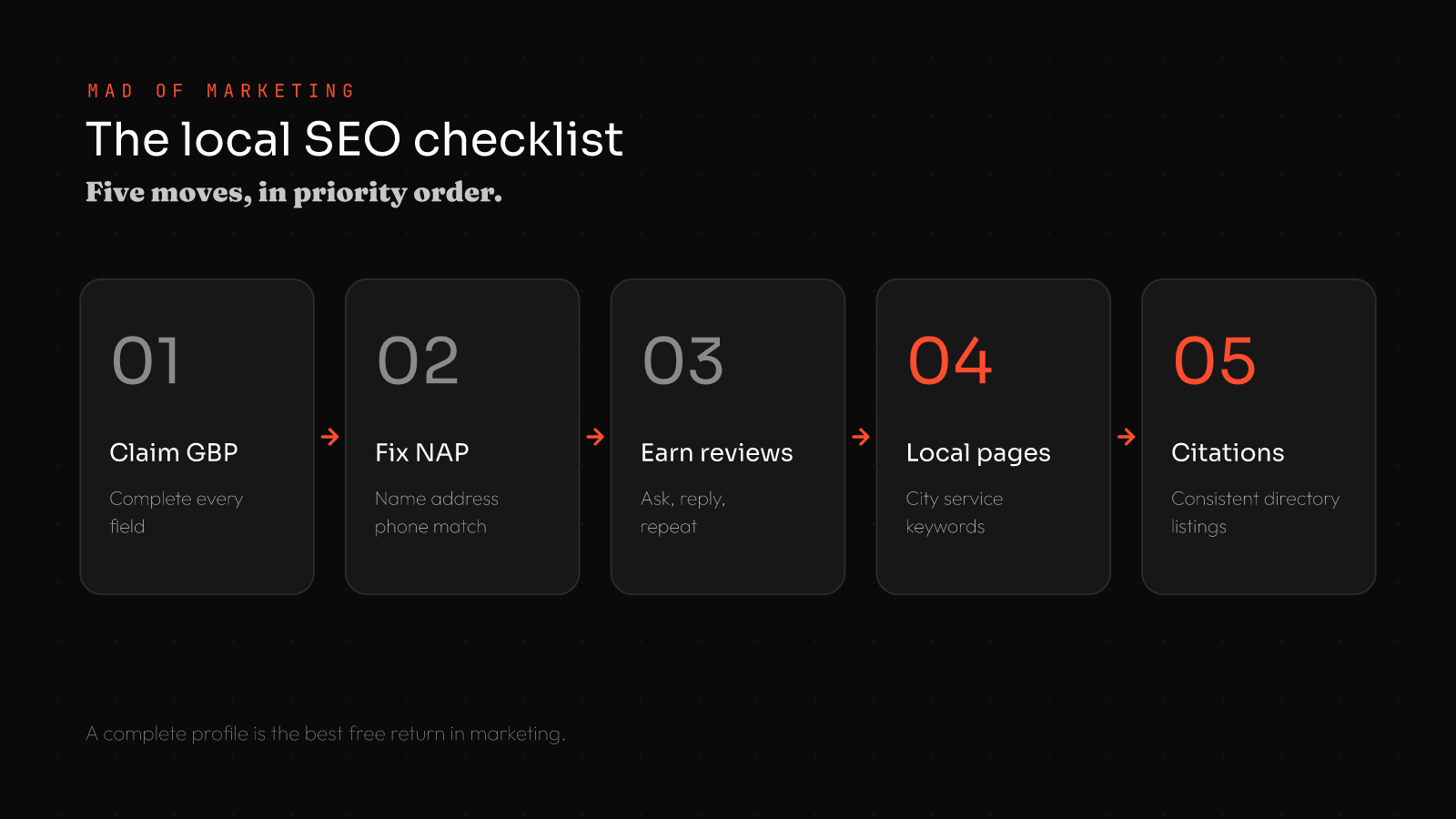
Do these five things, roughly in this order, and you’ll beat most local competitors.
1. Claim and complete your Google Business Profile
This is the highest-leverage free thing in local SEO. Claim it, then fill in every field: categories, services, hours, service area, photos, and a real description. Add fresh photos regularly. A complete profile is what earns that 70% visit lift.
2. Get your NAP consistent
Your Name, Address, and Phone number must match exactly everywhere they appear website, profile, directories. Inconsistent details confuse search engines and quietly sink your rankings.
3. Earn reviews and reply to them
Reviews are local SEO rocket fuel and the deciding factor for most buyers. Ask every happy customer, make it easy with a direct link, and reply to all of them good and bad. A steady drip beats a one-time pile.
4. Build location-based pages and content
Create pages that target your service plus your area (“dental implants in [city]”). If you serve multiple towns, give each a genuinely useful page rather than a thin copy-paste clone.
5. Build local citations
List your business consistently in relevant directories and local platforms. These citations reinforce that you’re a real, established business in your area.
How Google ranks local results (the 3 factors)
Google’s local rankings, the “map pack” of three businesses you see at the top, come down to three factors. Understanding them tells you where to put your effort.
- Relevance. How well your profile and website match what the person searched. This is why complete categories, services, and descriptions matter they tell Google what you actually do.
- Distance. How close you are to the searcher (or to the location they searched). You can’t move your business, but accurate location data and service-area settings help Google place you correctly.
- Prominence. How well-known and trusted you are driven heavily by your volume and quality of reviews, plus citations and links. This is the factor you have the most room to improve.
The practical takeaway: you can’t change distance, but you can dominate relevance and prominence and that’s usually enough to win.
Google Business Profile optimization, in depth
Because the profile drives so much of local SEO for small business, it’s worth going beyond “claim it.” The features most owners ignore are exactly the ones that lift rankings and conversions:
- Categories. Pick the most accurate primary category, then add relevant secondary ones. This is one of the strongest relevance signals there is.
- Services and products. List them out with descriptions. Each one is another chance to match a search.
- Google Posts. Publish updates, offers, and events. They keep the profile active a signal Google rewards and show up directly in your listing.
- Q&A. Seed and answer common questions yourself before competitors or randoms do it for you.
- Photos. Add new, real photos regularly. Listings with fresh images get more clicks and calls.
- Attributes. “Women-owned,” “wheelchair accessible,” “free Wi-Fi” these help you match filtered searches and stand out.
A review strategy that actually earns reviews
Reviews are the biggest lever on prominence and the deciding factor for most buyers so don’t leave them to chance. A simple system beats hoping:
- Ask every happy customer, at the moment they’re happiest right after the job’s done or the meal’s finished.
- Make it one tap. Share your Google review short link by text or email. Every extra step loses reviews.
- Reply to all of them. Thank the positive ones; respond calmly and helpfully to the negative ones. Google notes the engagement, and prospects read your responses as much as the reviews.
- Never buy fake reviews. Google detects and penalizes them, and customers can usually smell them. Slow and real beats fast and fake.
Local SEO for multi-location businesses
If you operate in several towns or have multiple branches, the rules shift slightly. Create a separate, genuinely useful page for each location with its own address, staff, photos, and locally relevant content rather than one thin page or duplicated clones. Set up a distinct Google Business Profile per physical location, and keep NAP consistent across every one. Done right, each location ranks in its own area instead of competing with itself.
How local SEO connects to the rest of your marketing
Local SEO rarely works in isolation. The reviews you collect feed your social proof, the local pages you build support your broader marketing strategy, and the high-intent traffic it drives is some of the cheapest, highest-converting you’ll get which keeps your overall digital marketing ROI healthy. It’s the foundation most local businesses should build on first.
Local keyword research: find what your customers search
You can’t rank for terms you haven’t identified. Local keyword research doesn’t need expensive tools — it needs you to think like your customer. Start with the pattern “[service] + [location]” and “[service] near me,” then expand:
- Use Google autocomplete. Start typing your service and see what Google suggests — those are real searches.
- Check “People also ask” and related searches. They reveal the questions behind the keywords.
- Mine your own inbox and calls. The exact words customers use to describe their problem are your best keywords.
- Look at competitors. What services and areas do the businesses ranking above you target?
Group what you find into the services and locations you serve, and build a page or profile section around each meaningful cluster. One clear page per service-plus-area beats one generic page trying to rank for everything.
How to track your local SEO results
Local SEO is measurable, so don’t fly blind. Watch a handful of signals month to month:
- Google Business Profile insights — searches, views, calls, direction requests, and website clicks straight from your listing.
- Map pack rankings — where you appear for your priority “service + city” terms.
- Calls and form fills — the actions that turn into revenue, tracked in GA4.
- Review velocity — how steadily new reviews are coming in.
Rising profile views and calls are the clearest sign your local SEO is working. Tie them back to booked jobs and you’ll know exactly what your local presence is worth and where it fits in your overall digital marketing ROI.
Local SEO mistakes that cost small businesses customers
- An unclaimed or half-finished profile. The most common and most expensive miss.
- Ignoring reviews. Not asking, or never replying. Both hurt.
- Inconsistent NAP. An old address or phone number floating around the web.
- No mobile-friendly site. Local search is overwhelmingly mobile; a slow site loses the click.
- Set-and-forget. Local SEO rewards ongoing activity fresh photos, posts, and reviews.
How much does local SEO cost?
Plenty of the highest-impact work claiming and completing your profile, asking for reviews, fixing NAP is free. If you hire help, local SEO for a single-location business typically runs $1,500–$3,000/month depending on competition. For the full picture, see how much digital marketing costs.
Why mobile and speed make or break local SEO
Local search is overwhelmingly a mobile, on-the-go behavior someone standing on a street corner, sitting in a car, or comparing options on the couch. That has two practical consequences for local SEO for small business.
First, your site has to load fast on a phone. A slow or clunky mobile site loses the click no matter how well you rank and page speed is itself a ranking factor. Second, the path to contact has to be frictionless. A tap-to-call button, your address linked to maps, and a short contact form should be reachable in one thumb-tap.
The businesses that win local aren’t always the biggest; they’re often just the easiest to act on the moment someone’s ready. Test your own site on your phone right now if calling you takes more than one tap, that’s costing you customers every day.
Frequently asked questions
What is local SEO for small business?
It’s optimizing your online presence Google Business Profile, reviews, local keywords, and consistent listings so you appear when nearby customers search for what you offer, especially “near me” searches.
How long does local SEO take to work?
Completing your Google Business Profile can lift visibility within days to weeks. Competitive local rankings usually build over 2–3 months of consistent reviews, content, and citations.
Is local SEO worth it for a small business?
Yes, it’s one of the best returns available. With 78% of local mobile searches converting within a day and most of the core work being free, even a one-location business sees outsized results from getting the basics right.
Can I do local SEO myself?
The fundamentals, yes claiming your profile, asking for reviews, and keeping details consistent take time, not budget. Competitive markets often benefit from help with content and citations.
The bottom line on local SEO for small business
Local SEO for small business is the rare channel that’s cheap, high-intent, and underused by competitors. Claim and complete your Google Business Profile, earn reviews relentlessly, keep your details consistent, and stay active. Do that and you’ll capture the customers already searching for you.
Want us to audit your local presence and find the quick wins? Book a free strategy call or see our services.