Content marketing for small business is how you earn attention instead of renting it. It generates about three times as many leads as outbound and costs 62% less, returns roughly $7.65 for every $1 spent, and compounds over time. The catch: it rewards patience and consistency, not one-off bursts.
Most small businesses treat content as an afterthought, a blog nobody updates, a few posts when there’s time. That’s a shame, because content marketing for small business is one of the few channels that keeps working long after you’ve paid for it. A single article that ranks can pull in customers for years; an ad stops the moment your card declines.
This guide is part of our wider playbook on digital marketing for small businesses. Here we focus on content: what it is, why the numbers are so good, and exactly how to build an engine that compounds.
What is content marketing for small business?
Content marketing for small business is the practice of creating and sharing useful, relevant content, blog posts, videos, guides, emails, to attract and keep customers, instead of interrupting them with ads. Rather than shouting “buy now,” you answer the questions your buyers are already asking, build trust, and become the obvious choice when they’re ready.
It’s a long game by design. You’re trading the instant (but rented) reach of advertising for an owned asset that grows in value. Done consistently, it becomes the cheapest source of qualified leads most small businesses ever build.
Why content marketing for small business works so well
The economics are hard to ignore:
- It’s cheaper and more productive than outbound. Content marketing generates roughly 3× the leads of outbound marketing at about 62% lower cost.
- The ROI is strong. The average return is around $7.65 per $1 spent, and content cuts customer acquisition costs by more than half versus paid channels.
- Blogging compounds. Companies that blog generate 55% more website traffic and 67% more leads than those that don’t.
- Consistency multiplies results. Brands publishing weekly see about a 3.5× increase in conversions versus those publishing monthly.
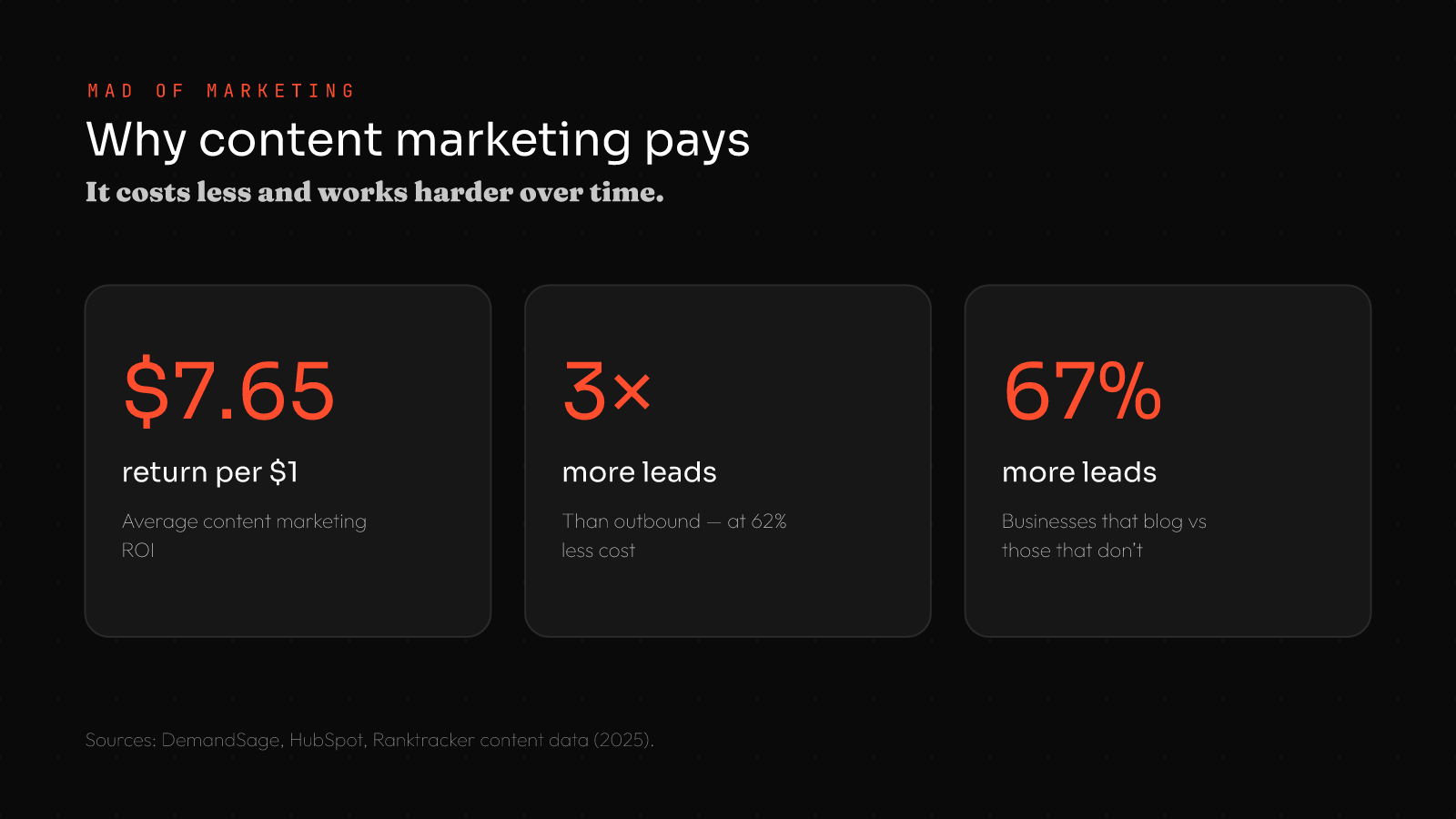
Adoption has caught up with the data: content marketing usage among small businesses rose to 78% in 2025, and many now lean on AI tools to keep production affordable, over half say they incur little extra cost because of them.
The types of content that actually move the needle
You don’t need to do everything. Pick the formats that fit your business and audience:
- Blog posts and guides. The backbone of SEO-driven content. They answer search queries and earn organic traffic for years.
- Short-form video. The fastest-growing format and one of the highest-returning, delivering ROI noticeably faster than text. Great for social discovery.
- Email newsletters. Where content turns into a relationship you own. (See our guide to email marketing for small business.)
- Case studies and testimonials. Proof that quietly closes sales.
- Interactive content. Quizzes, calculators, and tools that earn engagement and links.
Build a content engine in 5 steps
The word “engine” is deliberate. The goal isn’t to publish once, it’s to build a repeatable system where one idea fuels many pieces. Here’s the loop we use.
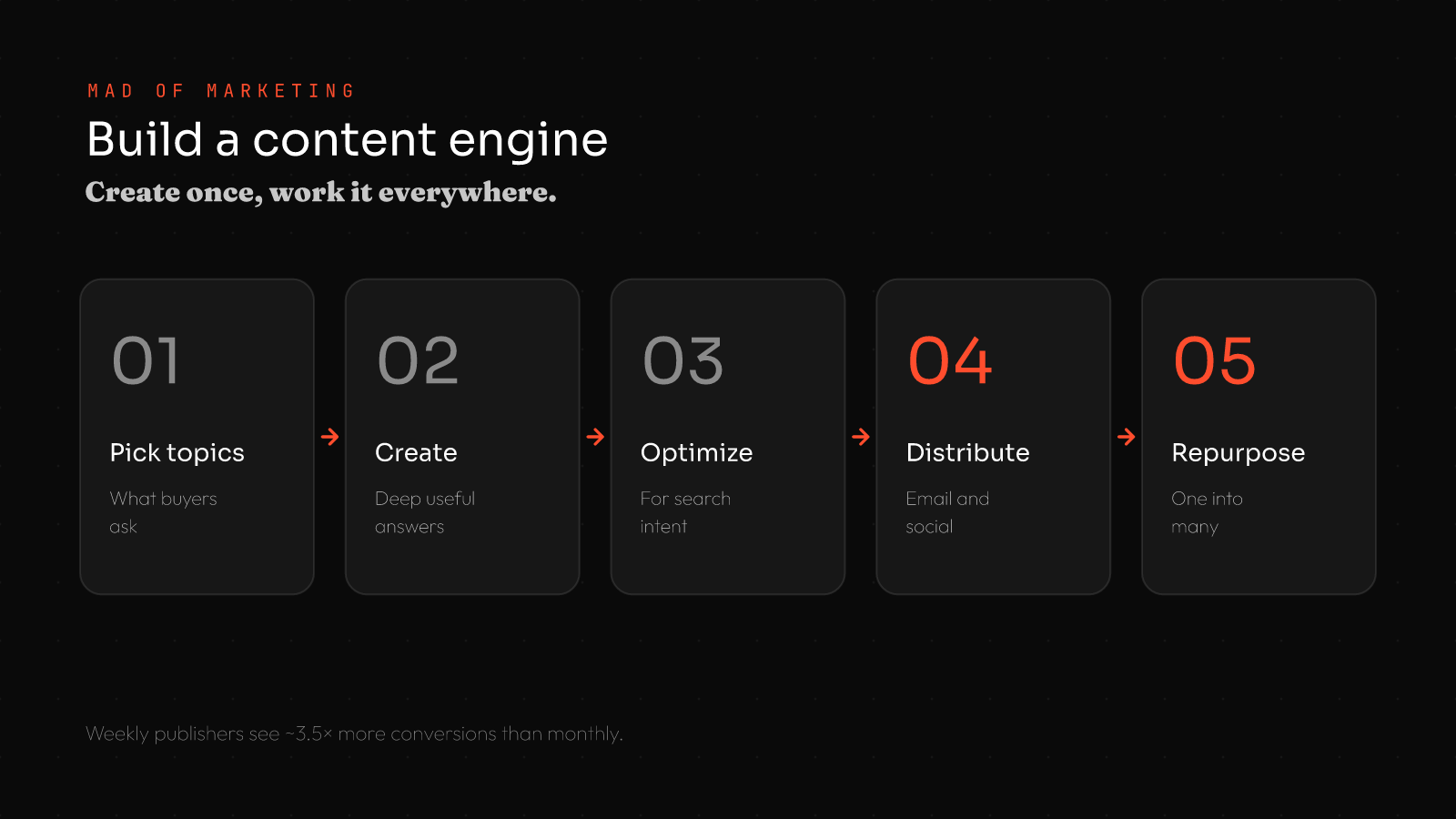
1. Pick topics your buyers actually search
Start with the questions customers ask before they buy. List every question your sales calls and emails surface, then check Google autocomplete and “People also ask” for the exact phrasing. Each real question is a topic with built-in demand.
2. Create something genuinely useful
Aim to be the most helpful answer on the page, not the longest. Write from real experience, include specifics and data, and make it skimmable with clear headings. Depth and honesty are what earn trust, and citations from AI search engines.
3. Optimize for search intent
Match the content to what the searcher wants, use the topic naturally in your title, headings, and intro, and structure it so Google can lift a clean answer. This is where content and SEO meet.
4. Distribute, don’t just publish
Hitting “publish” isn’t the finish line. Share each piece in your email newsletter, across your social channels, and anywhere your audience gathers. Distribution is where most small-business content quietly fails.
5. Repurpose one into many
A single blog post becomes a handful of social posts, two or three short videos, an email, and a downloadable checklist. Repurposing is how a small team produces like a big one.
How much should you invest in content marketing?
Small businesses that invest in content spend, on average, around $43,000 a year, with video and SEO the biggest line items, but that figure spans a wide range, and plenty do meaningful work for far less by writing in-house or using AI tools to speed production.
The honest minimum isn’t money; it’s consistency. One strong piece a month, every month, beats ten in a burst and then silence. For how content fits a wider budget, see how much digital marketing costs.
Measuring content marketing ROI
Content can feel fuzzy to measure, but it isn’t. Track a few signals over time: organic traffic growth, keyword rankings, time on page, email sign-ups from content, and, the one that matters most, leads and sales attributable to specific pieces. Because content compounds, judge it on a 6–12 month horizon, not week three. A post that looks quiet at launch can become your best salesperson a year later. Connect it all to your overall digital marketing ROI so content earns its place on results.
Content marketing and AI search
Something big has shifted in how people find answers. A growing share of buyers now ask ChatGPT, Gemini, Perplexity, or Google’s AI Overviews instead of scrolling ten blue links, and those engines build their answers from content they trust. That makes content marketing for small business more important, not less: if your content isn’t out there clearly answering questions, the AI has nothing of yours to cite.
The good news is that the same habits that win at SEO win here too. Write clear, factual, well-structured content; answer specific questions directly; include real data and sources; and use clean headings the AI can lift a confident answer from.
A short, quotable paragraph that nails a question is exactly what gets pulled into an AI answer with your brand attached. In practice, optimizing for humans and for AI engines is becoming the same job, be the clearest, most trustworthy source on the topic, and both reward you.
A content calendar you can actually keep
The reason most small-business content dies isn’t talent, it’s planning. A simple calendar turns “I should post something” into a system that runs whether or not you feel inspired. Keep it light:
- Pick a realistic cadence. One quality blog post a month plus weekly social repurposing is plenty for most small businesses. Promise only what you’ll keep.
- Plan a quarter at a time. List 3–6 cornerstone topics tied to what your buyers search and what you want to sell.
- Batch the work. Outline several pieces in one sitting, draft in another, edit in a third. Context-switching is what burns people out.
- Build a backlog. Keep a running list of customer questions; you’ll never stare at a blank page again.
The businesses that win at content aren’t the most creative, they’re the most consistent. A calendar is how consistency stops depending on motivation.
Common content marketing mistakes
- Publishing then ghosting. Three posts and silence. Consistency is the whole game.
- Writing for yourself, not the buyer. Content about your features instead of their problems.
- No distribution. Great content nobody sees because it was never shared.
- Chasing volume over value. Ten thin posts lose to one genuinely useful one.
- Quitting before it compounds. Killing the program at month three, right before the payoff.
How content fits your wider strategy
Content rarely works alone, it feeds everything else. It gives your social media something worth posting, your email list something worth sending, and your SEO the pages it needs to rank. That’s why content sits at the center of most strong small business marketing strategies: build it once, and it powers every other channel.
Should you write content yourself or hire help?
Either can work, it depends on time and skill, not budget alone. Writing in-house has a real edge: nobody knows your customers, their objections, and your expertise better than you, and that authenticity is exactly what builds trust and earns AI citations. If you can write clearly and protect the time, DIY is a legitimate long-term strategy, especially with AI tools to speed drafting and research.
Where help pays off is consistency and reach. Most owners start strong and fade by month three because content competes with running the business. A writer, strategist, or agency keeps the engine turning, brings SEO know-how, and handles distribution and repurposing so each piece works harder.
A practical hybrid: you supply the expertise and opinions in a quick voice note or interview, and someone else turns it into polished, optimized content. You keep the authenticity; they keep the cadence. Either way, the non-negotiable is consistency, content marketing for small business only compounds when it doesn’t stop.
Frequently asked questions
What is content marketing for small business?
It’s creating and sharing useful content, blogs, videos, guides, emails, to attract, build trust with, and retain customers, rather than interrupting them with ads. It turns your expertise into an owned asset that generates leads over time.
Is content marketing worth it for a small business?
Yes. It generates about 3× the leads of outbound at 62% less cost and returns roughly $7.65 per $1, but it rewards consistency and takes months to compound, so it suits businesses willing to play a longer game.
How often should a small business publish content?
Consistency matters more than volume, but more is better when it’s good: weekly publishers see roughly 3.5× more conversions than monthly ones. If weekly isn’t realistic, commit to one strong piece a month and never miss it.
How long does content marketing take to work?
Typically 3–6 months to gain traction and 6–12 to compound meaningfully. Video can return faster than text, but the biggest gains come from sustained publishing over a year or more.
The bottom line on content marketing for small business
Content marketing for small business is the closest thing to an appreciating asset you’ll build in marketing. Answer your buyers’ real questions, publish consistently, distribute and repurpose everything, and give it time.
The businesses that stick with it end up with a stream of qualified leads that costs a fraction of advertising, and keeps flowing whether or not you’re spending that month.
Want a content engine built and run for you? Book a free strategy call or explore our services.