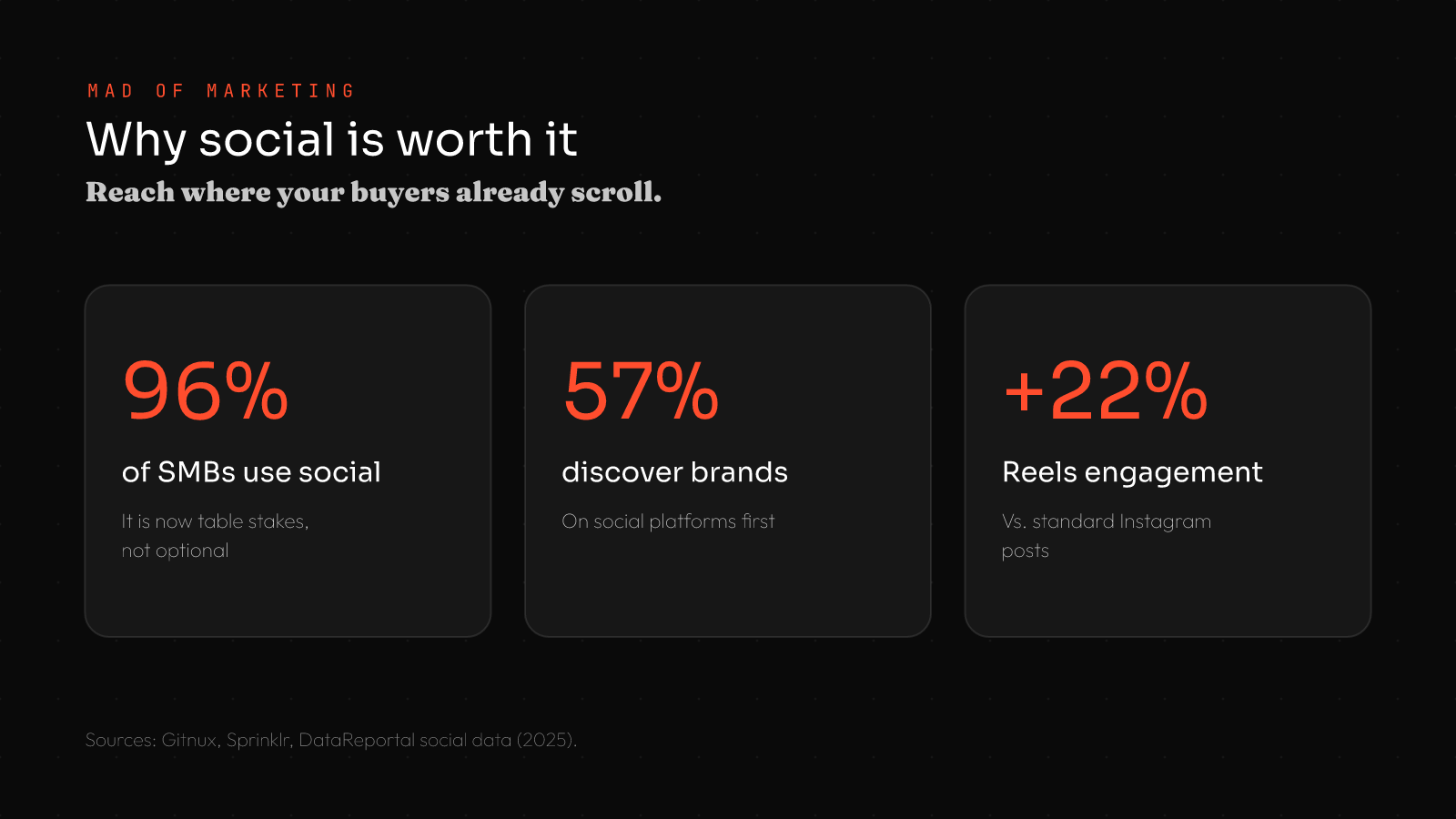
Small business social media marketing works best when you do less, better. 96% of small businesses already use social and 57% of consumers discover brands there, but spreading yourself across five platforms is how you burn out. Pick the one or two where your buyers actually are, lead with short-form video, and measure leads, not likes.
Social media is where most small businesses overextend: five accounts, daily posting into the void, and not much to show for it. The fix isn’t more effort, it’s focus. Done right, small business social media marketing is one of the cheapest ways to get discovered and build trust before anyone ever contacts you.
This guide is part of our wider playbook on digital marketing for small businesses. Here we focus on social, specifically.
Why small business social media marketing is worth it
The case is strong, but it’s about discovery and trust more than direct sales:
- It’s where discovery happens — around 57% of consumers discover new brands on social, and roughly 30% find new products through social ads specifically.
- Your competitors are already there — 96% of small businesses use social media; Facebook alone is used by about 82% of them to reach customers.
- Attention is enormous — the average user spends over 2 hours 45 minutes a day on social platforms.
Pick the right platform, don’t be everywhere
The single biggest small business social media marketing mistake is trying to win on every platform at once. You can’t, and you don’t need to. Go where your buyers already scroll. Here’s the worldwide ad reach by platform to frame where the audiences are:
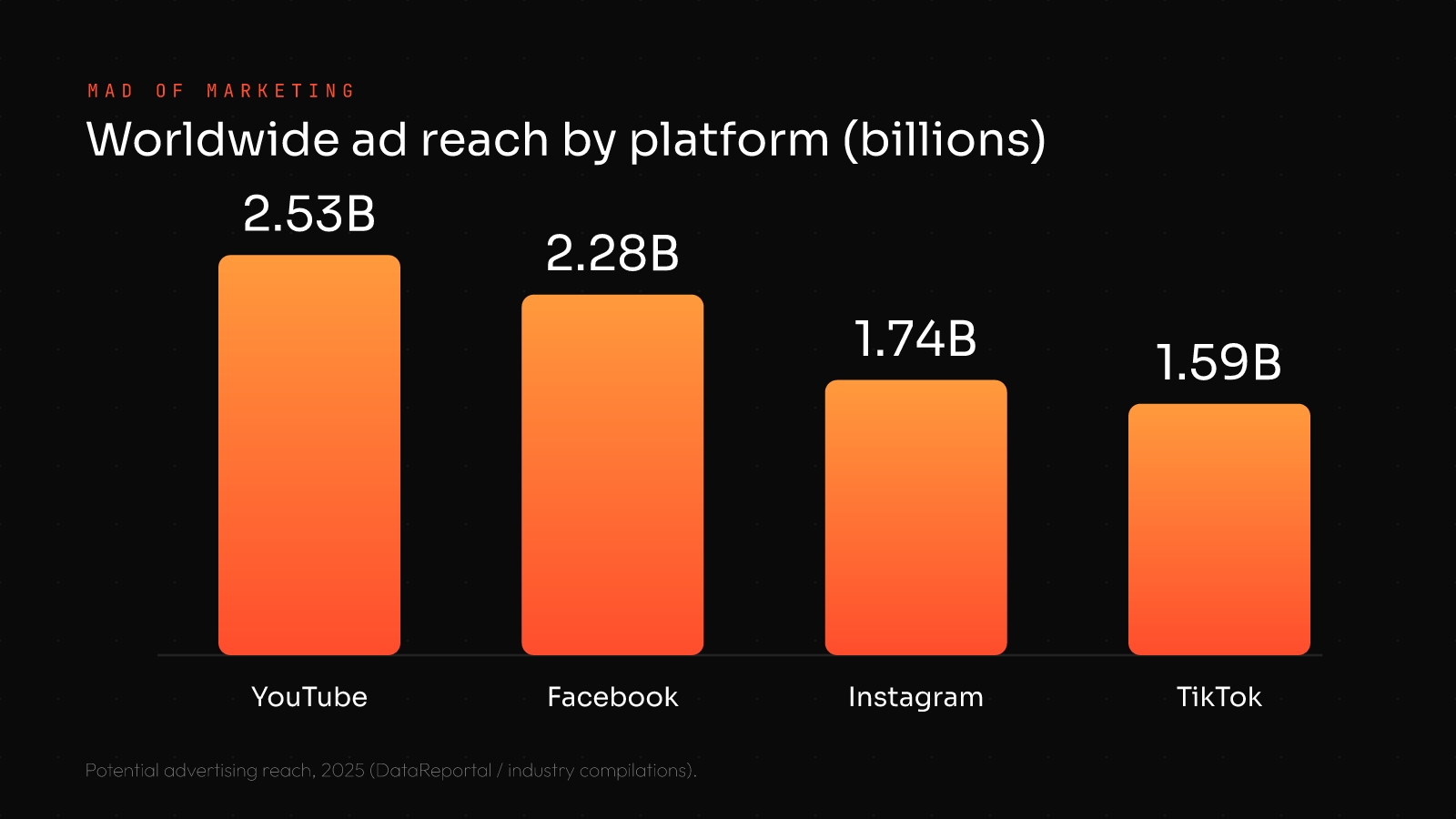
- Facebook — broadest small-business reach; strong for local businesses and older demographics.
- Instagram — visual brands, products, lifestyle; Reels drive discovery.
- TikTok — younger audiences, trend-driven reach, low-cost organic upside.
- YouTube — long-term, searchable content that compounds like SEO.
- LinkedIn — B2B, services, and high-consideration purchases.
Lead with short-form video
If you do one thing differently this year, make it video. Reels generate about 22% more engagement than standard Instagram posts, short-form is what every platform’s algorithm pushes hardest, and 88% of marketers say video gives them positive ROI.
You don’t need a studio, a phone, decent light, and a clear point will out-perform a polished ad that says nothing.
A simple, sustainable social workflow
- Choose one or two platforms. Based on where your buyers are, not where you have an account.
- Set a realistic cadence. Three good posts a week beats ten rushed ones. Consistency wins.
- Create once, repurpose everywhere. One blog post becomes several posts, a few short videos, and an email. (Your marketing strategy should feed this.)
- Engage, don’t just broadcast. Reply to comments and DMs, social is a conversation, and the algorithms reward it.
- Measure leads, not likes. Track clicks, DMs, bookings, and sales. Followers are vanity; revenue is the point.
What to actually post: the content mix
The fastest way to kill a small business social media account is to only post promotions. People don’t follow brands to be sold to constantly — they follow to be informed, entertained, or inspired. A simple, durable mix:
- Educational (40%). Tips, how-tos, myth-busting, answers to the questions customers actually ask. This builds trust and authority.
- Entertaining / relatable (30%). Behind-the-scenes, team moments, trends, humor. This earns reach and makes you human.
- Social proof (20%). Reviews, results, testimonials, before-and-afters. This does the quiet selling for you.
- Promotional (10%). Direct offers and calls to action. It works precisely because you’ve earned attention with the other 90%.
Map those four buckets to your week and you’ll never stare at a blank screen wondering what to post.
How to make short-form video that performs
Since short-form video drives the most reach, it’s worth getting the basics right. You don’t need production value, you need a strong start and a clear point:
- Hook in the first 2 seconds. Lead with the payoff or a bold question. Most viewers decide instantly whether to keep watching.
- Keep it tight. 15–30 seconds is plenty for most small-business content. One idea per video.
- Add captions. Most people watch on mute. On-screen text dramatically lifts completion.
- End with a nudge. “Follow for more,” “DM us ‘quote,'” or “link in bio.” Tell viewers the next step.
- Repurpose. One vertical video works on Reels, TikTok, and YouTube Shorts with minimal changes.
A weekly social media workflow you can sustain
Consistency is the whole game, and consistency comes from a system, not willpower. The trick is batching:
- Plan (30 min/week). Pick the week’s themes from your content mix.
- Batch-create (2 hrs). Film several videos and draft several posts in one sitting. Switching contexts daily is what burns people out.
- Schedule. Queue everything with a scheduler so posting is automatic.
- Engage (10 min/day). Reply to comments and DMs daily, this is where the algorithm and the relationships actually live.
Two focused hours a week beats a frantic scramble every morning, and it’s how small business social media marketing stays sustainable past month two.
The social media metrics that matter
Ignore the vanity numbers and watch the ones tied to business outcomes:
- Reach & impressions — are you being seen by new people?
- Engagement rate — are they interacting, not just scrolling past?
- Saves & shares — the strongest signal your content is genuinely useful.
- Profile clicks & link clicks — are viewers moving toward becoming customers?
- Leads, DMs & sales — the only metrics that pay the bills.
Tie these back to your overall digital marketing ROI so social earns its place in the budget on results, not follower count.
A platform-by-platform quick playbook
Each platform rewards different content. Once you’ve chosen your one or two, here’s how to play each:
- Facebook. Best for local reach, community groups, events, and targeted ads. Post a mix of updates, offers, and shares; lean on its precise ad targeting for local campaigns.
- Instagram. Visual-first. Reels for reach, carousels for saves and education, Stories for daily connection. Strong for products, food, beauty, fitness, and lifestyle brands.
- TikTok. Trend-driven, authentic, low-polish. The best organic reach available right now if your audience skews younger. Jump on trends with your own spin.
- YouTube. Long-term, searchable, compounding, closest to SEO. Great for tutorials, demos, and building deep authority over time.
- LinkedIn. The B2B platform. Share expertise, results, and behind-the-business insight; it’s where high-consideration buyers research providers.
Don’t try to win all five. Master one, get a reliable system running, then add a second only when the first runs on rails.
Community management: handle comments and DMs well
Social is a two-way channel, and how you respond is part of the marketing. A few rules that protect your brand and grow it:
- Reply quickly. Speed signals you’re attentive, and fast replies to questions often close sales.
- Treat DMs as leads. Many buyers prefer to message rather than fill out a form. Have a simple, friendly way to move them toward a quote or booking.
- Handle negatives calmly and publicly. A measured, helpful reply to a complaint impresses the hundreds of silent people reading it. Never argue; offer to make it right.
- Delete only spam and abuse, not honest criticism, hiding genuine feedback erodes trust fast.
Good community management turns a follower into a customer and a complaint into proof you can be trusted. It’s free, and most competitors do it badly, which makes it an easy edge.
Organic vs paid social: which should you use?
Use both, in order. Start organic to learn what resonates and build a base of content. Once a post or format proves it converts, put paid budget behind it to amplify a known winner instead of gambling on a cold ad. For how paid social fits your overall numbers, see how much digital marketing costs and our guide to digital marketing ROI.
Common small business social media marketing mistakes
- Being on every platform. Spread thin, effective nowhere.
- Posting only promotions. Sell constantly and people tune out. Lead with useful or entertaining.
- Ignoring video. Skipping the format the algorithms favor most.
- Chasing followers. A big following that never buys is a vanity metric.
- Going quiet. Sporadic posting kills momentum and reach.
How to grow your following the right way
Follower count isn’t the goal, but a relevant, engaged audience genuinely helps, it’s reach you don’t have to pay for every time. The catch is that how you grow matters more than how fast.
Never buy followers: a bloated, fake audience tanks your engagement rate, which is the very signal algorithms use to decide who sees your content. You end up paying to look bigger while becoming less visible.
Real growth comes from a few unglamorous habits: post content worth saving and sharing (shares are how you reach people who don’t follow you yet), show up consistently so the algorithm learns to trust you, collaborate with complementary local businesses or creators, and actually engage with your audience and community daily.
A thousand local followers who might buy from you beat fifty thousand who never will. For small business social media marketing, relevance always beats reach for its own sake.
Frequently asked questions
What is small business social media marketing?
It’s using social platforms, Facebook, Instagram, TikTok, YouTube, LinkedIn, to help a small business get discovered, build trust, and drive leads or sales, through a mix of organic content and paid ads.
Which social media platform is best for a small business?
The one your customers use most. Facebook offers the broadest small-business reach; Instagram and TikTok suit visual and younger audiences; LinkedIn fits B2B. Pick one or two and go deep rather than spreading across all of them.
How often should a small business post on social media?
Consistency matters more than volume, around three to five quality posts a week per platform is a sustainable target. A steady cadence beats sporadic bursts of activity.
Is social media marketing worth it for small business?
Yes, when it’s focused. With 96% of small businesses already using social and most consumers discovering brands there, the channel is essential, but the return comes from concentrating on one or two platforms and measuring real leads.
The bottom line on small business social media marketing
Small business social media marketing rewards focus, not hustle. Choose the one or two platforms where your buyers actually are, lead with short-form video, post consistently, engage like a human, and measure leads instead of likes. Less, done better, wins.
Want a social plan that fits your business and budget? Book a free strategy call or browse our services.