Digital marketing ROI is what you get back for every dollar you put in. On industry averages, email returns about $36 per $1, SEO about $22, and paid search about $2–$4. But the headline number matters less than the habit: track ROI, CAC, and your LTV-to-CAC ratio, and give campaigns ~90 days before you judge them.
Most small businesses don’t have a marketing problem, they have a measurement problem. They spend money, things happen, and nobody can say which dollar did the work. Digital marketing ROI is how you replace that fog with a number you can act on.
This guide is part of our broader playbook on digital marketing for small businesses. Here we get specific about return.
What is digital marketing ROI?
Digital marketing ROI (return on investment) measures the revenue you earn from marketing relative to what you spent on it. The formula is simple:
ROI = (Revenue from marketing − Marketing cost) ÷ Marketing cost × 100
Spend $2,000, earn $8,000 in attributable revenue, and your ROI is (8,000 − 2,000) ÷ 2,000 × 100 = 300%. The point isn’t the math, it’s that you can only improve what you measure.
Digital marketing ROI by channel
Not all channels return the same. These are widely-cited industry averages, read them as direction, not a promise, because your offer, margins, and execution move the numbers a lot.
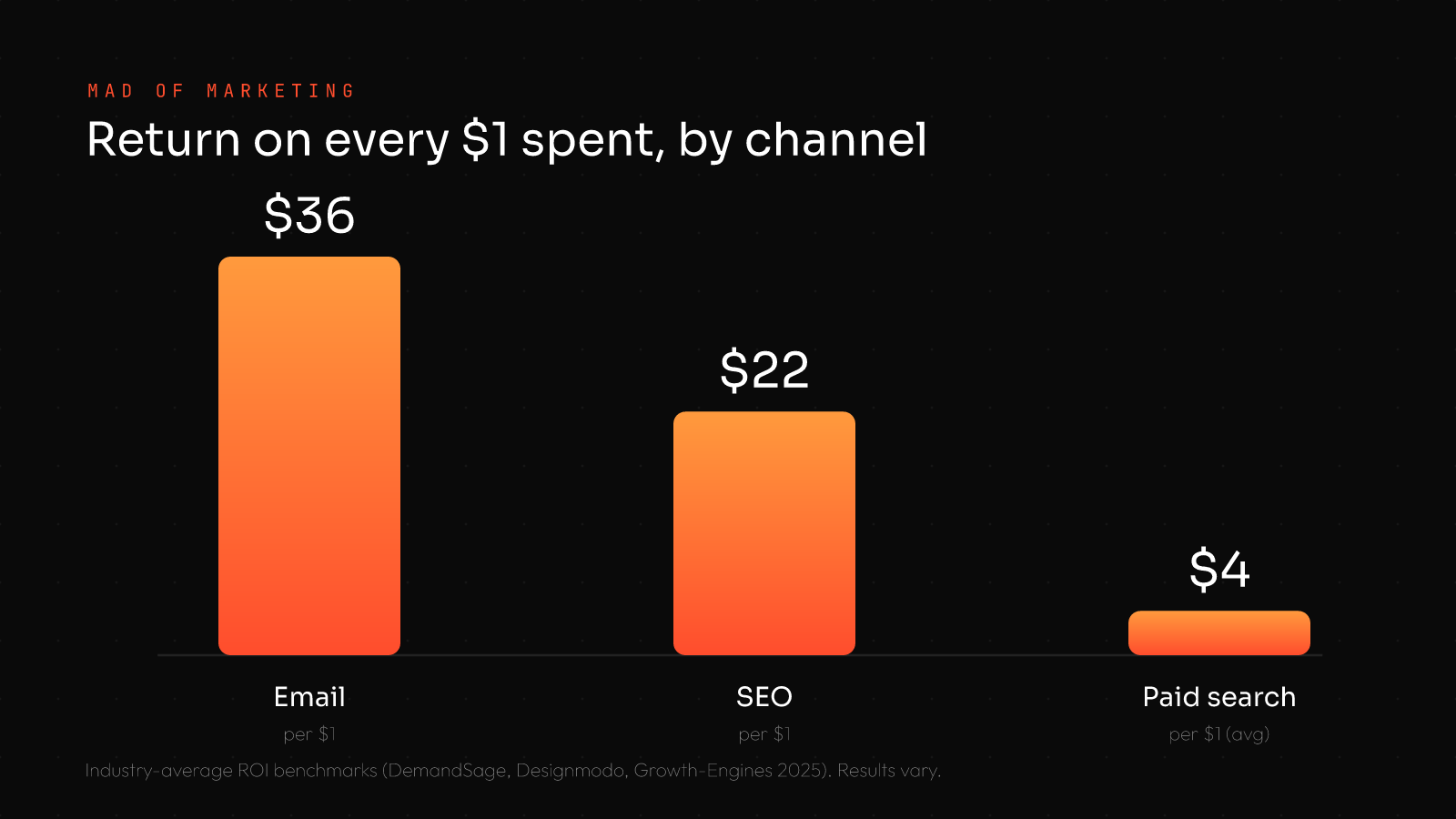
- Email — ~$36 per $1. Consistently the highest-ROI channel. It’s cheap, you own the list, and it compounds once you have an audience to send to.
- SEO — ~$22 per $1 over time. Slow to start, but a ranking page keeps paying you for months without ongoing spend. The closest thing to an appreciating asset in marketing.
- Paid search (PPC) — ~$2–$4 per $1. Lower multiple, but fast and dial-able. You can drive qualified traffic this week; it stops the moment you stop paying.
The pattern to internalize: paid channels rent attention; owned channels (SEO, email) build equity. Use a little paid spend to buy time while the compounding channels mature.
The 3 metrics that actually prove ROI
ROI alone can be gamed. These three together tell the real story.
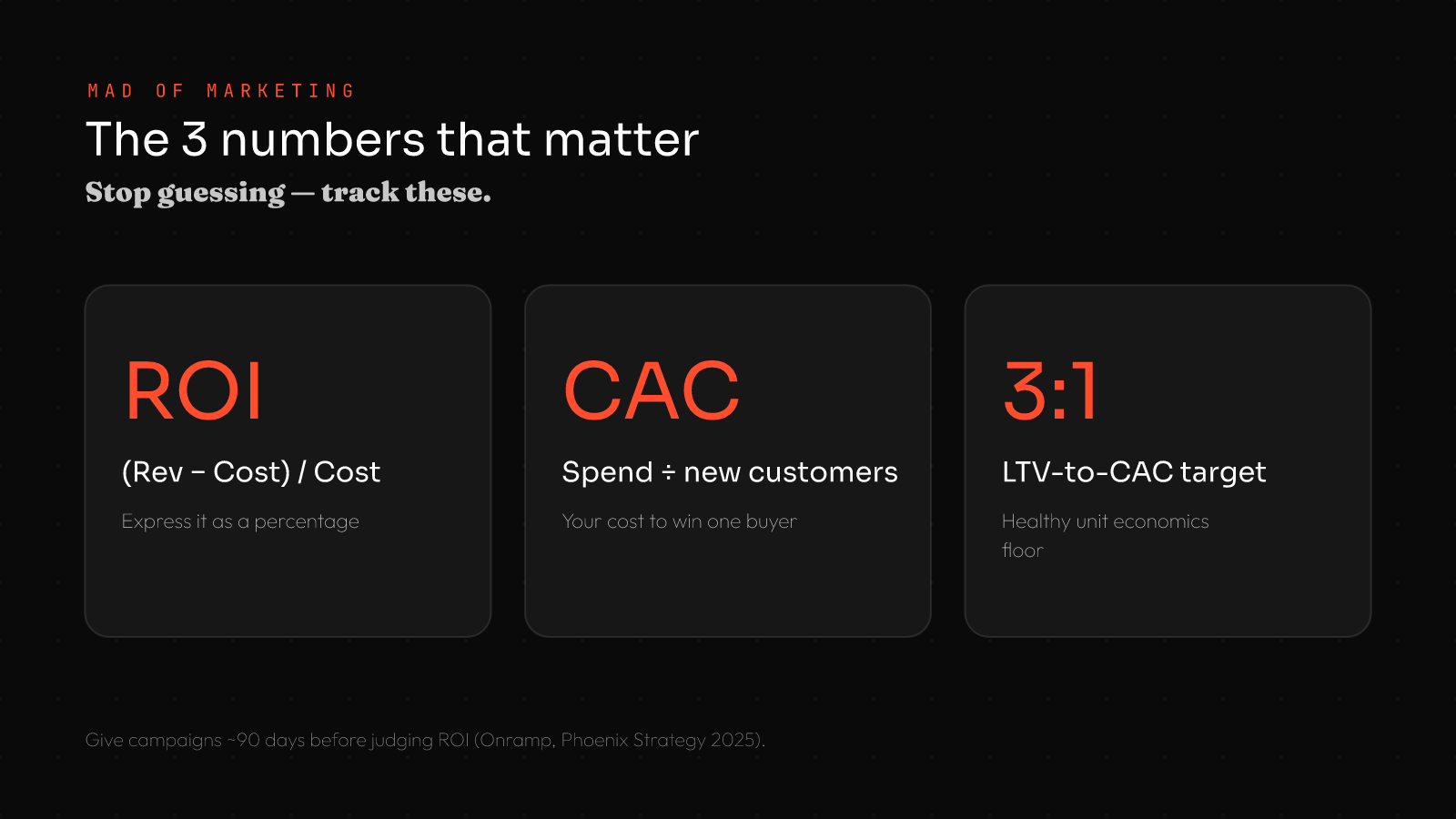
- ROI — the percentage return, as above. Your scoreboard.
- CAC (customer acquisition cost) — total sales & marketing spend ÷ new customers. Break it down by channel to see which sources are cheapest. CAC = Spend ÷ New customers.
- LTV-to-CAC ratio — lifetime value of a customer divided by what it cost to acquire them. A healthy floor is 3:1. Below that, you’re buying customers you can’t profit from.
How to measure digital marketing ROI (the practical version)
- Set up tracking first. Google Analytics 4 plus the Google/Meta pixels, before you spend. You can’t measure ROI you didn’t track.
- Define a conversion. A lead, a sale, a booked call, and assign it a value.
- Attribute by channel. Use UTMs and your analytics so you know which channel drove which conversion.
- Compare cost to revenue per channel. Now ROI and CAC fall out naturally.
- Give it time. Most profitable campaigns take 6–8 weeks to optimize; wait ~90 days before declaring a channel a loser.
A worked example: calculating digital marketing ROI
Numbers make this concrete. Say you run a campaign for three months:
- Spend: $3,000 on ads + $1,500 management = $4,500 total.
- Result: 30 new customers, each worth $400 on the first purchase = $12,000 revenue.
- ROI: (12,000 − 4,500) ÷ 4,500 × 100 = 167%.
- CAC: 4,500 ÷ 30 = $150 per customer.
Now the part most people miss: if each of those customers comes back and spends another $400 twice over the next year, their lifetime value is $1,200. That makes your LTV-to-CAC ratio 1,200 ÷ 150 = 8:1, well above the 3:1 healthy floor. The campaign looked “okay” at 167% on first purchase, but it’s actually excellent once repeat business is counted. That’s why measuring digital marketing ROI on first sale alone undersells your best channels.
Attribution: knowing which channel gets the credit
The hardest part of ROI isn’t the math, it’s deciding which channel earned the sale when a buyer touched several. That’s attribution, and the model you choose changes the story:
- First-touch. All credit to the channel that first found the customer. Good for measuring awareness.
- Last-touch. All credit to the final click before purchase. Simple, but it overvalues bottom-of-funnel channels like branded search.
- Multi-touch. Credit is shared across every touchpoint. The most accurate picture, and the most work to set up.
For most small businesses, start with last-touch in Google Analytics 4, then graduate to a multi-touch view as volume grows. The goal isn’t perfection; it’s enough clarity to stop funding what doesn’t work.
Digital marketing ROI across more channels
Beyond the big three, here’s how other channels typically stack up, again, directional averages, not promises:
| Channel | Typical return | Speed |
|---|---|---|
| Email marketing | ~$36 per $1 | Fast (with a list) |
| SEO / organic | ~$22 per $1 | Slow, compounds |
| Content marketing | High, long-term | Slow, compounds |
| Paid search (PPC) | ~$2–$4 per $1 | Immediate |
| Paid social | ~$2–$3 per $1 | Fast |
| Referral / word of mouth | Very high | Variable |
Notice the trade-off running through the table: the highest-ROI channels (email, SEO, content) are the slowest to build, while the fastest (paid) return the least per dollar. A balanced program uses both, which is the core idea in our marketing strategy guide.
Common ROI measurement mistakes
- Judging on first purchase only. Ignoring lifetime value makes good channels look mediocre.
- No tracking in place. You can’t attribute what you never measured. Set up GA4 and UTMs first.
- Quitting at week three. Most profitable campaigns need 6–8 weeks to optimize.
- Vanity metrics. Impressions and likes aren’t ROI. Tie everything to revenue or qualified leads.
- Ignoring overhead. Real ROI includes management fees, tools, and time, not just ad spend.
Tools to measure digital marketing ROI
You don’t need an expensive stack to start. The essentials: Google Analytics 4 for traffic and conversions, UTM parameters to tag every campaign, the Google and Meta pixels for ad tracking, and your CRM or a simple spreadsheet to connect leads to actual revenue.
The point of tooling isn’t sophistication, it’s closing the loop between spend and sales so ROI stops being a guess. For what this typically costs, see how much digital marketing costs.
Leading vs lagging indicators
ROI is a lagging indicator, it tells you what already happened. To manage a campaign while it’s running, you also need leading indicators that predict where ROI is heading:
- Leading: click-through rate, cost per click, landing-page conversion rate, email open and reply rates, cost per lead. These move first.
- Lagging: ROI, CAC, revenue, LTV. These confirm the outcome weeks later.
Watch the leading indicators weekly and the lagging ones monthly. If your cost per lead is climbing, you can fix it before it shows up as bad ROI, instead of finding out at the end of the quarter when the money’s already spent.
How to improve a disappointing ROI
A low return usually isn’t a reason to kill a channel, it’s a signal to fix one part of the funnel. Work through it in order:
- Check the landing page first. If traffic is fine but conversions are low, the problem is the page, not the channel. Often the cheapest, fastest win.
- Tighten targeting. Paying to reach the wrong people guarantees weak ROI. Narrow to your best-fit audience.
- Improve the offer. Sometimes the message and price, not the marketing, are what’s holding back results.
- Raise customer value. Upsells, repeat purchases, and retention lift LTV, which improves ROI without spending a cent more on acquisition.
- Reallocate, don’t just cut. Move budget from your weakest channel to your strongest. Small shifts compound fast.
Most “bad ROI” is a fixable funnel problem, not a doomed channel, which is exactly why measurement matters: it tells you where to look.
Why patience changes the ROI picture
The biggest ROI mistake we see is judging too early. Paid campaigns need data to optimize; SEO and content are designed to compound. A channel that looks like a 0.5× return at week three can be a 5× return at month six. Kill it early and you never find out. This is also why your marketing strategy and budget should plan for a runway, not a sprint.
Short-term vs long-term ROI thinking
One reason owners misjudge digital marketing ROI is mixing up two different time horizons. Short-term ROI comes from paid channels, you spend today, you can measure a return this month. It’s satisfying and easy to track, but it stops the moment you stop paying.
Long-term ROI comes from owned assets, SEO content, an email list, a library of social posts, a stack of reviews. These look like poor ROI early because the cost lands before the return.
But a blog post that ranks, or a list that converts, keeps paying for months or years with no extra spend. The mistake is judging a long-term asset by a short-term clock and killing it just before it compounds.
The healthiest portfolios run both: paid for cash flow now, owned for compounding later, and they measure each on its own timeline instead of holding them to the same one.
Frequently asked questions
What is a good digital marketing ROI?
A common benchmark for a healthy return is 5:1 (500%), five dollars back for every one spent. Email and SEO often exceed that over time; paid search typically runs lower but faster. Anything above 2:1 is generally profitable once costs are accounted for.
How do you calculate digital marketing ROI?
ROI = (Revenue from marketing − Marketing cost) ÷ Marketing cost × 100. Pair it with CAC (spend ÷ new customers) and your LTV-to-CAC ratio for the full picture.
Which digital marketing channel has the highest ROI?
Email marketing, at roughly $36 per $1 spent, followed by SEO at around $22 per $1. Both are owned channels that compound, which is why they out-return paid advertising over time.
How long before digital marketing shows positive ROI?
Paid channels can show returns within weeks; SEO and content usually take 3–6 months. Give any campaign at least 90 days before judging its ROI.
The bottom line on digital marketing ROI
Digital marketing ROI turns marketing from a cost you hope works into an investment you can manage. Track ROI, CAC, and LTV-to-CAC; favor the channels that compound; and give every campaign a fair runway. Do that and you’ll always know which dollar is pulling its weight.
Want us to build a measurement setup and find your highest-ROI channels? Book a free strategy call or explore our services.