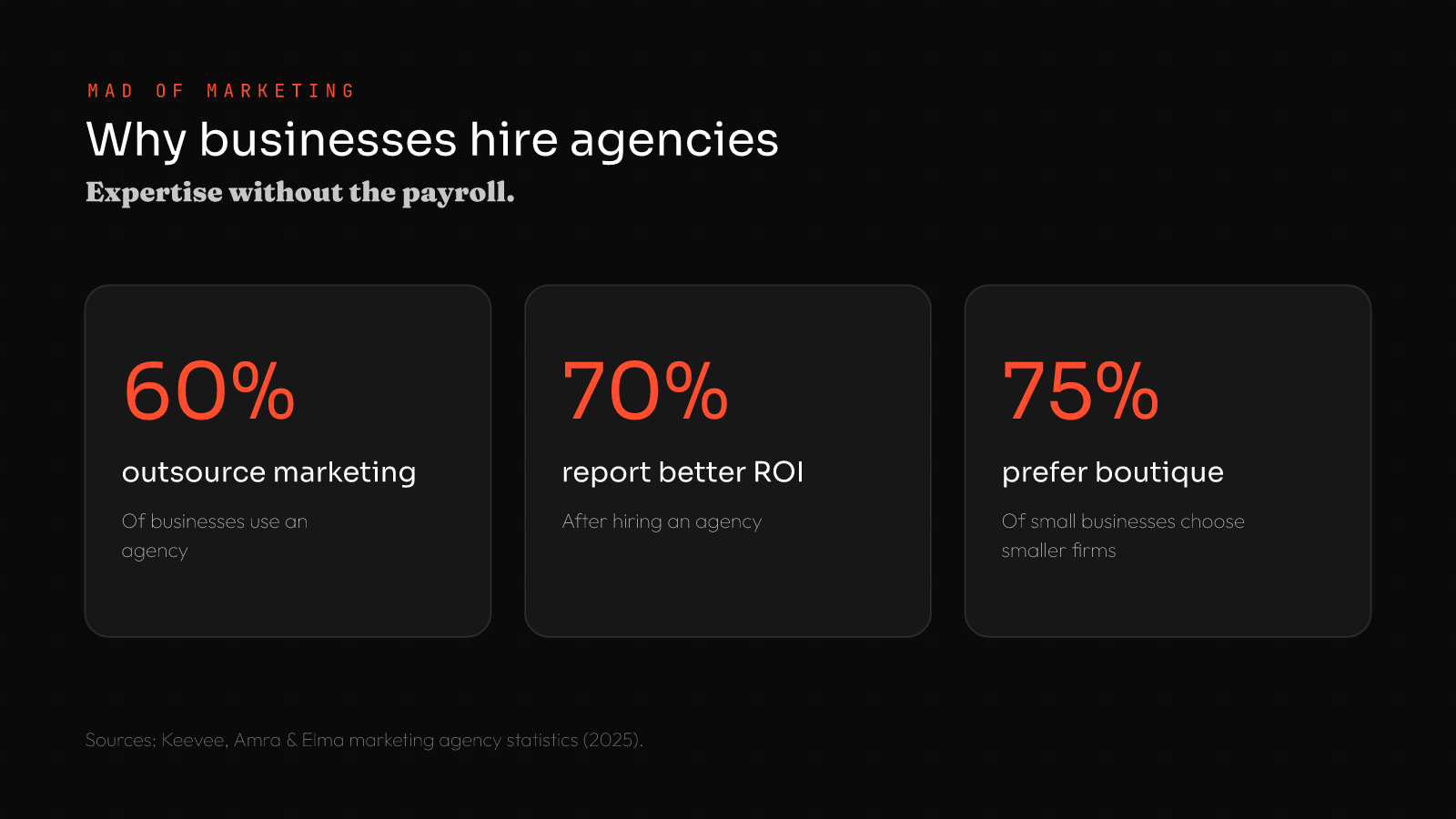
A digital marketing agency for small business handles the strategy, execution, and measurement of your marketing so you can run your business. Around 60% of businesses outsource marketing, 70% report better ROI after hiring an agency, and 75% of small businesses prefer smaller, boutique firms. Expect to invest roughly $2,000–$15,000 a month depending on scope.
Most small business owners reach a point where marketing becomes the bottleneck. You know you should be publishing content, running ads, and following up on leads but you’re busy running the business, and it all keeps slipping. That’s the gap a digital marketing agency for small business fills: senior expertise and consistent execution, without hiring a full team.
Fair disclosure: we’re an agency, so we have an obvious bias. This guide is written to be genuinely useful anyway including the parts where hiring an agency isn’t the right move. It’s part of our wider playbook on digital marketing for small businesses.
What is a digital marketing agency for small business?
A digital marketing agency for small business is a company that plans, executes, and measures your online marketing SEO, content, ads, social media, email, and web on your behalf. Instead of hiring a marketer for each discipline, you get access to a team of specialists for one monthly fee. A good agency doesn’t just “do tasks” it owns the strategy, runs the channels, and is accountable for results.
Agencies that serve small businesses are typically smaller and more hands-on than the big corporate firms which is exactly why 75% of small businesses prefer boutique agencies for their agility, cost-effectiveness, and niche expertise.
Why small businesses hire agencies
The data explains the appeal:
- Most businesses outsource: Around 60% of businesses outsource their marketing, and small and mid-sized businesses make up about half of agency clients.
- Results improve: 70% of businesses report better ROI after hiring an agency, as specialist expertise outperforms generalist in-house effort.
- Speed increases: Agencies reduce time-to-market by around 25% things actually get done.
- Time is the real constraint: With most owners having an hour or less a day for marketing, an agency buys back the capacity to run your business.
What a digital marketing agency actually does
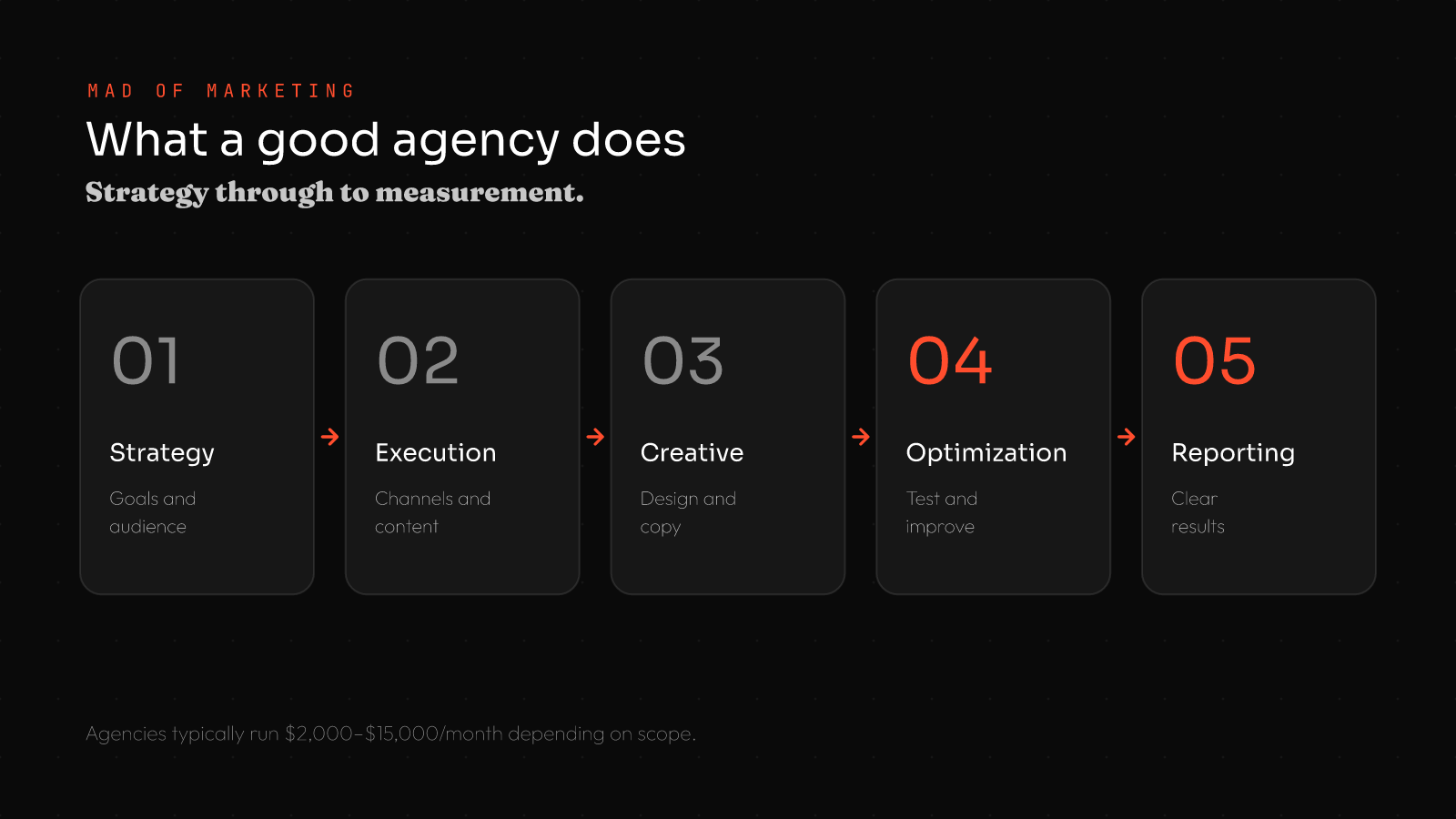
A good agency covers the full loop not just isolated tasks.
1. Strategy
Defining your goals, target audience, positioning, and the channel mix that fits your business and budget. This is the part most businesses skip and it’s what makes everything else work. (See our marketing strategy guide.)
2. Execution across channels
Actually running the work: SEO, content, Google Ads, social media, and email. Consistency is where most in-house efforts fail and agencies earn their fee.
3. Creative and design
The branding, copywriting, design, and video that make your marketing distinctive rather than forgettable.
4. Optimization
Continuously testing and improving ad performance, landing pages, and conversion rates so results get better over time instead of plateauing.
5. Reporting and accountability
Clear, regular reporting on what’s working, what it costs, and what it returns. If you can’t see the results, the agency isn’t doing its job.
How much does a digital marketing agency cost?
Agency pricing scales with scope. Most agencies serving small businesses charge $2,000–$15,000 per month, with plenty of smaller engagements starting around $1,500 for a focused scope like local SEO or ad management. Larger, full-service programs run higher.
Pricing usually comes as a monthly retainer for ongoing work, a project fee for defined deliverables like a website, or a percentage of ad spend (typically 10–20%) for paid media management.
Compare that to the alternative: an in-house marketing manager alone costs $90,000–$140,000 in salary before benefits, tools, and training and one person can’t cover strategy, SEO, ads, design, and content. That math is why outsourcing appeals to most small businesses. For the full picture, see how much digital marketing costs.
Signs an agency is right for you
- Marketing keeps slipping: You know what you should do but never have time to do it.
- You’re spending without results: Money going out with no clear return usually a strategy or tracking problem.
- You’re ready to grow: You have capacity for more customers and need a reliable way to get them.
- You need skills you don’t have: Technical SEO, paid media, and conversion work are specialist disciplines.
- You want accountability: One team responsible for results, not five freelancers doing pieces.
When an agency isn’t the right move
Honestly, an agency isn’t always the answer and any agency worth hiring will tell you so. If your budget is under roughly $1,000 a month, you’re usually better off doing the fundamentals yourself: claim your Google Business Profile, collect reviews, and build an email list.
At that level, agency fees eat too much of the budget to leave enough for actual marketing.Similarly, if you only need one narrow, well-defined task a logo, a single ad campaign a freelancer is likely more cost-effective than an agency.
And if you haven’t yet validated that people want what you sell, spend your money finding product-market fit first; marketing amplifies a working business, it doesn’t fix a broken offer. An agency makes sense when you have something worth scaling, a budget that allows real work, and a need for coordinated strategy across channels.
How to get the most from an agency
The best client-agency relationships are partnerships, not handoffs. To get the most value: be clear about your goals the more specific you are about what success looks like, the better an agency can deliver it.
Share your knowledge you know your customers and industry better than anyone; that insight makes the marketing far sharper. Give it time SEO and content take 3–6 months to compound, so judge the relationship on a fair timeline.
Stay involved a monthly review of results and priorities keeps everyone aligned. And expect transparency you should always know what’s being done, what it costs, and what it’s returning. Clients who engage as partners consistently get better results than those who hand everything over and disengage.
What to expect in the first 90 days
Knowing what a normal agency engagement looks like helps you judge whether yours is on track. Month one is foundation and discovery. Expect onboarding, access to your accounts, a deep dive into your business and customers, an audit of what you currently have, tracking and analytics setup, and a strategy built around your goals.
You typically won’t see big results yet you’re building the base, and any agency promising dramatic month-one results is overselling. Month two is execution. Campaigns launch, content and pages start going live, your profiles get optimized, and the first data begins coming in. You should start seeing leading indicators traffic, clicks, enquiries moving.
Month three is optimization. With real data in hand, the agency cuts what isn’t working, doubles down on what is, and results should be clearly trending in the right direction. By the end of 90 days you should have: a documented strategy, proper tracking, active campaigns, regular reporting, and a clear read on which channels are producing.
If you reach month three with no strategy document, no tracking, and no clear reporting, that’s a genuine problem worth raising immediately.
How to measure whether your agency is working
Don’t judge an agency on activity judge it on outcomes. Ask for reporting on the metrics that connect to your business: leads and enquiries generated, cost per lead and cost per customer, conversion rates, revenue attributable to marketing, and overall return on investment.
Traffic and impressions are useful leading indicators, but they aren’t the point a report full of impressions and follower counts with no mention of leads or revenue is a warning sign. Also weigh the timeline fairly: paid channels should show results within weeks, while SEO and content need 3–6 months to compound, so don’t judge slow channels on a fast clock.
Set expectations up front about which metrics matter and when you’ll review them, then hold the relationship to that standard. A good agency will welcome this they want to be measured on results, because that’s how they demonstrate their value and keep the account.
Frequently asked questions
What does a digital marketing agency do for a small business?
It plans, executes, and measures your online marketing strategy, SEO, content, ads, social, email, and web so you get a team of specialists without hiring one. A good agency owns the strategy and is accountable for results, not just tasks.
How much does a digital marketing agency cost for a small business?
Most agencies serving small businesses charge $2,000–$15,000 per month, with focused engagements starting around $1,500. Pricing comes as monthly retainers, project fees, or a percentage of ad spend (typically 10–20%) for paid media.
Is hiring a digital marketing agency worth it?
For most growing small businesses, yes 70% report improved ROI after hiring an agency, and it costs far less than building an in-house team. It’s worth it when you have a validated offer, a real budget, and need coordinated expertise you don’t have internally.
What should a small business look for in an agency?
Look for relevant experience with businesses like yours, transparent pricing and reporting, clear communication about what’s included, proof of results, and senior people actually doing the work. Transparency and fit matter more than the lowest price.
How long before an agency delivers results?
Paid channels can produce leads within weeks, while SEO and content typically take 3–6 months to compound. Expect the first 30 days to be foundation work strategy, tracking, and setup with results building from month two onward and becoming clear by months three to six.
The bottom line on hiring a digital marketing agency for small business
A digital marketing agency for small business gives you senior strategy and consistent execution for a fraction of what an in-house team costs which is why 60% of businesses outsource and 70% see better ROI. It’s the right move when you have something worth scaling, a budget that funds real work, and no time or expertise to run marketing well yourself. It’s the wrong move if your budget is tiny or your offer isn’t proven yet. Choose honestly, and the right partner pays for itself.
Want to talk through whether an agency makes sense for you honestly? Book a free strategy call or explore our services. We’ll tell you if you’re better off doing it yourself.
Sources: Keevee, Amra & Elma, Quickly Hire marketing agency statistics (2025). Figures are industry averages and vary by source.