The best marketing channels for small business, ranked by ROI, are email (~$36 per $1), SEO (~$22 per $1), and your Google Business Profile all owned, compounding, and cheap. Paid ads and social add speed and reach. But the real answer is: the best channel is the one where your customers are. Multi-channel businesses consistently outperform single-channel ones.
Every small business owner wants to know which marketing channel to focus on. The honest answer has two parts: some channels reliably deliver better returns than others, and the best channel for you depends on where your customers are and what you sell.
This guide ranks the best marketing channels for small business by ROI, explains what each is good for, and shows you how to choose the right mix so you can put your limited time and money where they’ll do the most.
This guide is part of our wider playbook on digital marketing for small businesses. Here we compare the channels.
Marketing channels ranked by ROI
Return per dollar is the clearest starting point. These are widely-cited industry averages read them as direction, not a guarantee, since your results depend on your offer and execution.
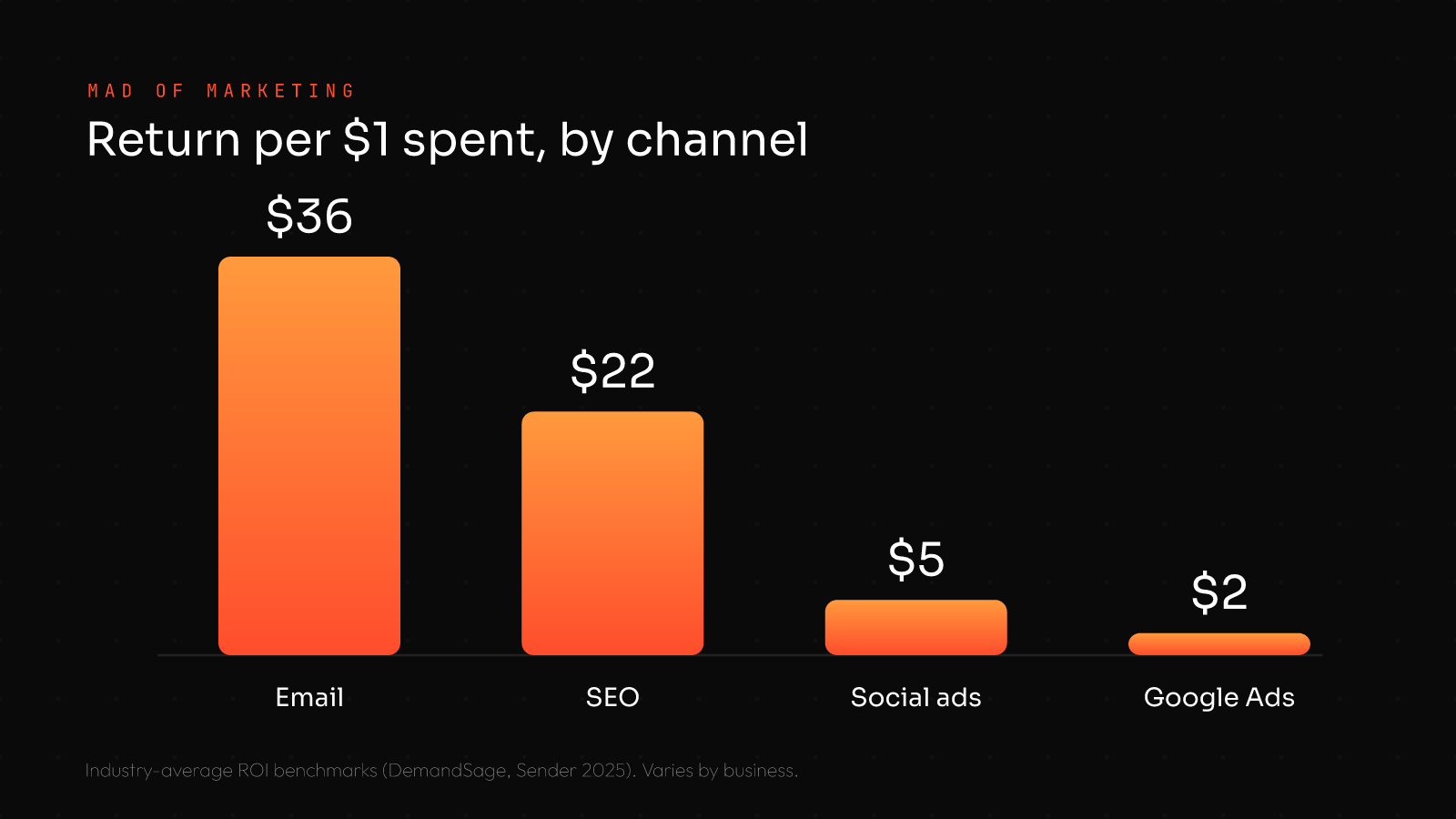
- Email marketing ~$36 per $1. Consistently the highest ROI. You own the list, it’s cheap, and it compounds.
- SEO ~$22 per $1. Slow to build but compounds, sending free traffic for years.
- Social media (ads) ~$5 per $1. Strong reach and targeting at a low cost per lead.
- Referrals & word of mouth very high. Trusted, high-converting, and nearly free.
- Paid search (Google Ads) ~$2 per $1. Lower multiple, but fast and high-intent.
The best marketing channels, and what each is for
ROI is one lens; fit is another. Here’s what each channel does best:
- Email marketing. The highest-ROI channel best for nurturing leads, driving repeat business, and retention.
- SEO & content. Best for earning free, compounding traffic and building long-term authority.
- Local SEO & Google Business Profile. Essential for local businesses captures high-intent “near me” searchers.
- Social media. Best for discovery, brand building, and engagement where your audience scrolls.
- Google Ads. Best for immediate, high-intent traffic from people actively searching.
- Facebook & Instagram ads. Best for creating demand and precise targeting at low cost.
- SMS marketing. Best for immediate, high-open-rate messages and retention.
- Referrals. Best for high-quality, low-cost customers who convert and stay.
How to choose the right channels
Don’t pick channels by ROI alone pick by fit. Here’s the process.
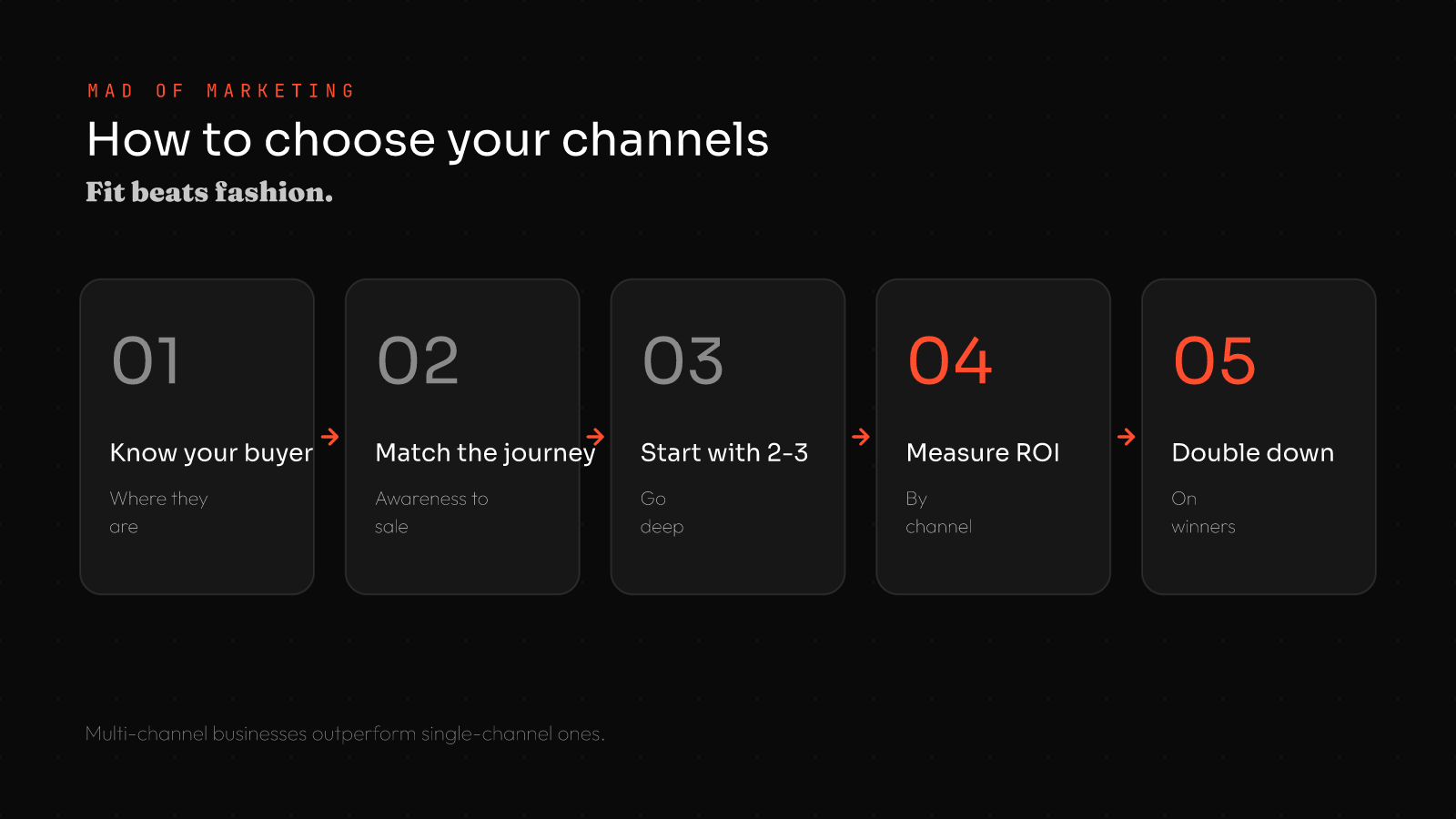
1. Know where your buyers are
The best channel is the one your customers actually use. A B2B firm belongs on LinkedIn and email; a visual consumer brand belongs on Instagram; a local service business belongs on Google. Start with your audience, not the channel.
2. Match channels to the buying journey
Different channels do different jobs. Use discovery channels (social, SEO) to get found, high-intent channels (Google Ads, local SEO) to capture demand, and nurture channels (email, SMS) to convert and retain. A good mix covers the whole journey.
3. Start with two or three
Resist the urge to be everywhere. Pick two or three channels that fit your buyer and budget, and go deep on them. A few channels done well beat many done badly and multi-channel beats single-channel, so two to three is the sweet spot.
4. Measure ROI by channel
Track what each channel actually returns leads, sales, and cost per customer. This tells you which channels deserve more investment and which to cut. Measurement turns channel choice from guesswork into data. (See our ROI guide.)
5. Double down on winners
Once you know which channels work, shift budget toward them and expand carefully. Reinvest your winnings, test new channels one at a time, and let performance guide your growth.
Why multi-channel beats single-channel
One of the clearest findings in small business marketing is that using multiple channels outperforms relying on just one. The share of businesses using a single channel has fallen from 24% to 11%, precisely because multi-channel businesses see better results 43% better in paid social, 53% more success in email, and 21% stronger search performance.
The reason is simple: customers don’t live on one platform. They might discover you on social, research you on Google, read your reviews, and finally convert through an email or ad. Each channel reinforces the others, and being present across the journey means you catch customers wherever they are. This doesn’t mean spreading yourself thin across every channel it means choosing a focused mix of two to three complementary channels that work together to cover discovery, consideration, and conversion.
Start with the channels that fit your business best, then expand as you have the capacity to do each one well.
Best channels by business type
The “best” channels shift depending on what you sell and who you sell to. Here’s a practical starting point by business type:
- Local service businesses (plumbers, clinics, salons): local SEO and Google Business Profile first, then Google Ads and reviews. Your customers search “near me” with high intent.
- Ecommerce and product businesses: Instagram and Facebook ads, SEO, and email. Visual discovery plus email for repeat purchases works best.
- B2B and professional services: LinkedIn, content and SEO, and email. Long, research-heavy buying cycles reward authority and relationships.
- Restaurants and hospitality: Instagram, local SEO, and reviews. Visual, local, and impulse-driven.
- Coaches, creators, and personal brands: the social platform that fits your content (Instagram, YouTube, or LinkedIn), plus email.
Use these as starting points, not rules then test and let your own results refine the mix.
Owned, paid, and earned channels
It also helps to think about channels in three categories, because a healthy marketing mix uses all three.
Owned channels your website, email list, SMS list, and content are assets you control completely; they cost time rather than ongoing media spend and compound over the years, which is exactly why email and SEO top the ROI rankings.
Paid channels Google, Facebook, and Instagram ads are ones you rent; they deliver immediate, controllable reach but stop the moment you stop paying.
Earned channels referrals, reviews, word of mouth, and press are the trust others give you; they’re the most credible and among the highest-converting, but you earn them through great work rather than buying them. The strongest small-business strategies build owned channels as their long-term foundation, use paid channels to accelerate and fill gaps, and actively cultivate earned channels through excellent service and by asking for referrals and reviews.
Balancing all three means you’re not overly dependent on any single one especially not a rented platform whose rules and costs you don’t control.
How to test a new channel
Once your core channels are working, you’ll want to expand but adding channels carelessly is how small businesses spread themselves thin. The answer is to test new channels one at a time, deliberately. Start by picking one channel that logically fits your audience and goals, and give it a real but limited trial rather than a half-hearted dabble.
Set a clear success metric up front what result, at what cost, over what timeframe, would make this channel worth keeping? Commit enough time and budget to give it a fair test; most channels take a few months (and paid channels a few weeks) to show their true potential, so judging too early gives false negatives. Measure honestly against your success metric, and be willing to cut a channel that doesn’t earn its place or double down on one that exceeds expectations.
Crucially, keep your core channels running while you test, so a failed experiment doesn’t set back your whole marketing. This disciplined, one-at-a-time approach lets you expand your channel mix based on evidence rather than hype, gradually building a multi-channel presence where every channel has proven it belongs.
Common channel-selection mistakes
- Chasing ROI alone: Picking a channel because it has high average ROI, even if your customers aren’t there.
- Being everywhere: Spreading thin across every channel instead of focusing on a few.
- Relying on one channel: Depending entirely on a single platform you don’t control.
- Ignoring owned channels: Skipping email and SEO the highest-ROI, compounding channels.
- Not measuring: Never tracking which channels actually drive customers.
- Chasing trends: Jumping on whatever’s new instead of what fits your business.
Frequently asked questions
What are the best marketing channels for small business?
By ROI, email (~$36 per $1), SEO (~$22 per $1), and your Google Business Profile lead all owned and compounding. Social media, Google Ads, and Facebook ads add reach and speed. The best channel overall is the one where your specific customers are.
Which marketing channel has the highest ROI?
Email marketing, at around $36 returned per $1 spent, followed by SEO at roughly $22 per $1. Both are owned channels that compound over time, making them the most cost-effective for small businesses.
How many marketing channels should a small business use?
Two or three, chosen to fit your audience and budget. Multi-channel businesses outperform single-channel ones, but spreading across every channel dilutes your effort. Focus on a few complementary channels and do each well.
How do I know which channel is right for my business?
Start with where your customers are and what you sell B2B fits LinkedIn and email, local businesses fit Google and local SEO, visual brands fit Instagram. Then test, measure the ROI of each, and double down on what works.
Should a small business focus on one channel or many?
Two or three complementary channels, not one and not everything. Single-channel businesses underperform, but spreading across every channel dilutes your effort. Start focused on the channels that fit your buyer, do each well, and expand one at a time as you have the capacity.
The bottom line on the best marketing channels for small business
The best marketing channels for small business combine high-ROI owned channels email, SEO, and your Google Business Profile with paid and social channels for speed and reach. But rankings only take you so far: the best channel is the one where your customers actually are. Know your buyer, match channels to the journey, focus on two or three, measure the return, and double down on winners. Do that and you’ll build a channel mix that delivers, without wasting effort on the ones that don’t fit.
Want help choosing and running the right channels for your business? Book a free strategy call or explore our services.
Sources: DemandSage, Sender, Intuit SMB MediaLab marketing channel statistics (2025). Figures are industry averages and vary by source.