SMS marketing for small business is the highest-engagement channel there is: texts get a 98% open rate, 90% are read within three minutes, and campaigns return $21–$41 for every $1 spent. 72% of consumers have bought something after a brand text. Get permission, send value, and you have a direct line to customers that almost everyone actually reads.
Email gets opened maybe a fifth of the time; a text gets read almost every time, usually within minutes. That single difference makes SMS marketing for small business one of the most powerful and most underused channels available. It’s direct, immediate, and remarkably cost-effective. The catch is that it’s also personal: people guard their text inbox, so SMS only works when it’s permission-based and genuinely useful. Done right, it’s a direct line to your best customers that drives sales on demand.
This guide is part of our wider playbook on digital marketing for small businesses. Here we focus on text-message marketing.
What is SMS marketing for small business?
SMS marketing for small business is sending promotional and transactional text messages offers, reminders, updates, and alerts to customers who have opted in to receive them. It’s permission-based by law and by necessity: customers choose to receive your texts, and you reward that trust with timely, valuable messages. From flash-sale alerts to appointment reminders to shipping updates, SMS reaches customers directly on the device they check most.
Why SMS marketing works so well
The engagement numbers are unmatched by any other channel:
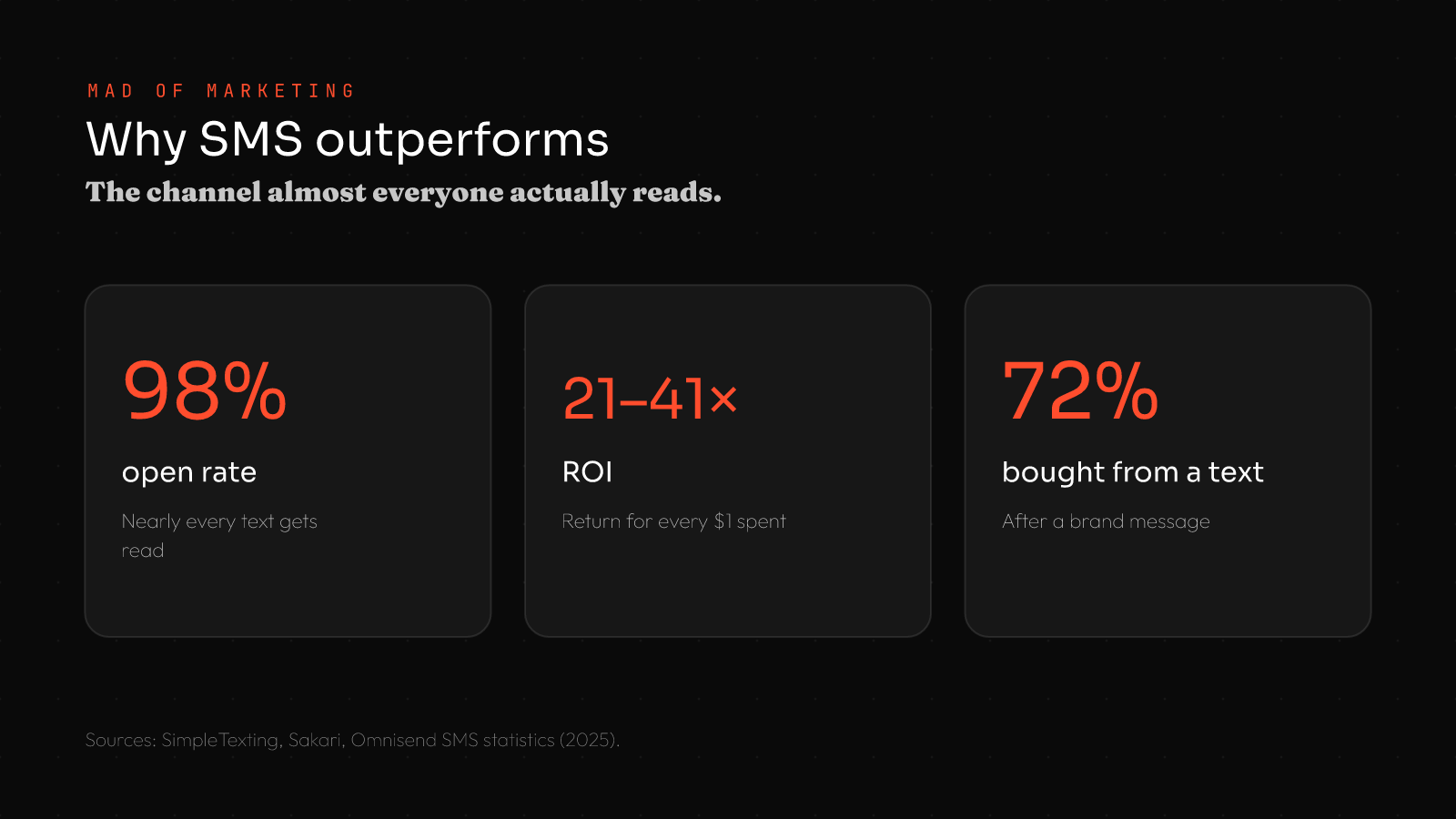
- Almost everyone reads it: SMS has a 98% open rate, and 90% of texts are read within three minutes of delivery.
- The ROI is exceptional: SMS returns an estimated $21–$41 for every $1 spent, and it’s extremely cheap to send.
- It drives purchases: 72% of consumers have made a purchase as a direct result of a brand text message.
- It converts: Well-run SMS campaigns see conversion rates of 21–30%, far above email’s ~12%.
There’s a reason adoption is surging: businesses that text customers are far more likely to report marketing success, and most plan to increase their SMS budgets. It’s a rare channel that’s both high-performing and low-cost.
What to send by SMS
The best texts are timely and valuable never spammy. Effective uses include:
- Exclusive offers and flash sales: Time-sensitive deals that reward subscribers for opting in.
- Appointment reminders: Cut no-shows with a quick, automatic nudge.
- Order and shipping updates: The transactional texts customers genuinely want.
- Restock and back-in-stock alerts: Let interested customers know the moment something’s available.
- Loyalty rewards and VIP perks: Make your text list feel special.
- Event and booking confirmations: Timely, useful, expected.
How to do SMS marketing in 5 steps
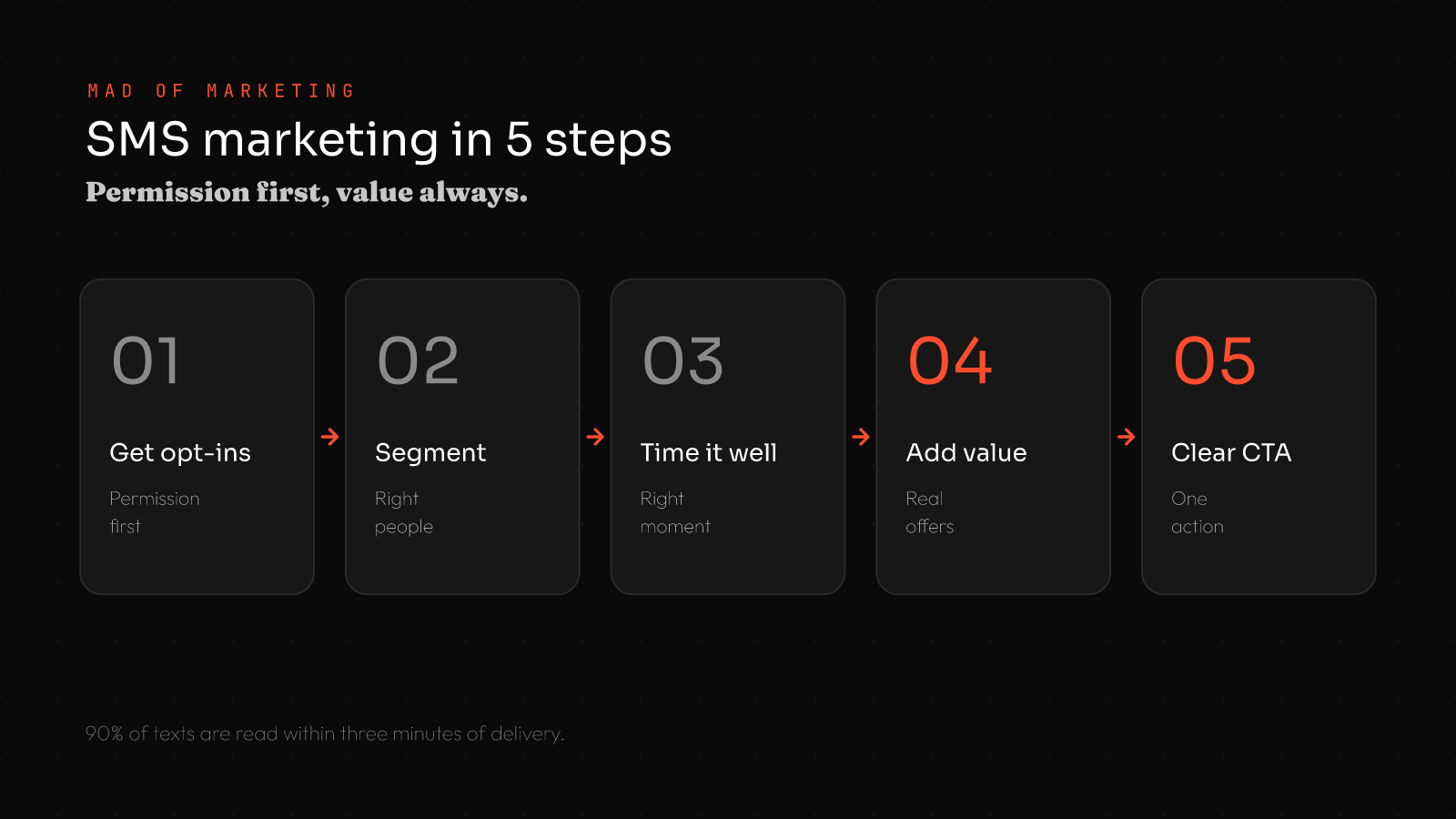
Permission first, value always. Here’s the order.
1. Build a permission-based list
You must have explicit opt-in it’s the law and it’s what keeps SMS effective. Offer a clear incentive to subscribe (a discount, exclusive offers, VIP alerts) via a keyword-to-text, a website form, or at checkout. Never buy lists or text people who didn’t opt in.
2. Segment your audience
Not every message suits every customer. Group your list by interest, location, or purchase history so texts stay relevant. Relevance is what keeps people subscribed and drives conversions and it keeps opt-out rates, already very low, even lower.
3. Time your messages well
Because texts are read almost instantly, timing is powerful and easy to get wrong. Send during reasonable hours, tie messages to the right moment (a lunch offer at 11am, a reminder the day before), and never over-message. Respect the inbox and people stay.
4. Lead with value
Every text should give the subscriber a reason to be glad they got it a real deal, useful info, or a genuine perk. SMS is intimate, so a steady stream of pure sales pitches wears out fast. Value keeps your list engaged and responsive.
5. Include a clear call to action
Texts are short, so make the one action obvious: “Show this text for 20% off,” “Tap to book,” “Reply YES to claim.” Include a link where relevant and make responding effortless. Clarity turns a read message into a sale.
SMS and email: better together
SMS and email marketing aren’t rivals they’re a team. Email is ideal for longer, richer content, storytelling, and detailed offers; SMS is perfect for short, urgent, time-sensitive messages that need to be seen now. Use email to nurture and educate, and SMS to prompt immediate action a flash sale, a reminder, a last-chance alert.
Many businesses build both lists together and coordinate them: email does the explaining, SMS does the nudging. Together they cover both how and when your customers want to hear from you, and both are channels you own outright, free from any algorithm.
Staying compliant with SMS rules
SMS is tightly regulated, and following the rules protects both your customers and your business. The essentials are straightforward: only text people who’ve explicitly opted in, clearly identify your business in messages, always include an easy opt-out (like “reply STOP”), honor opt-outs immediately, and send only during reasonable hours.
These rules (governed by regulations like the TCPA in the US) exist because SMS is personal and respecting them is exactly what keeps your open and conversion rates sky-high. Reputable SMS platforms build compliance features in, making it easy to stay on the right side of the rules.
How to grow your SMS list
SMS only works if people opt in, so growing a quality subscriber list is job one. The key is offering a clear, valuable reason to subscribe and making it easy:
- Offer an incentive: A discount, free gift, or exclusive-offers-only perk gives people a concrete reason to join.
- Use a text-to-join keyword: “Text SAVE to 12345 for 15% off” is simple and works well in-store, on signage, and online.
- Add sign-up at checkout: Both online and in person, the point of purchase is a natural moment to ask.
- Promote it everywhere: Your website, social profiles, email list, and receipts are all places to invite sign-ups.
- Cross-promote with email: Invite your email subscribers to also join your texts for time-sensitive deals.
Focus on quality over quantity a smaller list of engaged, opted-in subscribers who genuinely want your texts will always outperform a large, indifferent one.
Getting started with SMS marketing
Launching SMS is more straightforward than most owners expect. You’ll need an SMS marketing platform plenty of affordable, small-business-friendly options exist which handles compliance, opt-outs, keywords, scheduling, and automation for you. From there, the path is simple: choose a compelling opt-in incentive, promote your sign-up keyword or form, start collecting subscribers, and send your first valuable message once you have an audience.
Begin with the basics a welcome offer for new subscribers, the occasional exclusive deal, and useful transactional texts like reminders then add automation and segmentation as your list grows. You don’t need a big budget or technical skills to start; SMS is one of the most accessible high-ROI channels available, and its low cost per message means even a modest program can pay for itself quickly. Start small, deliver real value, and let results guide how you scale.
Common SMS marketing mistakes
- Texting without opt-in: Illegal, and a fast way to destroy trust.
- Over-messaging: Too many texts drive opt-outs respect the inbox.
- All sales, no value: Constant pitches with nothing useful wear out your list.
- Bad timing: Texting late at night or at the wrong moment.
- No clear CTA: A message that doesn’t tell people exactly what to do.
- Ignoring compliance: Skipping opt-outs and identification requirements.
SMS and customer retention
One of SMS’s most valuable uses is keeping the customers you already have. Because texts are read almost instantly and feel personal, SMS is a powerful retention tool most marketers who use it treat it as a retention channel first. A well-timed text keeps you top of mind and gives customers reasons to come back: a “we miss you” offer to lapsing customers, a loyalty reward, a restock alert on something they viewed, or a simple thank-you after a purchase.
These small, timely touches deepen loyalty and drive repeat business, and since retained customers spend far more than new ones, the payoff compounds. Pair SMS with your customer retention strategy and email marketing, and you have a direct, low-cost way to turn one-time buyers into loyal regulars which is often where the real profit in a small business lives.
Frequently asked questions
What is SMS marketing for small business?
It’s sending promotional and transactional texts offers, reminders, updates to customers who’ve opted in. It’s a permission-based, direct channel that reaches customers on the device they check most, with unmatched open and response rates.
Is SMS marketing worth it for a small business?
Yes. With a 98% open rate, $21–$41 ROI per dollar, and 72% of consumers buying after a brand text, SMS is one of the most effective and cost-efficient channels provided you use it responsibly with opted-in subscribers.
Do I need permission to text customers?
Absolutely. Explicit opt-in is legally required and essential to SMS working. Never buy lists or text people who haven’t subscribed build your list with clear incentives and always include an easy opt-out.
How often should I text my customers?
Less is more with SMS a few well-timed, valuable messages a month is often plenty. Over-messaging drives opt-outs, so prioritize relevance and timing over frequency to keep your list engaged.
Is SMS marketing legal?
Yes, when done correctly. Regulations like the TCPA in the US require explicit opt-in consent, clear business identification, and an easy way to opt out (such as replying STOP). Reputable SMS platforms build these compliance features in, making it straightforward to stay on the right side of the rules.
How much does SMS marketing cost?
SMS is one of the most cost-efficient channels available. You pay a small fee per message or a monthly plan through an SMS platform, and with a 98% open rate and $21–$41 ROI per dollar, even a modest program typically pays for itself quickly.
The bottom line on SMS marketing for small business
SMS marketing for small business is the most direct, most-read channel you can use and one of the highest-ROI. Build a permission-based list, segment it, time your messages, lead with real value, and make every call to action clear. Pair it with email, respect the rules and the inbox, and you’ll have a direct line to your best customers that drives sales almost the moment you hit send.
Want help launching an SMS program that customers love? Book a free strategy call or explore our services.
Sources: SimpleTexting, Sakari, Omnisend SMS marketing statistics (2025). Figures are industry averages and vary by source.