Facebook ads for small business put your offer in front of a precisely targeted slice of Meta’s 3.43 billion users often cheaper than Google. The average Facebook lead costs about $27.66 (versus ~$70 on Google) and lead campaigns convert at around 7.7%. The winners aren’t the biggest spenders; they’re the ones with the sharpest targeting and the most scroll-stopping creative.
Where Google Ads catch people actively searching, Facebook ads for small business create demand putting your business in front of the right people while they scroll, before they’ve even thought to look for you. With unmatched targeting and a massive audience, Meta’s platforms (Facebook and Instagram) are one of the most cost-effective ways for a small business to find new customers if you set them up properly.
This guide is part of our wider playbook on digital marketing for small businesses. Here we focus on Facebook and Meta advertising.
What are Facebook ads for small business?
Facebook ads for small business are paid promotions shown across Meta’s platforms Facebook, Instagram, Messenger, and the Audience Network targeted by detailed demographics, interests, and behaviors. You set a budget, choose who sees your ad, and pay for results like clicks, leads, or sales. The defining strength is targeting: you can reach, say, homeowners aged 35–55 within ten miles who are interested in home improvement a level of precision traditional advertising can’t touch.
Why Facebook ads work for small businesses
The numbers show why Meta remains a small-business favorite:
- Enormous, targetable reach. Meta’s apps reached 3.43 billion monthly users in early 2025 your customers are almost certainly there.
- Cheaper leads than Google. Facebook’s average cost per lead is about $27.66, well below Google’s ~$70 for the same industries.
- Solid conversion rates. Facebook lead campaigns convert at around 7.7% on average, higher in industries like restaurants (18%+) and legal services.
- Low entry cost. You can start meaningfully at $10–$50 a day, making it accessible even on a tight budget.
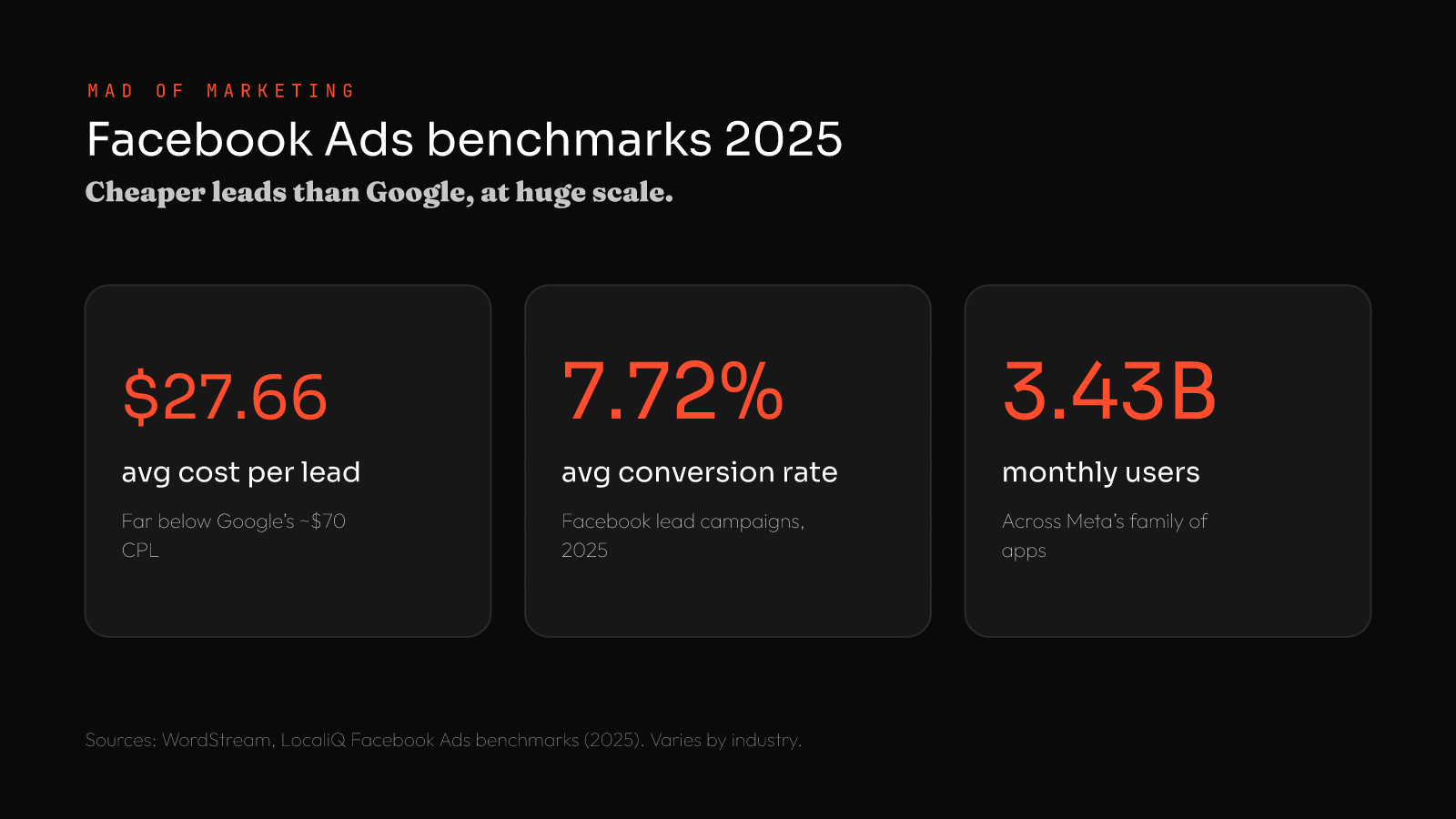
One important note: costs are rising Facebook’s cost per lead climbed about 21% year-over-year so efficient targeting and strong creative matter more than ever. It remains cost-effective, but sloppy campaigns waste money fast.
Set up a winning Facebook ads campaign in 5 steps
Success on Meta is mostly about targeting and creative. Follow this order.
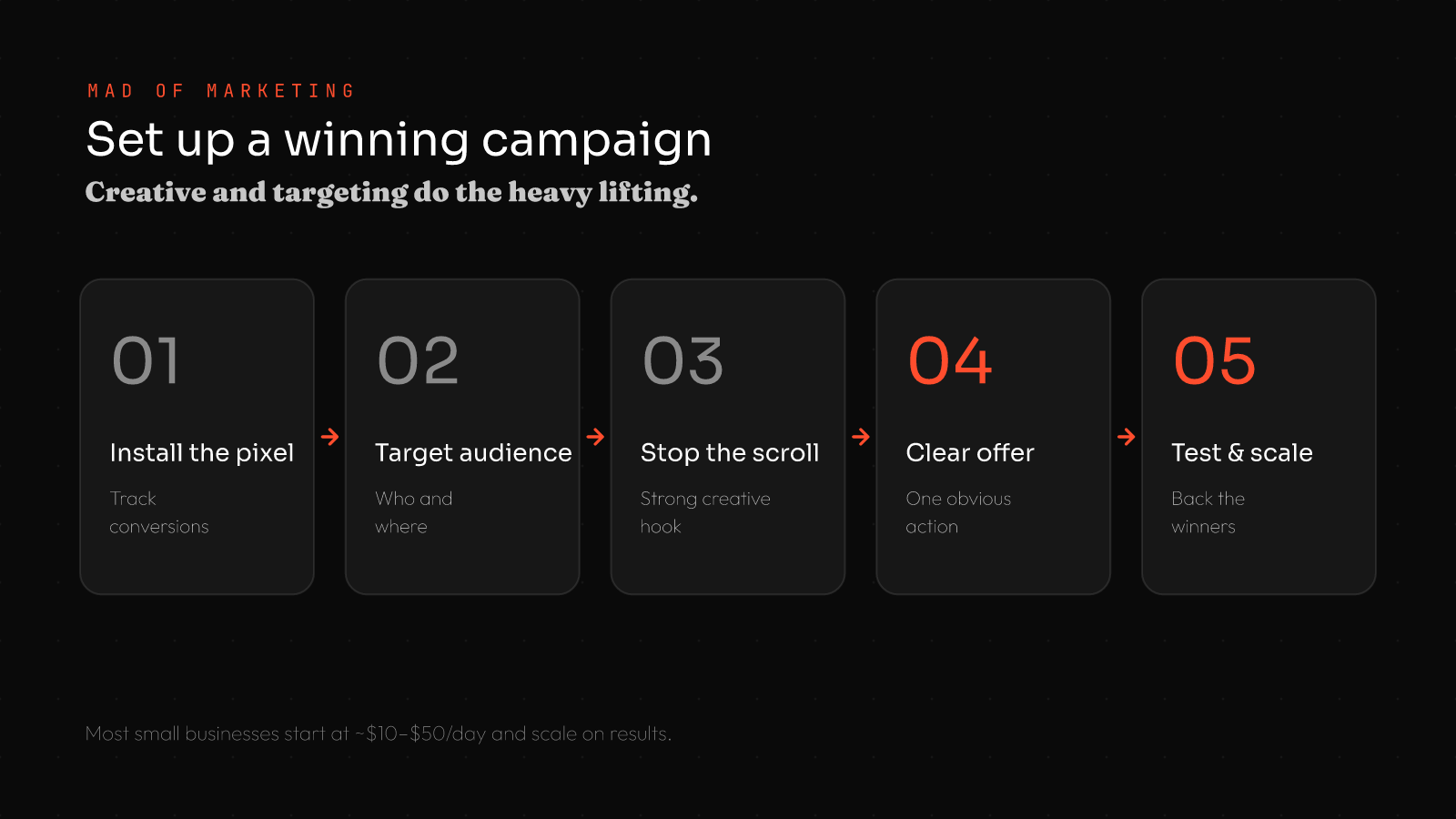
1. Install the Meta pixel
Before spending, add the Meta pixel to your website so you can track conversions, build retargeting audiences, and let Meta’s algorithm optimize toward people likely to act. Running ads without it wastes both money and data.
2. Define your audience
This is where Facebook shines. Use core audiences (demographics, interests, location) to reach new prospects, custom audiences to retarget people who visited your site or engaged with you, and lookalike audiences to find new people similar to your best customers. Sharp targeting is the single biggest driver of cheap leads.
3. Stop the scroll with creative
People scroll fast, so your ad has a split second to grab attention. Lead with a strong visual or short video, a clear hook in the first line, and one obvious benefit. Authentic, native-feeling content usually beats polished “ad-looking” ads especially short-form video.
4. Make a clear offer
Every ad needs one obvious next step and a reason to take it now a discount, a free quote, a guide, a limited offer. Vague ads get ignored; specific offers get clicks. Send those clicks to a fast, matching landing page, not your generic homepage.
5. Test and scale
Start by testing a few audiences and creatives against each other on a small budget. Kill what doesn’t work, then put more budget behind winners scaling gradually (15–20% at a time) so you don’t reset the algorithm’s learning. Continuous testing is how good accounts stay profitable as costs rise.
Facebook ads vs Google Ads: which should you use?
They do different jobs, and many small businesses run both. Google Ads capture existing demand people actively searching for what you sell, with high intent and a higher cost per lead. Facebook ads create demand interrupting people with something they didn’t know they wanted, at a lower cost per lead but typically colder intent.
A simple rule: if people search for your service (a plumber, a lawyer), lean Google; if you need to build awareness and demand (a new product, a local event, a lifestyle brand), lean Facebook. Used together, they cover both sides of the funnel and feed your overall lead generation.
How much do Facebook ads cost?
Facebook is budget-flexible. The average cost per click is around $0.70–$1.92 depending on campaign type, and cost per lead averages $27.66 though both swing widely by industry (dentists and lawyers pay far more than restaurants). Most small businesses start at $10–$50 per day and scale on proven results, plus 10–20% if an agency manages the campaigns. For where it fits your wider budget, see how much digital marketing costs.
Facebook ad formats explained
Meta offers several ad formats, and choosing the right one matters as much as the targeting. The main formats for a small business:
- Image ads. A single strong photo simple, fast to make, and effective for clear offers.
- Video ads. The best for stopping the scroll and explaining a product. Short-form video consistently earns the most reach and engagement.
- Carousel ads. Multiple images or products in one swipeable ad great for showcasing a range or telling a step-by-step story.
- Lead form ads. Capture leads directly inside Facebook without sending people to your site low friction and often the cheapest leads.
- Collection / Shopping ads. Built for ecommerce, letting people browse products right in the feed.
For most small businesses, video and lead form ads are the workhorses. Test a couple of formats early and let performance decide where to put your budget.
How to write Facebook ads that convert
Great targeting still fails with weak copy. A few principles that lift results: hook fast your first line has to earn the next one, so lead with the benefit, a bold question, or the problem you solve. Speak to one person, not a crowd write like you’re talking to your ideal customer. Focus on benefits, not features people care what your offer does for them, not its specs. Add social proof where you can a result or a quick testimonial builds instant trust.
And end with one clear call to action that tells them exactly what to do next. Keep it conversational and native to the feed; ads that look and feel like organic content almost always outperform polished, salesy ones.
Common Facebook ads mistakes
- No pixel or conversion tracking. Flying blind and missing retargeting the cardinal sin.
- Targeting too broad. Wasting budget on people who’ll never buy.
- Weak creative. Boring visuals that don’t stop the scroll.
- Selling too hard, too fast. Cold audiences need warming up, not an immediate hard sell.
- Sending clicks to the homepage. Generic pages that don’t match the ad and kill conversions.
- Quitting too soon. Pulling ads before they’ve gathered enough data to optimize.
How to retarget for cheaper conversions
The cheapest conversions on Facebook usually come from retargeting showing ads to people who already visited your site, engaged with your content, or abandoned a purchase. They already know you, so they convert at a far lower cost than cold audiences.
Set up a simple retargeting campaign that follows website visitors with a reminder or offer, and you’ll squeeze far more from the traffic your other marketing already drives. It’s one of the highest-ROI moves in all of paid social, and most small businesses skip it.
How to set your Facebook ads budget
You don’t need a big budget to start you need enough to gather data and a plan to scale on results. Most small businesses begin with $10–$50 a day, which is plenty to test a couple of audiences and creatives. The key early on is to spend enough that Meta’s algorithm can learn: spreading a tiny budget across many ad sets starves each of the data it needs, so concentrate spend on a few focused tests first.
Once you find a winning combination an audience and creative that produce leads at a cost you’re happy with scale gradually, raising the budget 15–20% at a time so you don’t reset the learning phase. Always judge spend against return, not cost alone: a $40 lead is cheap if that customer is worth $2,000, and a $10 lead is expensive if none of them buy. Tie your budget back to your digital marketing ROI, and let the numbers, not nerves, decide how fast you grow.
Frequently asked questions
What are Facebook ads for small business?
They’re paid promotions across Meta’s platforms (Facebook, Instagram, Messenger) targeted by demographics, interests, and behaviors. They let small businesses reach precise audiences and create demand at a relatively low cost per lead.
How much do Facebook ads cost for a small business?
The average cost per lead is about $27.66 and cost per click ranges roughly $0.70–$1.92, varying widely by industry. Most small businesses start at $10–$50 per day and scale based on results.
Are Facebook ads better than Google Ads?
Neither is universally better they do different jobs. Facebook creates demand at a lower cost per lead; Google captures existing demand at higher intent. Many small businesses use both, leaning on whichever fits the goal.
Do Facebook ads still work in 2026?
Yes. With 3.43 billion users and a cost per lead well below Google’s, Meta remains highly effective though rising costs mean targeting and creative quality matter more than ever to stay profitable.
How long until Facebook ads start working?
You can see clicks and leads within days, but give campaigns at least one to two weeks to exit the learning phase and stabilize before judging them. Most accounts improve with a few weeks of testing and optimization, so avoid pulling ads too early.
The bottom line on Facebook ads for small business
Facebook ads for small business offer unmatched targeting and reach at an accessible cost when you do the fundamentals right. Install the pixel, target sharply, lead with scroll-stopping creative, make a clear offer, and test relentlessly. Add retargeting to capture warm audiences cheaply, and you’ll turn Meta’s massive scroll into a steady, profitable source of new customers.
Want Facebook ads built and managed to convert? Book a free strategy call or explore our services.
Sources: WordStream, LocaliQ Facebook Ads benchmarks (2025). Figures are industry averages and vary widely by industry & setup.