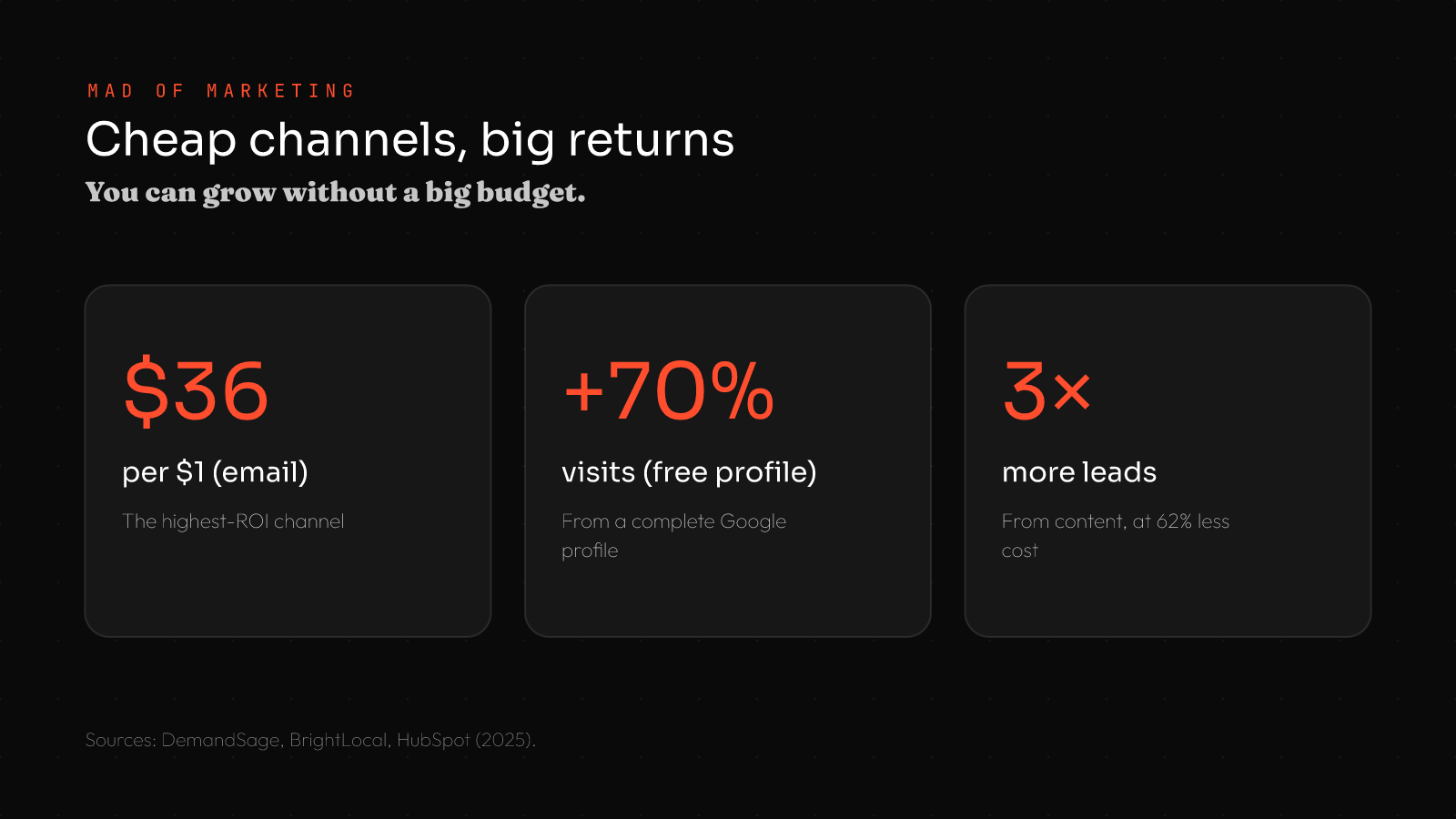
The best low budget marketing ideas for small business lean on the channels that cost time, not money and those are often the highest-ROI ones anyway. Email returns about $36 per $1, a complete Google Business Profile gets 70% more visits for free, and content generates 3× the leads of outbound at 62% less cost. You don’t need a big budget you need focus.
A small marketing budget isn’t a disadvantage it’s a forcing function. It pushes you toward the channels that actually deliver the best returns, because you can’t afford to waste money on the ones that don’t. The truth is that many of the most effective marketing tactics for a small business are free or nearly free; they just require effort and consistency instead of cash. Here are the low budget marketing ideas for small business that genuinely work.
This guide is part of our wider playbook on digital marketing for small businesses. Here we focus on doing more with less.
Why a small budget can still win
The economics favor the scrappy:
- The cheapest channels often have the best ROI: Email returns roughly $36 per $1 the highest of any channel and costs very little to run.
- Your Google profile is free: A complete Google Business Profile gets about 70% more visits at no cost.
- Content compounds: Content marketing generates around 3× the leads of outbound at 62% lower cost, and keeps working for years.
- Referrals cost nothing: Word of mouth is the top customer source for most small businesses and it’s free.
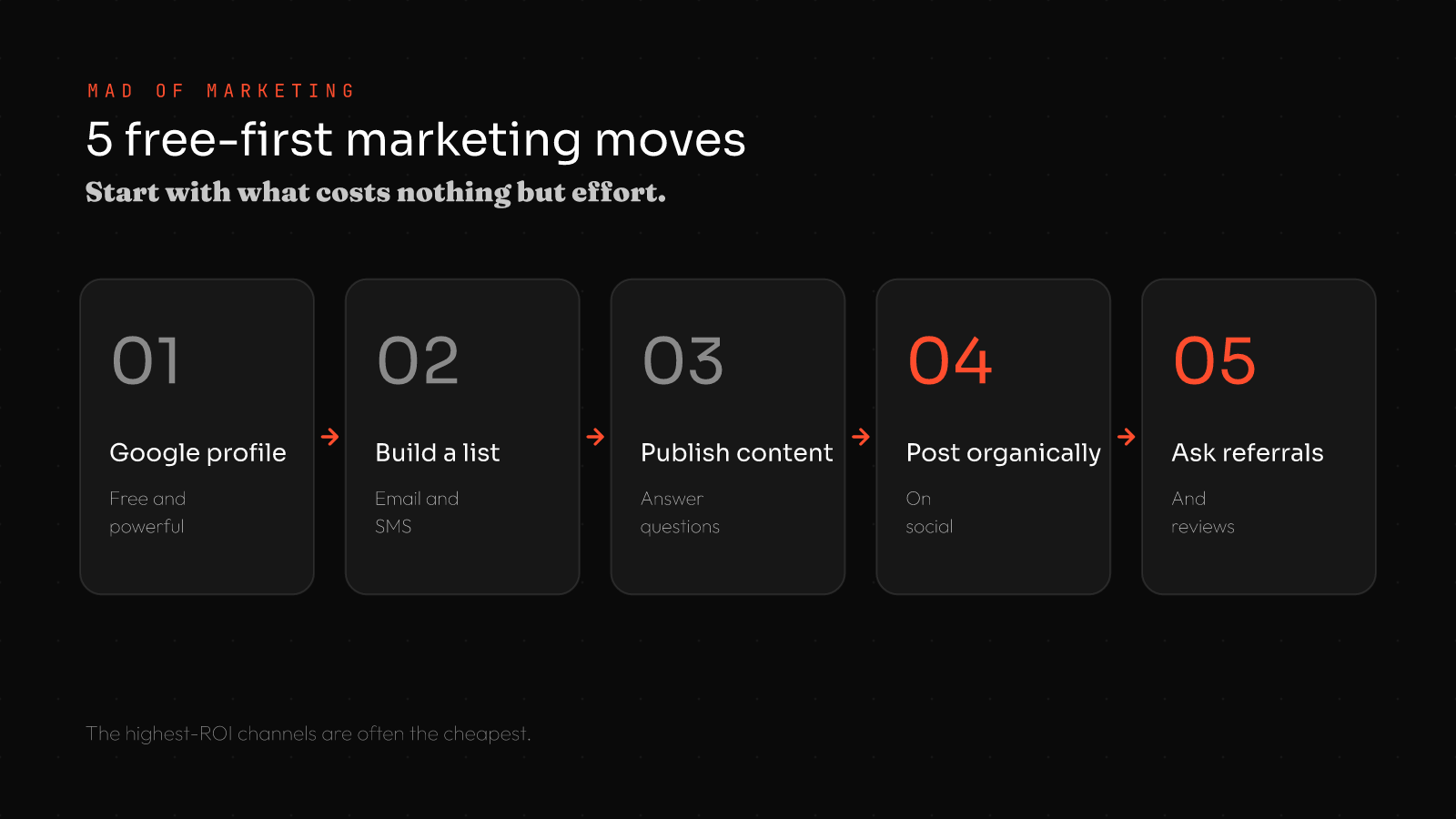
Start with these 5 free-first moves
Before spending anything, get these foundational, no-cost channels working.
1. Optimize your Google Business Profile
The single best free marketing move for any local business. Claim it, complete every field, add photos, and collect reviews and you’ll show up when nearby customers search, at zero cost.
2. Build an email (and SMS) list
Owned channels you control forever. Start collecting emails and phone numbers with a simple incentive, then stay in touch. Email and SMS are cheap and deliver the best returns in marketing.
3. Publish helpful content
Answer your customers’ questions in blog posts, videos, or social content. Content attracts people via search and builds trust — costing only your time and compounding for years.
4. Post organically on social
Being active on the one or two platforms your customers use is free reach. Share value, engage genuinely, and lead with short video, which drives the most organic discovery.
5. Ask for referrals and reviews
Turn happy customers into marketing. Simply asking for referrals and reviews consistently is one of the highest-ROI, lowest-cost things you can do.
15 more low-budget marketing ideas
Once the foundation is in place, here are more cheap, effective tactics to grow:
- Repurpose content: Turn one blog post into social posts, videos, and an email create once, use everywhere.
- Start a referral incentive: A small reward for referrals costs little and drives high-quality customers.
- Partner with local businesses: Cross-promote to each other’s audiences for free.
- Get listed in local directories: Free citations that boost local SEO.
- Use free design tools: Create professional graphics without hiring a designer.
- Go live on social: Live video is free, engaging, and favored by algorithms.
- Answer questions online: Be helpful in local groups and forums to build authority.
- Send a regular newsletter: Keep your list engaged with useful updates.
- Collect and share testimonials: Social proof that costs nothing and converts.
- Optimize existing pages for SEO: Improve what you already have to rank higher.
- Host a small event or workshop: Build relationships and local awareness.
- Run a simple contest or giveaway: Low cost, high engagement and reach.
- Reach out to local press: Free publicity from a newsworthy angle.
- Use email automation: Set up welcome and follow-up sequences once; they run free forever.
- Ask for reviews after every sale: Build the reputation that wins future customers.
Where to spend if you have a little budget
Even a small paid budget goes far if you spend it right. If you have $100–$500 a month to invest, put it where returns are quickest and most measurable. A modest Google Ads budget targeting high-intent local searches can deliver customers fast, and Facebook ads start at just a few dollars a day with precise targeting. An affordable email platform (many have free tiers) pays for itself many times over.
The key with a small budget is focus: pick one paid channel, track results closely, and only scale what proves it works. Don’t spread a tiny budget across five channels concentrate it where you can measure a clear return, then reinvest your winnings.
Free marketing tools worth using
You don’t need expensive software to market well a stack of free tools covers most of what a small business needs. For design, free graphic tools let you create professional social posts, flyers, and graphics without hiring a designer.
For analytics, Google Analytics and Google Search Console (both free) show you where your traffic comes from and which keywords you rank for. For your Google presence, your Google Business Profile is entirely free and one of the most powerful tools you have. Many email platforms offer free tiers generous enough to start building and emailing a list. Free social schedulers let you plan and queue posts in advance, and free heatmap tools show how visitors use your site.
Between them, these free tools handle design, analytics, email, social, and optimization the core of a small-business marketing operation for essentially nothing. Start with the free versions, learn what you actually need, and only pay for upgrades once a tool is clearly earning its cost.
Make your effort go further
On a small budget, your time is your most valuable resource so the goal is to get maximum output from every bit of effort. The key is repurposing: create something once, then use it everywhere.
A single blog post can become several social posts, a short video, an email newsletter, and a downloadable tip sheet. One customer testimonial can appear on your website, your Google Business Profile, and your social channels. A frequently asked question can be answered in a blog post, a video, and a social post. This approach means one piece of work fuels weeks of marketing across multiple channels, multiplying your reach without multiplying your effort.
Combine repurposing with batching creating several pieces of content in one focused session rather than scrambling daily and even a time-strapped owner can maintain a consistent, multi-channel presence. Working smarter like this is how small businesses punch far above their budget, turning limited time and money into steady, compounding marketing momentum.
Common low-budget marketing mistakes
- Confusing free with easy: Free channels still take consistent effort to work.
- Spreading too thin: Trying every idea at once instead of doing a few well.
- Ignoring your existing customers: The cheapest growth is repeat business and referrals.
- Not measuring: Spending time or money without tracking what works.
- Giving up too soon: Content and SEO take months to compound quitting early wastes the effort.
- Skipping the free basics: Paying for ads before claiming a free Google profile.
A simple low-budget marketing plan
To pull it all together, here’s a practical plan a small business can run for little to no money.
Month 1 build the free foundation. Claim and fully optimize your Google Business Profile, set up a simple email sign-up on your website, and start asking every happy customer for a review and a referral. These moves cost nothing and start working immediately.
Month 2 add content and social. Begin publishing helpful content that answers your customers’ questions even one post a month and stay active on the one or two social platforms your customers use, repurposing that content across them.
Month 3 systematize and amplify. Set up simple email automations (a welcome sequence, a follow-up), launch a basic referral incentive, and get listed in relevant local directories. Ongoing optimize and, if possible, add a little paid.
Keep publishing, keep asking for reviews and referrals, track what’s working in Google Analytics, and if you can spare $100–$300 a month put it behind a single well-targeted ad channel. This plan relies almost entirely on free, high-ROI channels, requires more consistency than cash, and compounds month over month. Follow it steadily and you’ll build real marketing momentum without a real marketing budget.
Frequently asked questions
What are the best low budget marketing ideas for small business?
The best are the free, high-ROI ones: optimizing your Google Business Profile, building an email and SMS list, publishing helpful content, posting organically on social, and asking for referrals and reviews. These cost time rather than money and compound over time.
How can I market my business with no money?
Focus on free channels: a complete Google Business Profile, local directory listings, organic social media, helpful content, email, and referrals. Consistency is what makes them work they require effort rather than budget.
What is the highest-ROI marketing channel?
Email marketing, at around $36 returned per $1 spent, followed by SEO. Both are low-cost and compound over time, making them ideal for small businesses on a tight budget.
Is it worth paying for ads on a small budget?
Yes, if you focus. Even $100–$500 a month on a single well-targeted channel like Google Ads can deliver measurable customers. The key is to concentrate your budget, track results, and scale only what works.
How can I market my business on social media for free?
Choose the one or two platforms your customers actually use, post helpful and engaging content consistently, lead with short video for reach, and genuinely engage with your audience. Repurpose one piece of content across platforms to save time. Organic social costs nothing but effort and consistency.
How much should a small business spend on marketing?
A common benchmark is 5–10% of revenue, but you can start with almost nothing by focusing on free, high-ROI channels. Spend time before money: nail the free foundations first, then add a modest paid budget where you can measure a clear return.
The bottom line on low budget marketing ideas for small business
Low budget marketing ideas for small business prove you don’t need deep pockets to grow you need focus and consistency. Start with the free, high-ROI foundations: your Google Business Profile, an email list, helpful content, organic social, and referrals. Layer in more free tactics, and spend any small budget where returns are quickest and measurable. Done consistently, these cheap channels compound into steady, sustainable growth.
Want a marketing plan that maximizes a modest budget? Book a free strategy call or explore our services.
Sources: DemandSage, BrightLocal, HubSpot marketing statistics (2025). Figures are industry averages and vary by source.