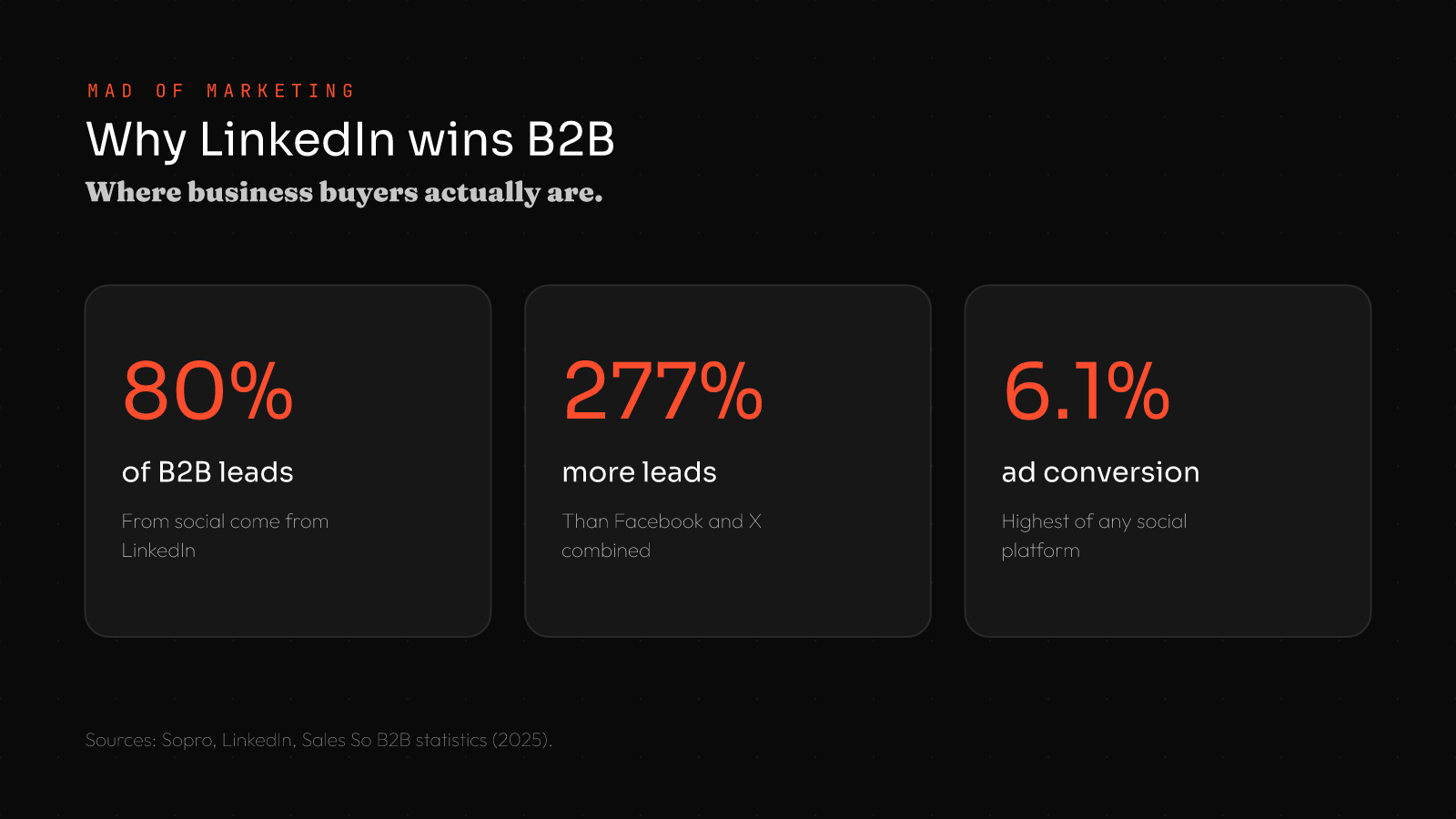
LinkedIn marketing for small business is the B2B growth engine where 80% of B2B social leads come from and where marketing converts up to twice as well as other platforms. LinkedIn generates 277% more leads than Facebook and X combined, and its ads convert at around 6.1%. If you sell to other businesses or professionals, this is where your buyers are.
For consumer brands, Instagram and TikTok make sense. But if your customers are other businesses, professionals, or decision-makers, LinkedIn is where the real opportunity sits. It’s the one platform where people show up specifically to do business to learn, network, and make buying decisions. That mindset is why LinkedIn marketing for small business consistently out-converts every other social channel for B2B, and why so many service firms, consultants, and B2B companies build their pipeline there.
This guide is part of our wider playbook on digital marketing for small businesses and a companion to our social media marketing guide. Here we focus on LinkedIn.
What is LinkedIn marketing for small business?
LinkedIn marketing for small business is using LinkedIn your profile, company page, content, networking, and ads to build authority, generate leads, and win customers, especially in B2B. It combines organic activity (sharing expertise, connecting, and engaging) with paid options (ads and lead-gen forms) to reach a professional audience in a business frame of mind.
Because people come to LinkedIn to advance their careers and companies, marketing that educates and builds trust performs exceptionally well.
Why LinkedIn marketing works for small businesses
For B2B, no other platform comes close:
- It dominates B2B leads. 80% of B2B leads from social media come from LinkedIn, and it generates 277% more leads than Facebook and X combined.
- It converts. LinkedIn’s visitor-to-lead conversion runs nearly three times higher than Facebook or X, and its ads deliver the highest B2B conversion rate of any social platform at around 6.1%.
- Lead forms work. LinkedIn Lead Gen Forms convert at about 13% more than five times the industry average.
- Marketers trust it. 93% of B2B marketers use LinkedIn for content marketing.
How to win on LinkedIn in 5 steps
LinkedIn rewards expertise and relationships, not hard selling. Follow this order.
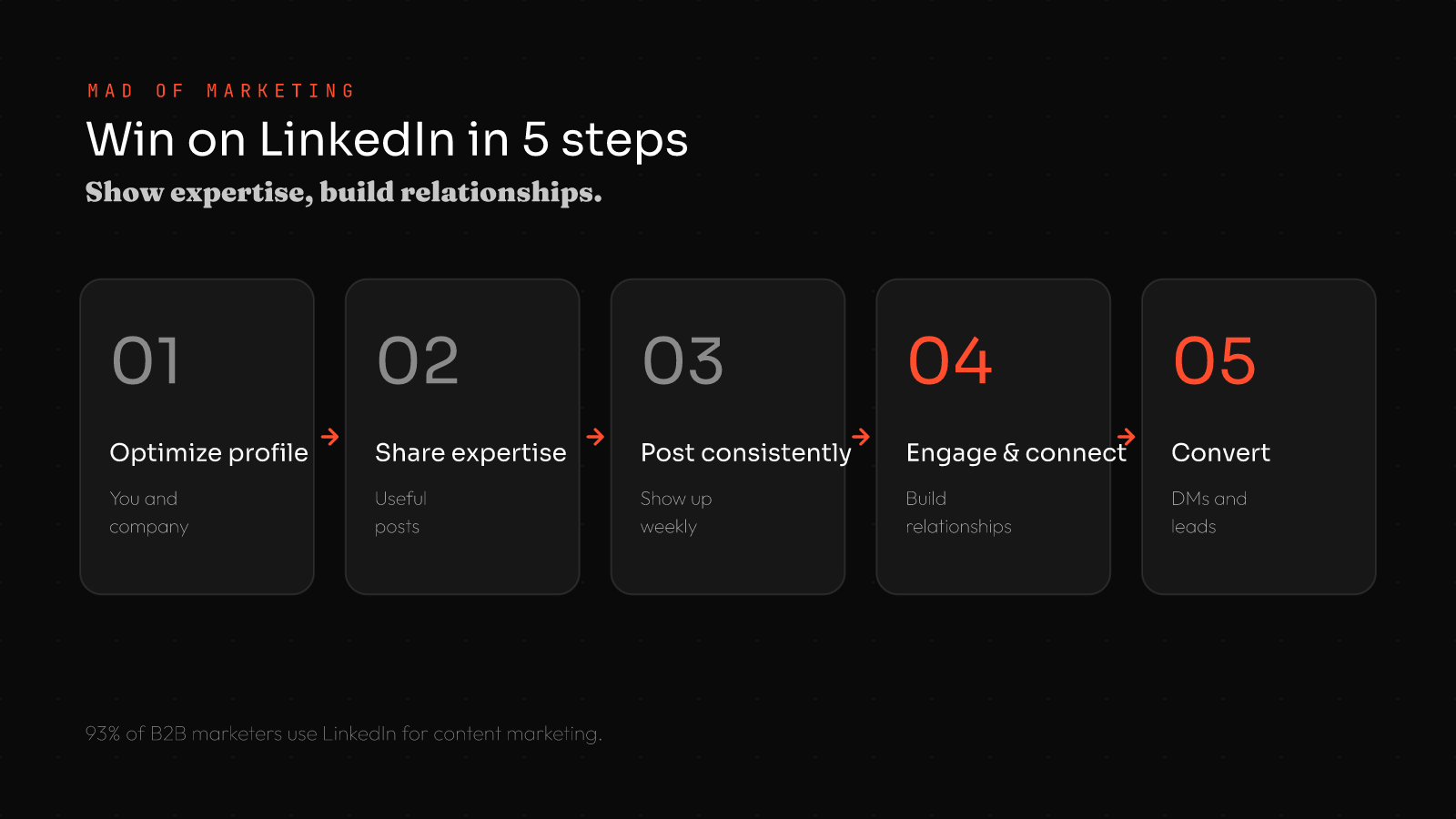
1. Optimize your profile and company page
On LinkedIn, your personal profile often matters more than your company page people connect with people. Use a professional photo, a headline that states who you help and how, and an about section focused on your customers’ problems. Set up a complete company page too, so your business has a credible presence.
2. Share your expertise
Content is how you build authority on LinkedIn. Share useful insights, lessons, and answers to the questions your buyers face text posts, short articles, and native video all work. Teach generously; the goal is to become the knowledgeable, trustworthy name in your niche.
3. Post consistently
Showing up regularly keeps you visible in your network’s feed and builds familiarity over time. A sustainable cadence a few quality posts a week beats occasional bursts. Consistency is what turns strangers into a warm audience that eventually buys.
4. Engage and connect
LinkedIn is a networking platform, so networking is the point. Connect with your ideal customers and partners, comment thoughtfully on their posts, and start genuine conversations. Relationships not cold pitches are what generate business here.
5. Convert relationships into leads
Once you’ve built trust, move conversations toward business: a helpful DM, an offer of value, a call. Use LinkedIn’s lead-gen forms in ads to capture interest with minimal friction, and always lead with how you can help. Warm, relationship-led outreach dramatically outperforms cold spam.
Organic vs LinkedIn ads
You can build a strong LinkedIn presence for free, and ads accelerate it. Organic activity posting, engaging, and networking builds authority and relationships over time at no cost beyond effort. LinkedIn ads let you target a precise professional audience by job title, industry, company size, and seniority targeting no other platform matches for B2B.
Ads cost more per click than other social channels, but the higher intent and conversion rates often justify it. The smart approach for most small businesses: build organically to establish credibility, then use ads to scale reach to your exact target buyers once you know what resonates. It ties directly into your broader lead generation.
Is LinkedIn right for your business?
LinkedIn shines for B2B professional services, consultants, agencies, software, and any business selling to other businesses or to professionals. If that’s you, it should likely be a core channel. If you’re a purely consumer-facing local business a restaurant or a salon your customers are probably better reached on Instagram, Facebook, or through local SEO. The honest answer: go where your buyers are.
For B2B, that’s overwhelmingly LinkedIn; for B2C, it usually isn’t. Choosing the right platform is a core part of any sound marketing strategy.
LinkedIn content that gets engagement
On LinkedIn, content is how you build authority and stay visible but not all content performs. The posts that consistently earn engagement share a few traits:
- Share real insights and lessons: Practical takeaways from your experience what worked, what didn’t, and why outperform generic advice.
- Tell stories: A short story about a client win, a mistake you learned from, or your journey humanizes you and draws people in.
- Start conversations: Ask questions and invite opinions. Comments boost reach, and genuine discussion builds relationships.
- Use native formats: Text posts, document carousels, and native video keep people on-platform and tend to be favored in the feed.
- Lead with value, not pitches: Teach generously; the business follows the trust you build.
- Write like a human: Skip the corporate jargon a clear, conversational voice out-engages stiff, formal posts every time.
Consistency plus genuine value is the formula. Show up regularly with helpful, human content and your authority and your inbound opportunities compound.
Personal profile vs company page
A question every small business faces on LinkedIn: focus on your personal profile or your company page?
The honest answer is to lead with the personal profile. People connect with people, not logos, and personal posts consistently earn far more reach and engagement than company-page posts. Your own profile is where you build authority, relationships, and trust the things that actually generate business. That doesn’t mean the company page is useless: it gives your business credibility, a place for company news, and a destination for ads.
The winning approach for most small businesses is to build your founders’ and team’s personal profiles as the engine of engagement, while keeping the company page complete and active as the professional home base. If you have a team, encourage everyone to post from their own profiles and engage the combined reach of several personal profiles far outstrips any single company page.
Common LinkedIn marketing mistakes
- Pitching too soon: Cold-selling in the first message instead of building a relationship.
- Neglecting your profile: An incomplete or self-focused profile that doesn’t speak to customers.
- Only broadcasting: Posting without engaging with others LinkedIn rewards two-way activity.
- Being too corporate: Stiff, jargon-heavy content that nobody engages with; authentic beats polished.
- Inconsistency: Posting once then disappearing, so you never build momentum.
- Ignoring your personal profile: Relying only on the company page when people connect with people.
How to get started with LinkedIn marketing
If LinkedIn is new territory, start simple and build momentum. First, optimize your personal profile a professional photo, a customer-focused headline, and an about section that speaks to the problems you solve. Complete your company page too. Then commit to a modest, sustainable posting habit: even two or three quality posts a week, sharing genuine insights from your work, will steadily grow your visibility and authority.
Spend a few minutes a day engaging commenting on your ideal customers’ posts and connecting with relevant people because relationships are where the business comes from. As you build a following and learn what resonates, you can layer in LinkedIn ads or lead-gen forms to reach a wider, precisely targeted audience.
Costs are flexible: organic LinkedIn marketing is free beyond your time, while ads run at a premium per click compared to other platforms but the higher B2B intent and conversion rates often justify it. Most small businesses succeed by building organic authority first, then scaling with paid once they have proven content and a clear offer. For where it fits your overall budget, see how much digital marketing costs.
Frequently asked questions
What is LinkedIn marketing for small business?
It’s using LinkedIn your profile, company page, content, networking, and ads to build authority, generate leads, and win customers, especially in B2B. It blends organic activity with paid targeting to reach professionals in a business mindset.
Is LinkedIn marketing worth it for a small business?
For B2B and professional services, absolutely 80% of B2B social leads come from LinkedIn and it converts up to twice as well as other platforms. For purely consumer-facing businesses, other channels are usually a better fit.
How often should I post on LinkedIn?
A few quality posts a week is a solid, sustainable target. Consistency keeps you visible in your network’s feed and builds the familiarity that turns connections into customers over time.
Does LinkedIn work for B2C businesses?
It can for professional services and higher-consideration purchases, but for typical consumer or local businesses, platforms like Instagram, Facebook, and local search usually reach customers more effectively. Match the platform to where your buyers spend their time.
How much does LinkedIn marketing cost?
Organic LinkedIn marketing is free beyond your time building a profile, posting, and networking cost nothing. LinkedIn ads run at a premium per click compared with other social platforms, but the higher B2B intent and conversion rates often justify it. Most small businesses start organically and add paid once they know what resonates.
Should I post from my profile or my company page?
Lead with your personal profile people engage with people, and personal posts consistently reach far more than company-page posts. Keep the company page complete and active for credibility and ads, but make your (and your team’s) personal profiles the main engine of engagement and relationship-building.
The bottom line on LinkedIn marketing for small business
LinkedIn marketing for small business is the clear winner for B2B where the leads, the intent, and the conversions are. Optimize your profile, share your expertise generously, post consistently, build genuine relationships, and move warm connections toward business. Add precise LinkedIn ads once you know what resonates, and you’ll turn the world’s biggest professional network into a steady source of high-quality customers.
Want a LinkedIn strategy that fills your pipeline? Book a free strategy call or explore our services.
Sources: Sopro, Sales So, LinkedIn B2B marketing statistics (2025). Figures are industry averages and vary by source.