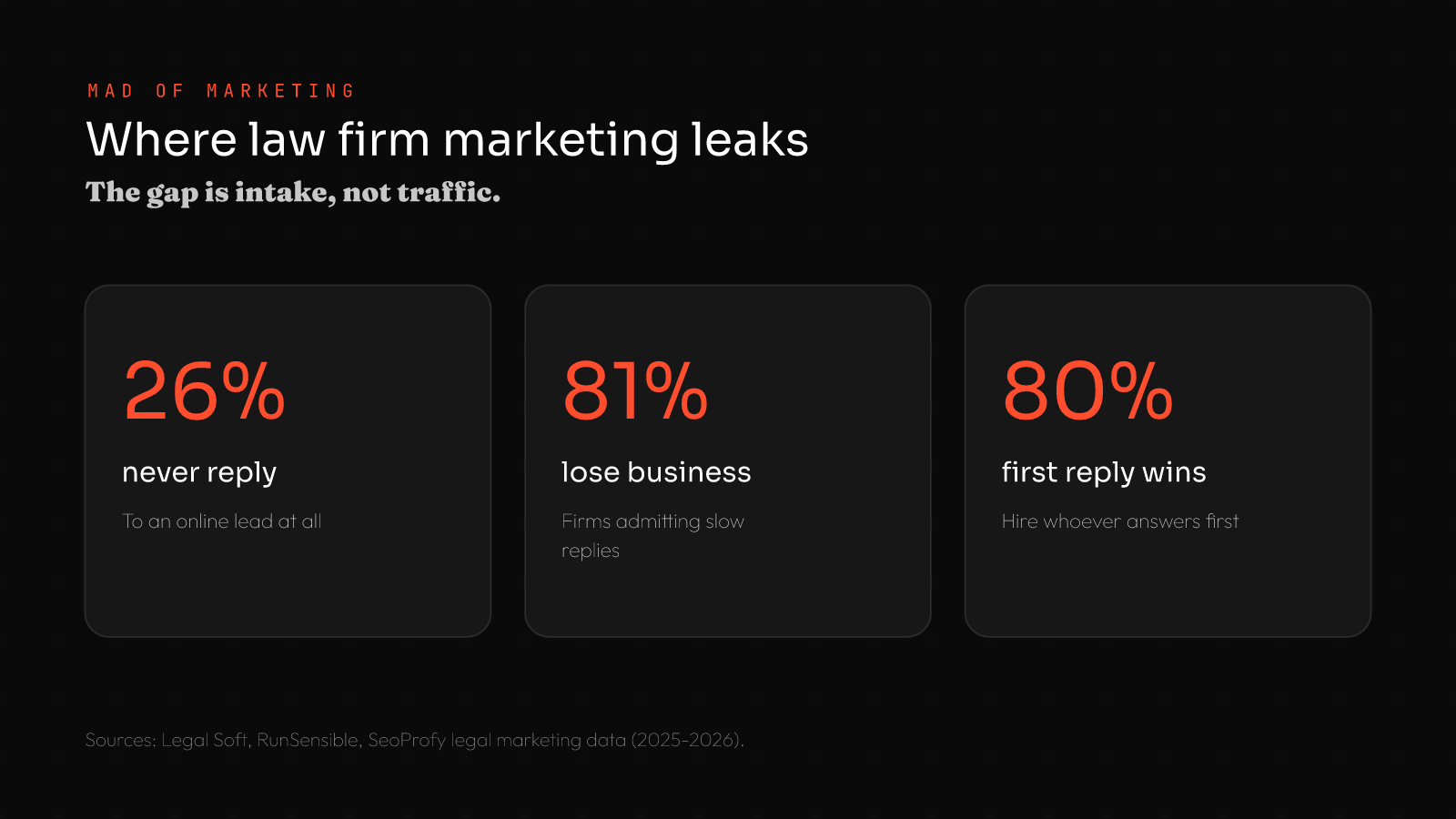
Most law firm marketing ideas focus on generating more enquiries, but the data says the leak is further down. 26% of law firms never respond to an online lead at all, 81% admit losing business to slow responses, and roughly 80% of legal consumers hire whoever replies first.
Get found on search and in directories, earn reviews that survive comparison then answer the phone faster than the firm down the road.
Legal marketing has an uncomfortable open secret. Firms spend heavily to make the phone ring, then let it ring.
The research on client intake is brutally consistent: a quarter of firms never reply to an online enquiry, and four in five admit they have lost work to slow follow-up. Most prospective clients simply hire the first lawyer who gets back to them with a useful answer.
Before you buy another ad, it is worth knowing that the cheapest new client available to most firms is the one who already contacted you.
This guide is part of our wider playbook on digital marketing for small businesses. Here we focus on law firms.
How clients actually choose a lawyer
Legal hiring is a high-anxiety, low-frequency decision. Most people do it once or twice in a lifetime, under stress, with no way to judge quality.
That shapes everything about how they pick:
- The search comes first, almost universally: The large majority of consumers use a search engine to find the attorney they end up contacting commonly reported at around 96%.
- Directories still convert: Roughly 62% of law firms report winning new clients through their online directory listings, which makes those profiles worth real attention rather than a one-time setup.
- Reviews carry the decision: Around 90% of consumers say what the reviews actually say shapes their choice not just the star rating next to your name.
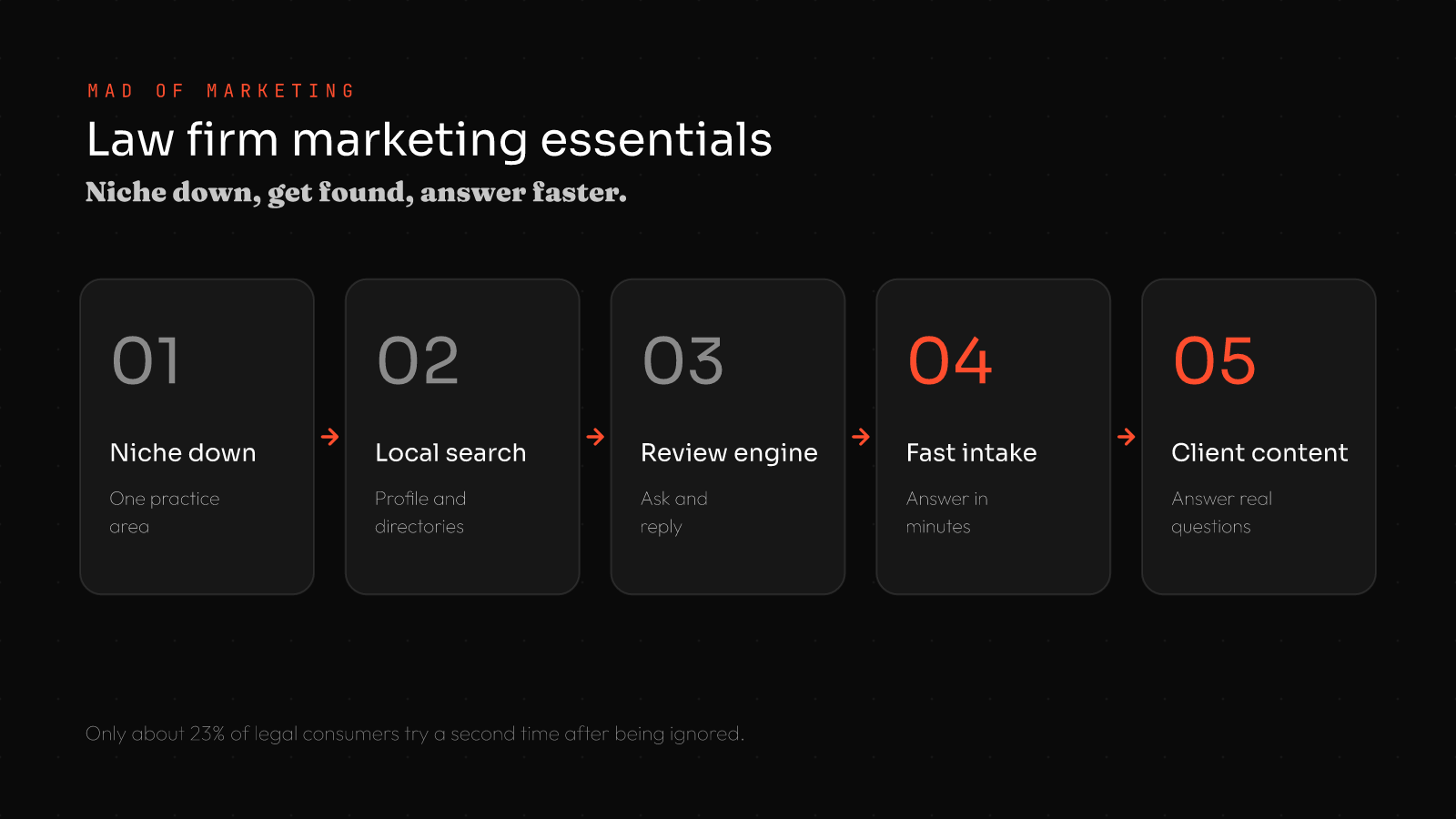
- Speed closes it: Nearly 8 in 10 legal consumers expect a reply within 24 hours, and only about 23% will keep trying a firm that ignored their first enquiry.
The law firm marketing essentials
Before the creative ideas, get these five foundations right. For most firms they account for the overwhelming majority of new matters.
1. Niche down before you spend a penny
A general practice competing on “lawyer near me” is competing with every firm in the city, and with national lead-generation sites that outspend all of them. A firm known for one thing construction disputes, immigration appeals, motorcycle injury, employment tribunals competes in a far smaller pool and can charge accordingly.
Niching is a marketing decision before it is a legal one. It decides which keywords you can realistically win, which directories are worth paying for, and whether your content has anything specific to say.
If you take one idea from this page, take this one.
2. Own local search and your directory profiles
Legal demand is overwhelmingly local and overwhelmingly search-led. Your Google Business Profile needs every field completed, your practice areas listed as services, and real photographs of your office and your people a firm with no faces reads as a firm with nothing to show.
Then treat your legal directory listings as live assets rather than a form you filled in once: consistent name, address and phone everywhere, practice areas that match how clients describe their problem, and the same review discipline you apply to Google. Combined with a properly structured site, this is what local SEO delivers for a firm.
3. Build a review engine, and reply to the bad ones
Legal reviews are read more carefully than almost any other category, because the stakes are high and the buyer is unqualified to judge the work. That means volume, recency, and critically what the text actually says.
Ask every client at the point of resolution, when relief is highest, and make it one tap. Reply to critical reviews calmly and without ever disclosing case details.
A measured, professional response to an angry review is quietly persuasive to the far larger number of people reading silently. Our guide to getting more Google reviews covers the mechanics, and reputation management covers the harder cases.
4. Fix intake before you increase spend
This is the one that separates firms that grow from firms that merely advertise. A quarter of firms never respond to online enquiries and the majority take hours or days, while most clients hire whoever answers first with something useful.
So: decide who owns first response and by when, put a real phone number and a short form on every page, and answer web enquiries in minutes rather than hours. Follow up more than once the second attempt catches a surprising share of people who were simply in a meeting.
If you do nothing else on this list, instrument your response time and hold someone accountable for it.
5. Publish content that answers what clients are frightened to ask
Prospective clients search for their problem, not your practice area. They type what happens if I ignore a tribunal claim, how long does probate take, can I be sacked for this.
Writing plain-language answers to those questions does three jobs at once: it ranks for the way people genuinely search, it demonstrates competence better than any list of credentials, and it gives your intake team something useful to send. This is content marketing doing its actual job reassurance that happens to be indexable.
15 law firm marketing ideas that bring in matters
With the foundations in place, here are specific ideas worth running:
- Build a page per practice area written in client language, not statute language.
- Publish plain-English answers to the questions clients are embarrassed to ask.
- Track and publish your response time internally what gets measured gets answered.
- Add live chat or a callback form for people who will not phone a stranger.
- Claim and complete every legal directory profile, then keep them current.
- Ask for a review at resolution, not weeks later when relief has faded.
- Record short explainer videos a face and a calm voice de-risks the first call.
- Run a referral agreement with firms in adjacent practice areas you do not compete with.
- Host a free clinic or webinar on a narrow topic your niche audience genuinely worries about.
- Write case studies with outcomes, anonymized and within your advertising rules.
- Target high-intent search ads only for matters that are worth the click price.
- Publish transparent fee structures or at least explain how pricing works.
- Build relationships with local professionals accountants, brokers, medics who see your clients first.
- Follow up unconverted enquiries twice more before writing them off.
- Reply to every review, especially the critical ones, without ever discussing the case.
Why intake beats advertising for most firms
Consider the arithmetic. If a quarter of your online enquiries never receive a reply, and a further share receive one too late to matter, then a meaningful portion of everything you spend on search, directories and content is being poured into a bucket with a hole in it.
Doubling your ad budget doubles the enquiries and doubles the leak. Fixing the leak costs a process change and someone’s accountability, and it improves the return on every channel you already run at once.
This is why the first thing worth auditing at a law firm is rarely the marketing it is the twenty minutes after a form is submitted. Instrument it honestly: log when each enquiry arrived, when it was first answered, and how many attempts were made.
Most firms who do this for a month are unpleasantly surprised. Most also find the single highest-return improvement available to them sitting in that log.
Only once first response is reliably fast does it make sense to buy more of it. That is the same logic behind measuring digital marketing ROI properly rather than by volume of leads.
Law firm marketing on a modest budget
Legal keywords are among the most expensive in search, which makes paid advertising an unforgiving starting point for a small firm. Fortunately most of what works is unpaid.
Start with a fully completed Google Business Profile, complete directory listings, and a systematic review request at the end of every matter. Those three things cost time rather than money, and they directly address how clients actually choose.
Then write, because a narrow practice with genuinely useful answers can out-rank a general firm with a bigger budget on the specific questions its clients ask. Build referral relationships with professionals who encounter your clients before you do for many firms these produce better-qualified work than any advertising.
When you do spend, spend narrowly: high-intent search terms for matters with enough value to justify the click price, pointed at a page built to convert rather than your homepage. The same discipline that applies to any low-budget marketing applies here earn the free visibility first, then pay for reach you have proven you can convert.
Ethics, compliance, and what you cannot say
Legal advertising is regulated in ways most marketing advice ignores, and the rules vary by jurisdiction. The recurring themes are consistent enough to plan around.
Do not promise or imply a particular outcome, and do not describe yourself as a specialist or expert where that term is formally restricted. Do not publish client information or case detail without informed consent.
Be careful with testimonials, which some jurisdictions restrict outright and others require to be qualified. Comparative claims about other firms are a common trap, as are unqualified superlatives like “best” or “leading”.
None of this prevents effective marketing it mostly prevents lazy marketing. Specific, verifiable, plainly-worded claims are both more compliant and more persuasive than superlatives, because the audience is already sceptical.
Check your own regulator’s current guidance before publishing. When a claim feels like it needs a disclaimer to survive, that is usually a sign to rewrite the claim rather than add the disclaimer.
Common law firm marketing mistakes
- Marketing everything to everyone: A general practice has no keyword it can win.
- Ignoring enquiries: A quarter of firms never reply at all the bar is genuinely low.
- Writing for other lawyers: Clients search their problem, not your practice area.
- Treating directories as set-and-forget: Stale profiles with no reviews convert nobody.
- Buying broad legal keywords: Expensive clicks for matters that cannot repay them.
- No faces anywhere: A firm with no photographs reads as a firm with something to hide.
Frequently asked questions
What are the best law firm marketing ideas?
Narrow your practice focus, own local search and your directory profiles, build a systematic review process, publish plain-language answers to the questions clients actually search, and fix your intake so enquiries are answered in minutes. The last one is usually the highest-return change available, because most firms are losing work they already paid to generate.
How do law firms get more clients?
By being findable at the moment someone searches their problem, credible enough to survive a review comparison, and fast enough to answer before a competitor does. Referral relationships with accountants, brokers and other professionals add well-qualified work on top of that, and usually convert better than advertising.
How much should a law firm spend on marketing?
Firms commonly budget somewhere in the region of 2% to 10% of revenue, weighted higher when newer or entering a new practice area. The percentage matters less than the sequence: fix intake and the free fundamentals first, because spending more to generate enquiries you do not answer reliably wastes most of the increase.
Is Google Ads worth it for lawyers?
It can be, but legal keywords are among the most expensive in search, so it only works when the matter value justifies the cost per click and the landing page and intake process are already converting. Most firms get better returns by fixing response time, local search and reviews first, then buying narrow high-intent terms rather than broad ones.
Do legal directories still work?
Yes, a majority of firms report winning clients through directory listings, and prospective clients use them as a comparison layer even when they found you elsewhere. Treat them as live profiles: complete, current, matched to how clients describe their problem, and carrying recent reviews.
How fast should a law firm respond to an enquiry?
Within minutes where possible, and certainly within the same business day most legal consumers expect a reply inside 24 hours, roughly 80% hire whoever responds first with something useful, and only about a quarter will try a second time after being ignored. Speed is a competitive advantage precisely because so few firms have it.
Should a law firm blog?
Yes, if it answers real client questions in plain language rather than publishing legal commentary for other lawyers. A small number of genuinely useful pages targeting the way people describe their problem will out-perform a large archive of thin updates, and gives your intake team something credible to send a hesitant enquirer.
The bottom line on law firm marketing ideas
The best law firm marketing ideas do three jobs: make a narrow, specific practice easy to find, make it easy to trust through reviews and plain-spoken content, and make it impossible to lose an enquiry once it arrives. The third is where most firms have the largest gap and the least competition, because a quarter of the profession still does not answer at all.
Pick a niche, own local search and your directories, run a review engine, publish the answers your clients are anxious about and then measure how long it takes you to call them back.
Want a law firm marketing plan that turns enquiries into signed matters? Book a free strategy call or explore our services.
Sources: Legal Soft law firm client intake statistics, RunSensible lead response time data, SeoProfy legal marketing statistics, Juris Digital legal review research (2025–2026). Figures are industry averages that vary by source and jurisdiction, and nothing here is legal or regulatory advice check your own regulator’s current advertising guidance before publishing.