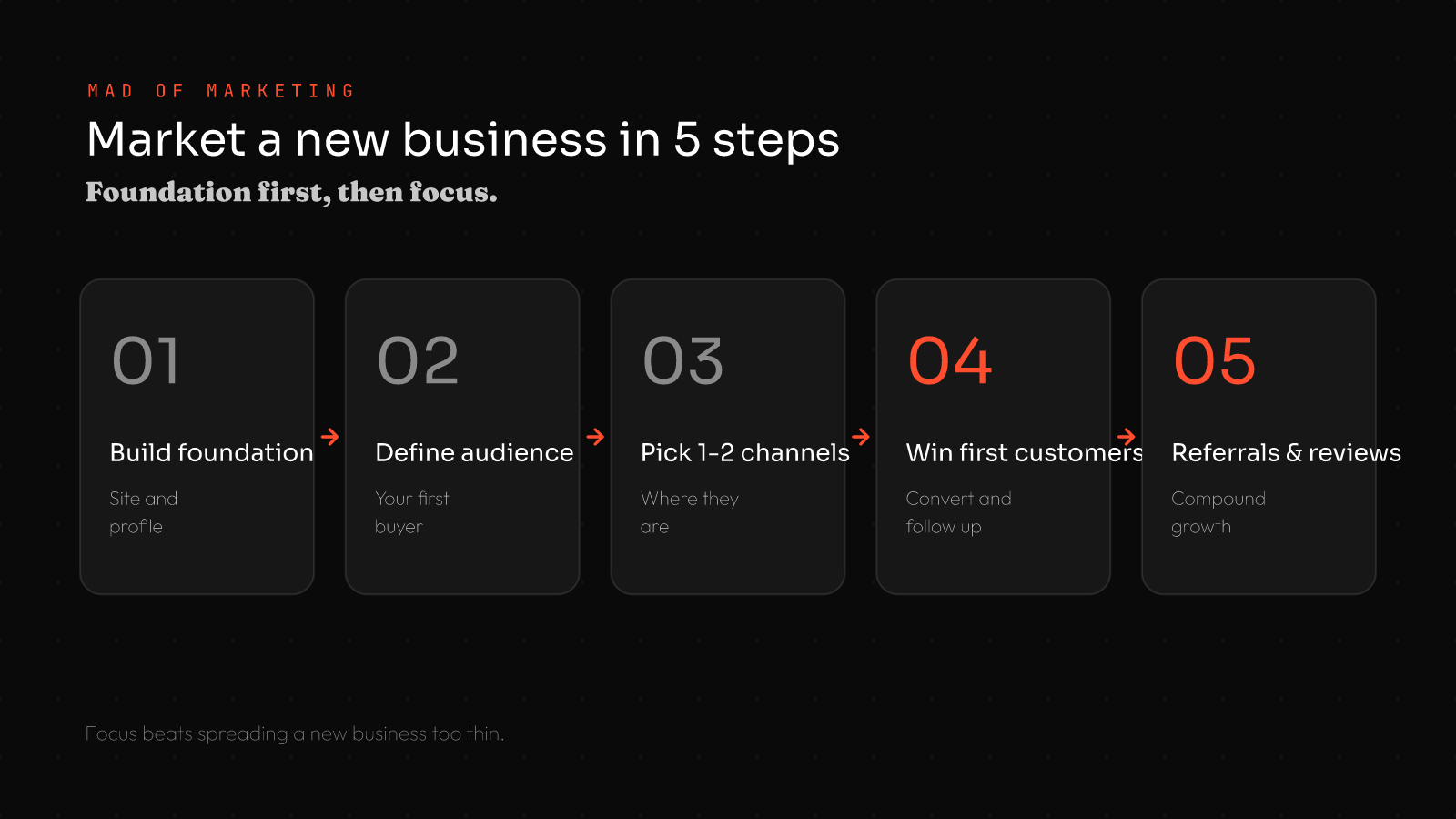
To market a new business, build a findable foundation (a simple website and Google Business Profile), get crystal clear on who your first customers are, focus on one or two channels where they already are, win those first customers with fast follow-up and a strong offer, then turn them into referrals and reviews. 81% of people research online before choosing a business so being findable from day one is everything.
Launching a new business is exciting and marketing it can feel overwhelming. You have limited time, a limited budget, and no existing customers or reputation to build on. The temptation is to try everything at once, which spreads a new business too thin to make progress anywhere. The better path is focus: do a few essential things well, win your first customers, and build momentum. This guide shows you exactly how to market a new business from scratch.
This guide is part of our wider playbook on digital marketing for small businesses. Here we focus on launching.
What matters most when marketing a new business
At launch, a few things matter more than anything else:
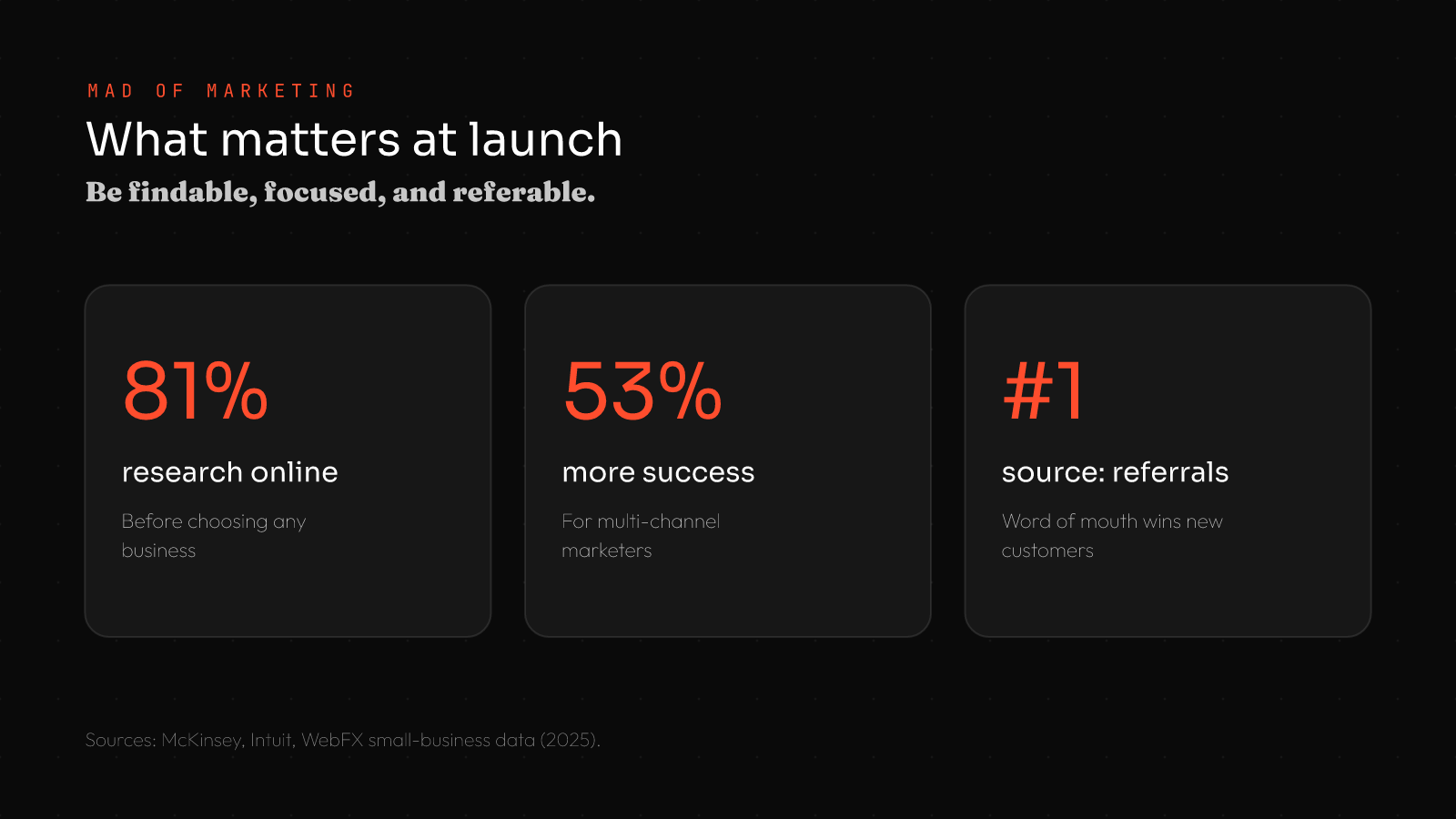
- Being findable: 81% of consumers research a business online before choosing, so a basic online presence isn’t optional it’s the price of entry.
- Focus over breadth: Multi-channel businesses see 53% more success, but a new business should start focused and expand trying everything at once fails.
- Word of mouth: Referrals are the top customer source for small businesses, so your first happy customers are your most important marketing asset.
How to market a new business in 5 steps
Start with the foundation, then focus. Here’s the order.
1. Build your foundation
Before promoting anything, make sure people can find and trust you. Set up a simple, clear website that says what you do and how to contact you, claim and complete your Google Business Profile if you’re local, and secure your social handles. This foundation is where all your marketing will send people, so get it right first.
2. Get clear on your audience
A new business can’t be for everyone. Define your ideal first customer precisely their problem, where they spend time, and why they’d choose you. The narrower and clearer your focus, the easier and cheaper it is to reach them. You can broaden later; at launch, specific wins.
3. Pick one or two channels
Don’t try to be everywhere. Choose the one or two channels where your target customers already are and go deep. A local business might focus on local SEO and Google; a visual brand on Instagram; a B2B startup on LinkedIn. Master one before adding another.
4. Win your first customers
Your first customers matter more than anything they generate revenue, feedback, and proof. Make a strong first-time offer, respond to every enquiry fast, and deliver an exceptional experience. Consider a small paid budget on Google Ads or Facebook ads to get in front of buyers quickly while your organic presence builds.
5. Turn customers into referrals and reviews
Once you have happy customers, put them to work. Ask every one for a review and a referral this builds the social proof and word of mouth that a new business desperately needs. Referred customers convert better and cost almost nothing, creating the momentum that carries you forward.
Low-cost marketing ideas for a new business
New businesses are usually tight on budget, so lean on free and cheap tactics first:
- Optimize your Google Business Profile: Free and one of the fastest ways to get found locally.
- Publish helpful content: Answer your customers’ questions to attract them via search.
- Build an email list from day one: Start collecting contacts immediately it’s your most valuable owned asset.
- Be active on your chosen social platform: Free reach where your audience already is.
- Tap your network: Tell everyone you know; your first customers often come from existing relationships.
- Partner with complementary businesses: Reach each other’s audiences at no cost.
- Ask for reviews after every sale: Build the trust that wins future customers.
For many more, see our guide to low budget marketing ideas.
Build a simple launch plan
To avoid overwhelm, put your new-business marketing into a simple plan you can actually follow.
In your first month, build the foundation: launch a clear website, claim your Google Business Profile, set up an email sign-up, and secure your social handles.
In your second month, start showing up: post consistently on your one chosen social channel, begin publishing helpful content, and tell your entire network you’re open.
In your third month, drive customers: run a modest paid ad campaign to your best-fit audience, make a compelling first-customer offer, and follow up on every lead fast.
Ongoing, systematize the momentum: ask every happy customer for a review and referral, keep publishing and posting, track what’s working, and reinvest in the channels that produce results. This focused, phased approach beats trying to do everything at once it lets a new business build real traction with limited time and money. Writing it down as a simple marketing plan makes it far more likely to happen.
How to build buzz before you launch
Marketing a new business doesn’t have to wait until opening day the smartest launches build anticipation beforehand, so you have customers ready the moment you open.
In the weeks before launch, start collecting interest: set up a simple landing page or social profile and invite people to sign up for launch news or an early offer, so you’re building an email list before you even have a product to sell. Share your journey the behind-the-scenes of building your business is genuinely engaging content that makes people feel part of the story and invested in your success.
Tell your personal network what you’re creating and ask them to spread the word. Consider a launch offer or limited early-bird deal to reward the people who show up first and create urgency. Reach out to any local press, community groups, or complementary businesses who might help you get the word out.
By the time you officially launch, you’ll have an audience warmed up and waiting rather than starting from zero. This pre-launch groundwork costs almost nothing but effort, and it turns opening day from a quiet start into a running start.
Turn early customers into growth
For a new business, your first customers are worth far more than the revenue they bring they’re the engine of everything that follows. Treat them accordingly. Deliver an exceptional experience so they become genuine fans, then systematically turn that goodwill into growth: ask each of them for an honest review (the social proof a new business badly needs to earn strangers’ trust), request referrals to people like them, and gather feedback to improve your offering while it’s still early and easy to change.
Feature their testimonials on your website and social channels. Stay in touch through email so they come back and buy again repeat customers and referrals are what let a new business grow without constantly spending to acquire strangers. This is how early momentum compounds: a handful of delighted first customers generate reviews and referrals that bring the next customers, who generate more of the same.
Getting those first few customers is the hard part; turning them into a growth loop is what carries a new business from launch to lasting success, and it ties directly into your ongoing customer retention.
Marketing a new business on a tight budget
Most new businesses launch with little money to spare, but a small budget is no barrier to effective marketing it just means prioritizing the free, high-return channels first.
Get your Google Business Profile and basic SEO working (free), start building an email list from day one (nearly free and the highest-ROI channel there is), publish helpful content that answers your customers’ questions, and stay active on the one social platform your buyers use. Lean heavily on your existing network and on referrals from your first customers, since word of mouth costs nothing and converts best.
If you do have a little to invest, put a modest amount behind a single paid channel Google or Facebook ads targeted tightly at your ideal first customers, and scale only what proves profitable. The mistake to avoid is spreading a tiny budget across many channels; concentrate your limited time and money where you can measure a clear return. Marketing a new business well is far more about focus and consistency than about how much you can spend.
Common new business marketing mistakes
- Trying to do everything: Spreading a new business too thin across every channel.
- No online foundation: Promoting before you have a findable website and profile.
- Being too broad: Marketing to “everyone” instead of a specific first customer.
- Ignoring your first customers: Not turning them into reviews and referrals.
- Expecting instant results: Quitting organic channels before they compound.
- No plan: Marketing reactively instead of following a simple launch plan.
Frequently asked questions
How do I market a new business?
Build a findable foundation (website and Google Business Profile), define your ideal first customer, focus on one or two channels where they are, win first customers with a strong offer and fast follow-up, and turn those customers into referrals and reviews. Start focused, then expand.
How do I market a new business with no money?
Lean on free channels: optimize your Google Business Profile, publish helpful content, build an email list, be active on one social platform, tap your existing network, and ask every customer for referrals and reviews. Consistency and focus matter more than budget.
How do I get my first customers?
Make a strong first-time offer, respond to every enquiry fast, tap your existing network, and consider a small paid ad budget to get in front of buyers quickly. Then deliver an exceptional experience so those first customers refer others.
How long does it take to market a new business successfully?
Paid ads and your network can bring first customers within weeks, while organic channels like SEO and content take 3–6 months to build momentum. Focus on quick wins early while building compounding channels for sustainable growth.
The bottom line on how to market a new business
Marketing a new business comes down to focus, not doing everything. Build a findable foundation, get clear on your first customer, concentrate on one or two channels where they are, win those first customers with a great offer and fast follow-up, and turn them into referrals and reviews. Follow a simple phased plan, lean on free channels while budgets are tight, and let momentum build. Do that and a new business can go from unknown to growing one focused step at a time.
Want help launching your new business the right way? Book a free strategy call or explore our services.
Sources: McKinsey State of the Consumer, WebFX, Intuit SMB MediaLab small business marketing statistics (2025). Figures are industry averages and vary by source.