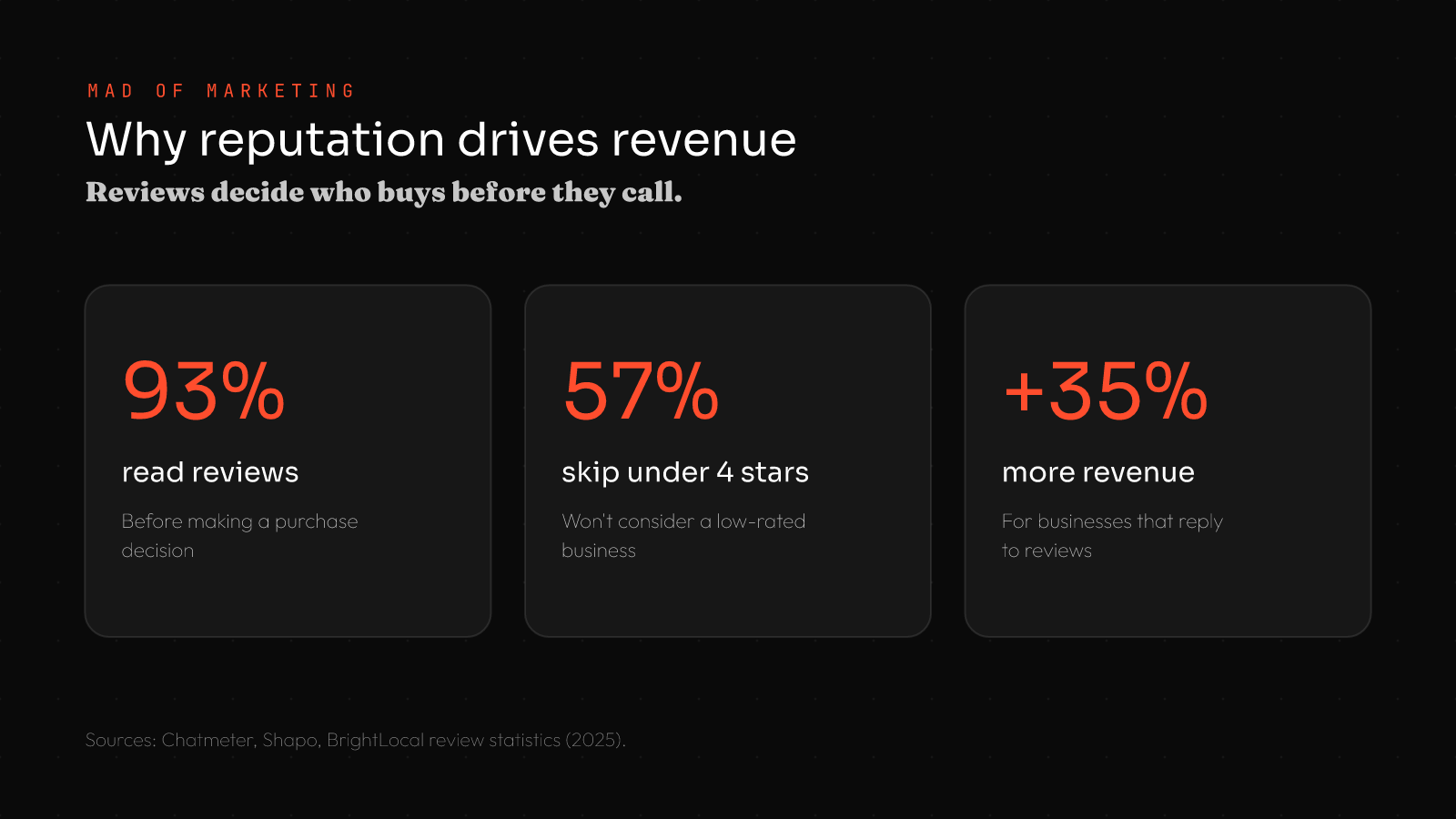
Online reputation management for small business is how you shape what people find and believe when they look you up. 93% of consumers read reviews before buying, 57% won’t consider a business rated under 4 stars, and replying to reviews is linked to 35% more revenue. Your reviews are your storefront manage them, and you control the first impression that decides the sale.
Before a customer ever calls you, they Google you and what they find decides whether they make contact. Reviews, star ratings, and search results now do the work a salesperson used to. That’s both a risk and an opportunity: a strong online reputation wins customers automatically, while a neglected one quietly sends them to competitors. Online reputation management for small business is the practice of taking control of that first impression instead of leaving it to chance.
This guide is part of our wider playbook on digital marketing for small businesses. Here we focus on reputation.
What is online reputation management for small business?
Online reputation management (ORM) for small business is the practice of monitoring, influencing, and improving how your business is perceived online across reviews, search results, and social media. It covers earning and responding to reviews, keeping your business listings accurate, monitoring what people say about you, and addressing negative content. The goal is simple: make sure the picture people find online reflects the quality of your business and builds the trust that turns searchers into customers.
Why online reputation management matters
Reviews and reputation now drive real revenue:
- Almost everyone reads reviews. 93% of consumers read online reviews before buying, and 99% of Americans read them before a purchase.
- Ratings are a filter. 57% of consumers won’t consider a business rated below 4 stars the sweet spot for conversions is 4.2–4.5.
- Responding pays. Businesses that respond to reviews earn about 35% more revenue on average, and reviews can drive 15–20% conversion lifts.
- Recency counts. 73% of consumers trust reviews from the last 30 days most, so a steady flow matters more than old five-stars.
And the investment pays back: 94% of local businesses that invest in reputation management see a positive return. Reputation isn’t a soft, feel-good metric it’s a direct driver of revenue.
How to manage your online reputation in 5 steps
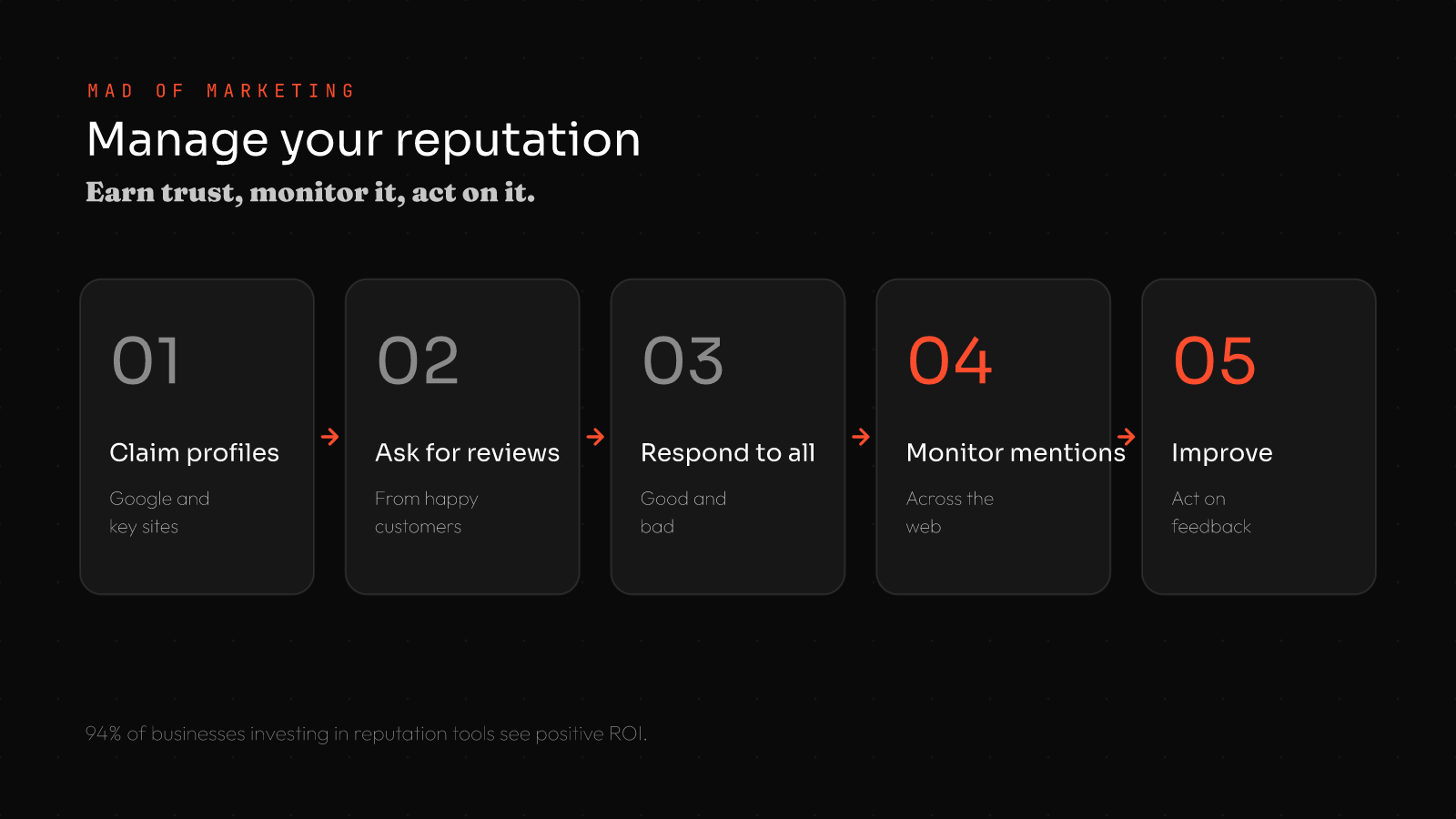
ORM is a system, not a one-off cleanup. Here’s the loop.
1. Claim your profiles
Take control of your presence everywhere customers look: Google (the big one), Facebook, Yelp, industry directories, and any platform relevant to your business four platforms host about 88% of all reviews. Claiming them lets you manage information, respond to reviews, and present your business accurately.
2. Ask for reviews systematically
Most happy customers won’t review you unless asked, so build asking into your routine. Request a review at the moment of satisfaction — right after the job, sale, or service and make it one tap with a direct link. A steady, ongoing flow of recent reviews beats a one-time pile, because recency is what customers trust.
3. Respond to every review
Replying is one of the highest-ROI habits in ORM. Thank positive reviewers warmly, and respond to negative ones calmly, professionally, and with a genuine offer to make things right. Hundreds of silent prospects read your responses a measured reply to criticism often impresses them more than the complaint hurts. Never argue or get defensive.
4. Monitor your mentions
You can’t manage what you don’t see. Set up Google Alerts for your business name, keep an eye on review sites and social media, and watch for new feedback. Catching issues early lets you respond fast before a single unhappy voice shapes the whole impression.
5. Improve from the feedback
The best reputation strategy is to deserve a good one. Treat recurring complaints as a free roadmap: if several reviews mention slow service or a confusing process, fix it. Acting on feedback both lifts your ratings over time and makes your business genuinely better the surest long-term reputation play there is.
How to handle negative reviews
Negative reviews feel like a crisis, but handled well they can actually build trust a business with only flawless five-stars looks suspicious. When you get a bad review: respond promptly and publicly, stay calm and professional, acknowledge the concern, and offer to make it right offline. Never argue, never get defensive, and never ignore it.
Prospects don’t expect perfection; they want to see how you handle problems. A thoughtful, human response to criticism reassures the many people reading silently that you’ll take care of them too. And keep earning fresh positive reviews a steady flow naturally outweighs the occasional negative one.
How to ask for reviews the right way
Since most happy customers won’t review you unless asked, how you ask largely decides how many you get. A few principles make a big difference:
- Ask at the peak moment: Request a review right after a great experience when the job’s done, the meal’s finished, or the problem’s solved and the customer is happiest.
- Make it effortless: Send a direct link to your Google review page by text or email. Every extra step loses reviews.
- Personalize the ask: A genuine, individual request converts far better than a generic mass message.
- Build it into your process: Add the review request to your follow-up routine so it happens automatically, not only when you remember.
- Never incentivize or fake them: Paying for reviews violates platform rules and erodes the trust you’re trying to build.
A simple, systematic ask is the single biggest driver of review volume and recent, steady reviews are exactly what customers trust most.
Reputation management tools that help
You can manage your reputation manually when you’re small, but a few tools make it far easier as you grow. Google Alerts (free) notifies you whenever your business is mentioned online. Your Google Business Profile dashboard lets you read and respond to reviews in one place.
As volume grows, dedicated reputation platforms can centralize reviews from multiple sites, automate review requests by text and email, and alert you to new feedback instantly and 94% of businesses that invest in these tools report a positive return. You don’t need expensive software to start, though: a simple routine of asking for reviews, responding to every one, and checking your profiles weekly covers the essentials. Add tools as your review volume makes manual management impractical.
Common reputation management mistakes
- Ignoring reviews: Not responding signals you don’t care and forfeits the revenue lift from replying.
- Only reacting to problems: Treating ORM as damage control instead of proactively building reputation.
- Buying fake reviews: Google detects and penalizes them, and customers can usually tell.
- Getting defensive: Arguing with reviewers publicly does far more damage than the original review.
- Letting reviews go stale: Old reviews carry less weight; recency is what builds trust.
- Not monitoring: Missing mentions and feedback until they’ve already shaped opinion.
How reputation connects to the rest of your marketing
Your reputation underpins everything else you do. Strong reviews boost your local SEO and power your Google Business Profile, social proof makes your website and ads convert better, and trust is the foundation of your brand. You can spend heavily driving traffic, but if your reputation turns people away when they check you out, that spend leaks away. Managing your reputation protects the return on every other channel.
Reputation beyond reviews: your search results
Reviews are the heart of online reputation, but they aren’t the whole of it. Your reputation is everything someone finds when they search your business name and that includes the search results page itself. Ideally, the first page of results for your brand shows a healthy mix of positive signals: your website, your active Google Business Profile, your social media, good reviews, and any press or content you’ve published.
The goal is to control as much of that first page as possible with assets you own or influence, so there’s no room for anything negative or misleading to dominate the impression. You build this the same way you build everything else: a solid website, active and consistent social profiles, helpful content, and strong SEO so your own properties rank for your name. When someone Googles you and finds a confident, professional, well-reviewed presence everywhere they look, the sale is half made before they ever reach out.
Frequently asked questions
What is online reputation management for small business?
It’s monitoring, influencing, and improving how your business is perceived online across reviews, search results, and social media. It includes earning and responding to reviews, keeping listings accurate, and addressing negative content.
Why is online reputation management important?
Because 93% of consumers read reviews before buying and 57% won’t consider a business rated under 4 stars. Your online reputation is often the deciding factor before a customer ever contacts you, and managing it directly affects revenue.
How do I get more positive reviews?
Ask every satisfied customer at the moment of satisfaction, make it one tap with a direct link, and build the request into your routine. A steady, ongoing flow of recent reviews is what builds trust focus on consistency, never on buying fake ones.
How should I respond to a negative review?
Respond promptly and publicly, stay calm and professional, acknowledge the concern, and offer to resolve it offline. Never argue or get defensive a thoughtful response reassures the many prospects reading silently that you handle problems well.
How much does online reputation management cost?
The core habits asking for reviews, responding to them, and monitoring mentions with free tools like Google Alerts cost only your time. Dedicated reputation platforms that centralize reviews and automate requests range from modest monthly fees upward, and 94% of businesses that invest in them report a positive return. Start with the free fundamentals and add tools as your volume grows.
The bottom line on online reputation management for small business
Online reputation management for small business is how you control the first impression that decides most sales. Claim your profiles, ask for reviews systematically, respond to every one, monitor your mentions, and act on the feedback to keep improving. Handle negatives with grace and keep earning fresh positives. Do that and your reputation becomes a 24/7 salesperson earning trust and customers before you ever say a word.
Want help building and protecting your reputation? Book a free strategy call or explore our services.
Sources: Chatmeter, Shapo, BrightLocal online review statistics (2025). Figures are industry averages and vary by source.