Website design for small business isn’t about looking pretty, it’s about turning visitors into customers. Around 94% of first impressions are design-related, 53% of people abandon a site that takes over three seconds to load, and a single one-second delay can cut conversions by up to 20%. Fast, clear, mobile-first design is one of the highest-return investments you can make.
Your website is the one piece of marketing that’s working 24/7, and for most small businesses it’s the first real impression a potential customer gets.
Yet plenty of sites quietly repel the very visitors that ads and SEO worked hard to attract: slow to load, confusing to navigate, unclear about what to do next. Good website design for small business fixes that, turning traffic you already pay for into actual leads and sales.
This guide is part of our wider playbook on digital marketing for small businesses. Here we focus on building a site that converts.
What is website design for small business?
Website design for small business is the practice of building a site that not only looks professional but loads fast, works on mobile, and guides visitors toward a clear action, calling, booking, buying, or enquiring.
It blends visual design, user experience, and conversion thinking. A pretty site that nobody can use, or a fast site that doesn’t tell people what to do, both fail the only test that matters: did it turn a visitor into a customer?
Why website design matters more than owners think
The data on first impressions and speed is striking:
- Design is the first impression. Around 94% of first impressions are related to website design, and people judge a site in as little as 0.05 seconds.
- Speed decides who stays. About 53% of users abandon a page that takes more than three seconds to load, and mobile users are even less patient.
- Slow costs sales. A one-second delay can cut conversions by up to 20%, and sites loading in one second convert dramatically better than those taking five.
- Mobile is the majority. Mobile devices drive roughly 62% of web traffic, so a desktop-only mindset loses most of your audience.
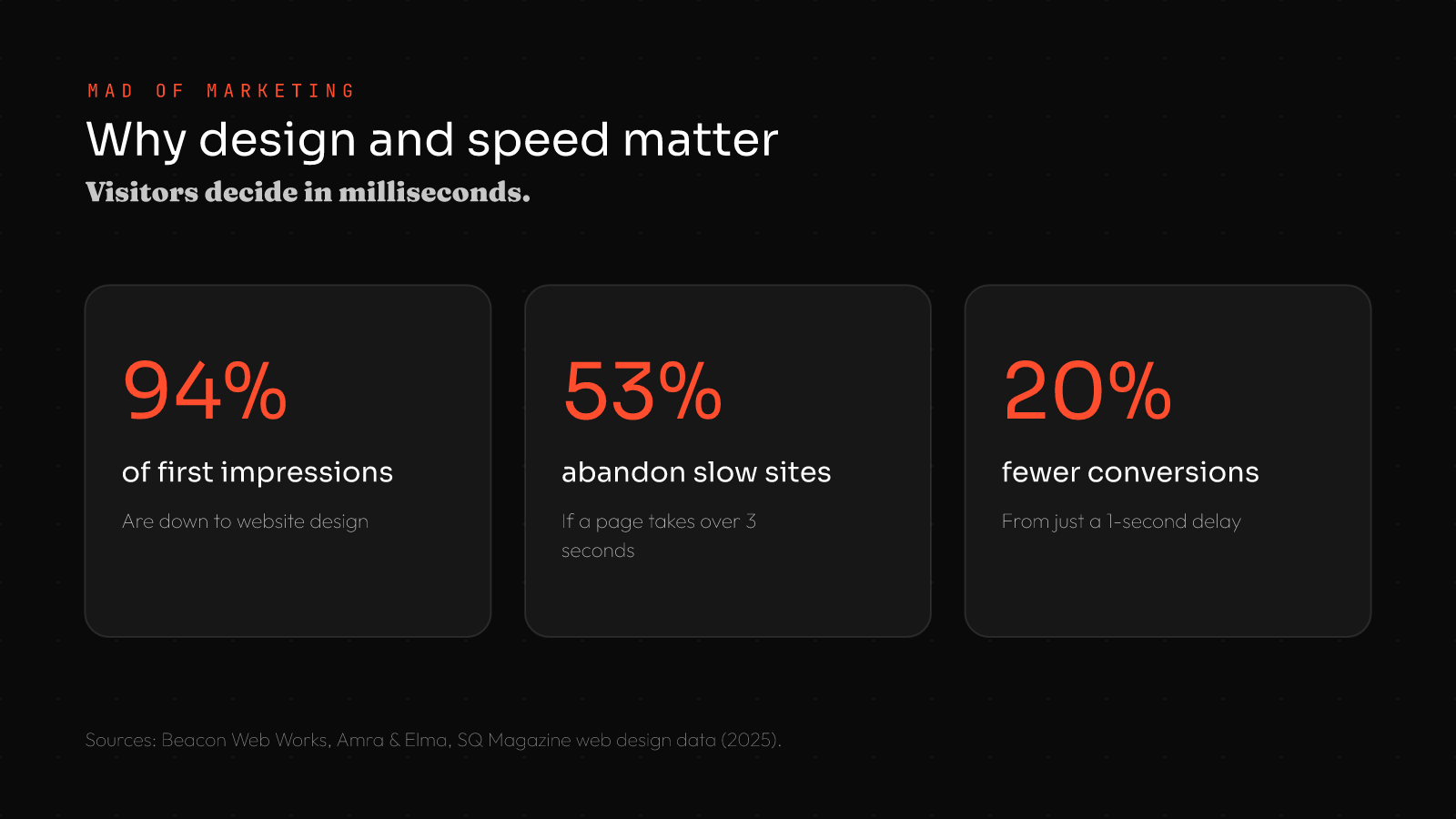
The takeaway: your website is often the bottleneck. Driving more traffic to a slow, confusing site is like pouring water into a leaky bucket — which is why fixing the site usually beats buying more clicks, and lifts the ROI of every other channel you run.
The 5 essentials of a small business website that converts
You don’t need a huge, complicated site. You need these five things done well.
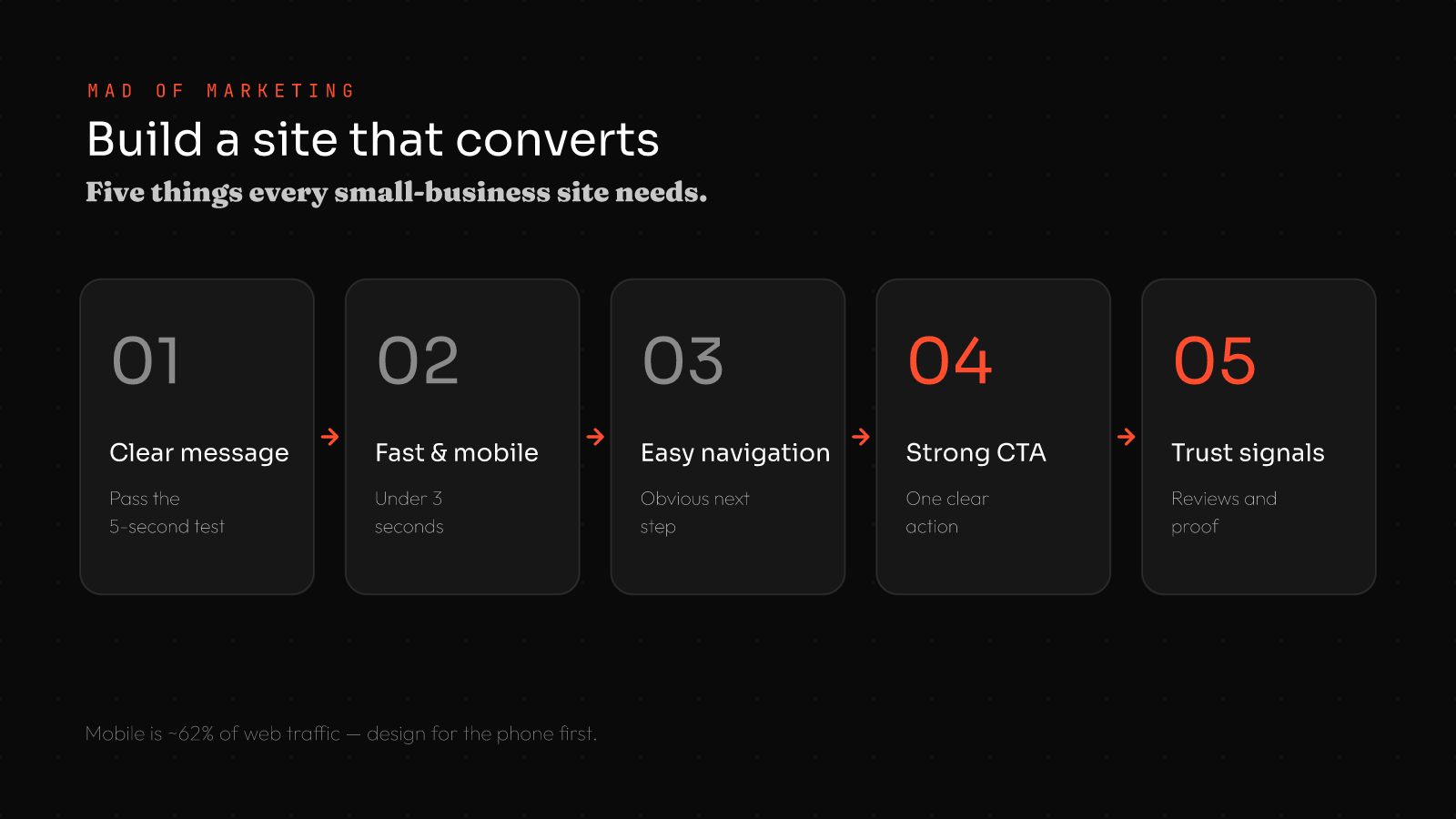
1. A clear message (the 5-second test)
Within five seconds, a visitor should know what you do, who it’s for, and what to do next. Lead with the problem you solve and the outcome you deliver, not “Welcome to our website.” If a stranger can’t pass that test on your homepage, no amount of design polish will save it.
2. Fast and mobile-first
Aim to load in under three seconds, and design for the phone first since that’s where most visitors are. Compress images, keep the code lean, and test on a real phone. Speed isn’t a technical nicety, it directly decides how many visitors stay and convert.
3. Easy navigation
Make it obvious how to find what people need and how to take the next step. Keep menus simple, limit choices, and never make a visitor hunt for your phone number or booking button. Confused visitors leave; guided ones convert.
4. A strong, clear call to action
Every page should have one obvious next step, “Get a free quote,” “Book a call,” “Shop now.” Make it prominent, repeat it as people scroll, and don’t dilute it with five competing buttons. One clear action beats a cluttered page of options.
5. Trust signals
People buy from businesses they trust, so prove you’re credible: reviews and testimonials, recognizable client logos, guarantees, real photos, and clear contact details. These signals do the quiet work of reassuring a stranger that you’re the safe choice, and they pair naturally with strong branding.
Common small business website mistakes
- Slow load times. The single biggest silent killer of conversions.
- Not mobile-friendly. Losing the majority of visitors who are on phones.
- Unclear message. A homepage that doesn’t say what you do or who it’s for.
- No clear call to action. Visitors who don’t know what to do next simply leave.
- Design over function. Flashy effects that look impressive but slow the site and confuse users.
- Out-of-date content. Old hours, dead links, and stale info that erode trust.
How website design supports SEO and conversions
Good design does double duty. Search engines reward fast, mobile-friendly, well-structured sites, so design directly affects your local SEO and rankings.
At the same time, the same qualities, speed, clarity, easy navigation, are exactly what turn visitors into leads. In other words, a well-designed site helps you get found and helps you convert the people who find you.
That’s why your website should be the foundation you build before pouring budget into ads or content, every other channel sends people here.
Choosing a website platform
The platform you build on shapes how easy your site is to run. The main options for a small business:
- Website builders (Wix, Squarespace). Easiest to start with, all-in-one, great for simple sites. Less flexible as you scale.
- WordPress. The most popular choice, flexible, SEO-friendly, and endlessly extendable, with a steeper learning curve.
- Shopify. Purpose-built for e-commerce; the default if selling products online is the core of your business.
- Custom-built. Maximum control and performance, but the most expensive and slowest to change.
For most small businesses, a builder or WordPress covers the need well. Choose based on what you’ll actually maintain, the best platform is the one you (or your provider) can keep fast, current, and on-brand without a fight.
Should you DIY your website or hire a designer?
DIY works when budgets are tight and your needs are simple, modern builders let you launch a clean, functional site yourself.
The catch is that the things that actually drive results, conversion-focused layout, speed optimization, and clear messaging, are easy to get wrong without experience, and a slow or confusing DIY site can quietly cost you more in lost customers than a professional one would have cost to build.
Hiring a web designer or agency pays off when your website is central to winning customers, when you’re investing in ads or SEO that send traffic to it, or when conversions really matter.
Professionals build for speed, mobile, and conversion from the start, not as an afterthought. A practical approach: start with a simple DIY site to get online, then invest in professional website design for small business once traffic and revenue justify squeezing more conversions from every visitor.
Keep your website current
A website isn’t a one-and-done project, it’s a living asset. Outdated hours, dead links, old prices, and stale content quietly erode the trust good design builds.
Set a simple habit: review your site every quarter, keep your platform and plugins updated for security and speed, refresh content and offers, and test the key actions (forms, buttons, checkout) on a real phone. A little ongoing maintenance protects the investment and keeps your hardest-working salesperson in top shape.
How much does a small business website cost?
Costs vary with complexity. A simple, professional small-business site might run from a modest amount on a DIY builder to several thousand dollars for a custom, conversion-focused design from an agency, plus ongoing hosting and maintenance.
Given that the site is where most of your marketing ultimately converts, it’s rarely the smartest place to cut corners. For the full picture, see how much digital marketing costs.
Your homepage: the page that matters most
If you only get one page right, make it the homepage, it’s where most first impressions form and where visitors decide whether to stay.
A high-converting small-business homepage follows a simple structure: a clear headline that states what you do and who it’s for, a short supporting line and a prominent call to action above the fold, then proof (reviews, logos, results), a concise explanation of your services or benefits, and another call to action as people scroll.
Avoid the common trap of a slider full of stock photos and vague slogans that say nothing. Every section should move the visitor one step closer to contacting you. Get the homepage right and the rest of the site has a much easier job, it ties directly back to strong branding and a clear message.
How to measure if your website is working
A website isn’t “done” at launch, it’s something you improve with data. You don’t need a complex setup; install Google Analytics 4 and watch a handful of signals each month:
- Conversion rate. The percentage of visitors who take your key action, the number that matters most. Small lifts here compound across all your traffic.
- Bounce rate and engagement. If most visitors leave immediately, your message, speed, or relevance needs work.
- Page speed scores. Run a free test like Google PageSpeed Insights and fix what it flags, especially on mobile.
- Top pages and exits. See where people land and where they drop off, then improve those pages first.
- Traffic sources. Know which channels send visitors who actually convert, and feed that into your digital marketing ROI.
Check these monthly, fix the weakest link, and your site gets steadily better at turning visitors into customers, which is the entire point of website design for small business.
Frequently asked questions
What is website design for small business?
It’s building a site that looks professional, loads fast, works on mobile, and guides visitors toward a clear action like calling, booking, or buying. It blends visual design with user experience and conversion thinking.
Why is good website design important for small business?
Because your site is often the first impression and the place most marketing converts. Around 94% of first impressions are design-related, and slow or confusing sites lose visitors fast, a one-second delay alone can cut conversions by up to 20%.
How fast should a small business website load?
Aim for under three seconds, ideally close to one. About 53% of users abandon a page that takes longer than three seconds, and faster sites convert significantly better, so speed should be a top priority, especially on mobile.
How much does a small business website cost?
It ranges from a modest amount on a DIY builder to several thousand dollars for a custom, conversion-focused design from an agency, plus hosting and maintenance. Since the site is where marketing converts, it’s worth investing in getting it right.
Do I need a website if I have social media?
Yes. Social platforms rent you an audience and can change the rules anytime, while your website is an asset you own and control. It’s where high-intent visitors go to research and buy, and many consumers won’t trust a business without one.
The bottom line on website design for small business
Website design for small business is where your marketing either pays off or leaks away. Lead with a clear message, make the site fast and mobile-first, keep navigation simple, give every page one strong call to action, and back it all with trust signals. Get those right and your website becomes your hardest-working salesperson, turning the traffic you already earn into real customers.
Want a website built to convert, not just impress? Book a free strategy call or explore our services.