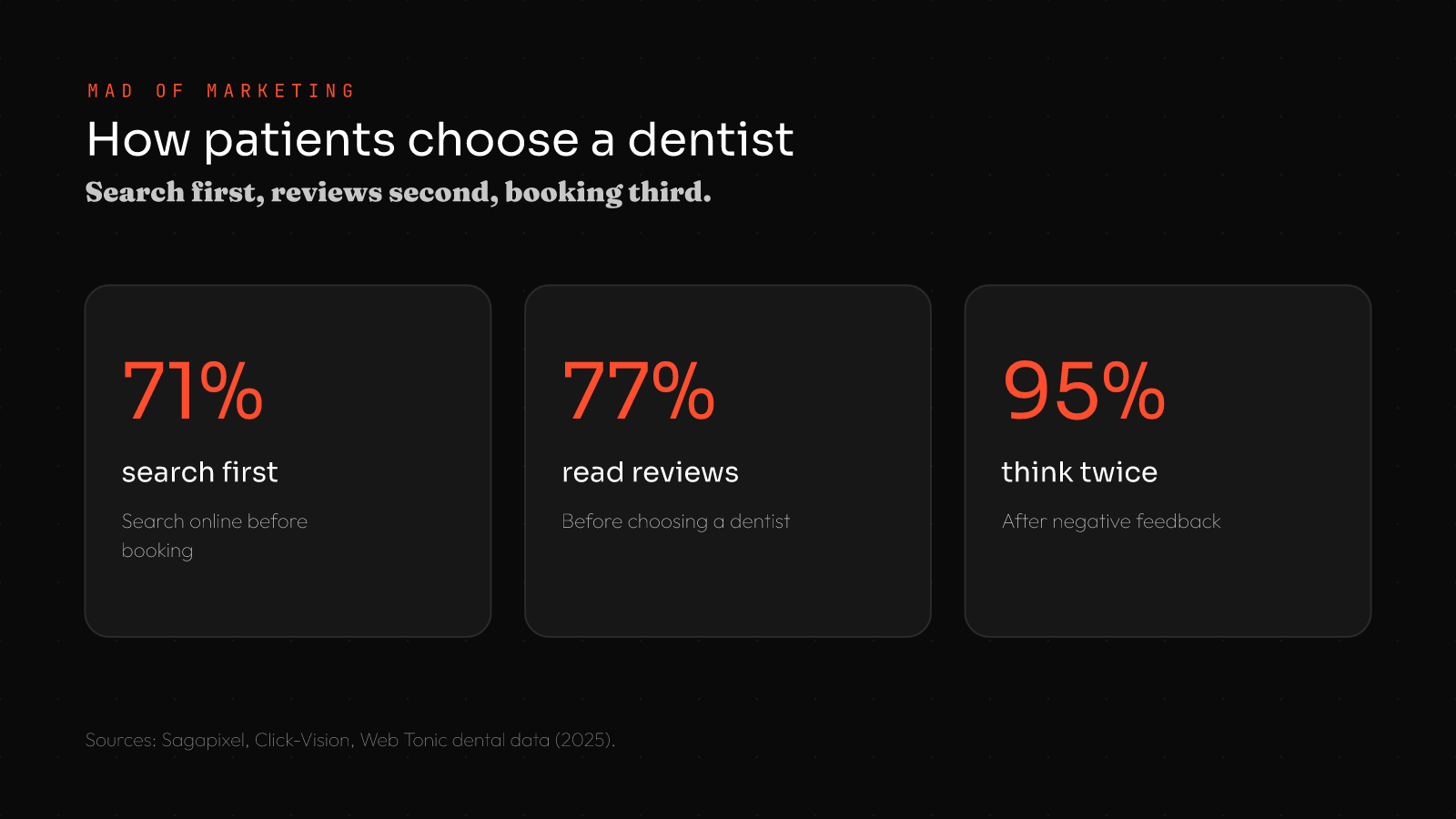
The best dental marketing ideas make you easy to find, easy to trust, and easy to book. 71% of people search online before choosing a dentist, 77% read reviews first, and 95% think twice after seeing negative feedback yet only 35% of dentists reply to bad reviews. Own your Google profile, build a steady review flow, make booking effortless, and stay in touch with the patients you already have.
Dentistry is one of the most competitive local markets there is. In most towns there are half a dozen practices within a few miles of each other, all offering broadly the same treatments at broadly the same prices. What separates a full appointment book from a quiet one usually isn’t clinical skill it’s whether nervous, comparison-shopping patients can find you, trust you, and book you in under two minutes. The best dental marketing ideas are the ones that remove friction at each of those three steps.
This guide is part of our wider playbook on digital marketing for small businesses. Here we focus on dental practices.
How patients choose a dentist
Understanding how someone actually picks a practice tells you exactly where to spend your effort:
- The search comes first. 71% of prospective patients run a web search before booking an appointment usually something local like “dentist near me.”
- Reviews decide it. 77% of patients read reviews before choosing a dentist, and many won’t consider a practice without a healthy volume of recent ratings.
- Negatives carry weight. 95% think twice after reading negative feedback but only 35% of dentists respond to unfavorable ratings, which is a wide-open opportunity.
- Referrals still lead. Around 77.5% of practices report referrals as their single most effective channel, which makes patient experience a marketing decision.
The dental marketing essentials
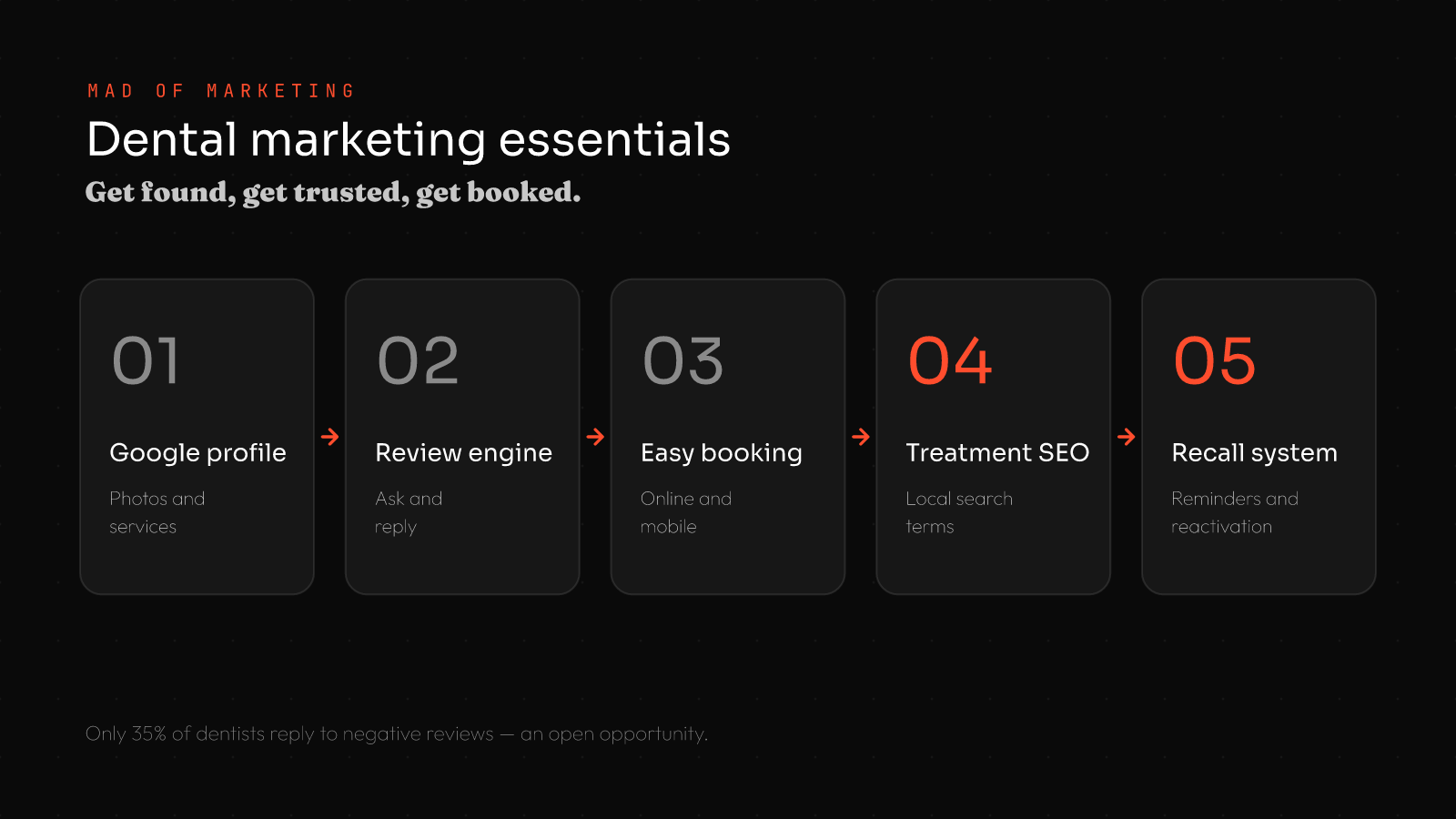
Before the creative ideas, get these five foundations right. They do the overwhelming majority of the work.
1. Own your Google Business Profile
When someone searches “dentist near me,” your Google Business Profile is the first thing they see often before your website. Complete every field, list your treatments as services, keep opening hours accurate (including holidays), and add real photos of your practice, your team, and your waiting room. Nervous patients are reassured by seeing the place before they walk in. This is the highest-return free asset a dental practice owns.
2. Build a review engine, not a review habit
Reviews are the deciding factor for most new patients, so asking for them can’t be something you remember to do occasionally. Make it systematic: a text or email goes out after every completed appointment with a one-tap link, and someone owns the job of replying to every review within 48 hours. Responding to criticism calmly and professionally is quietly persuasive it tells the 95% who read negatives that you take care seriously. Our guide on getting more Google reviews covers the mechanics.
3. Make booking effortless
Every extra step between “this practice looks good” and “I have an appointment” costs you patients. Put online booking on your site and your Google profile, make the phone number tappable on mobile, and make sure your website loads fast and reads well on a phone. A patient deciding at 11pm should be able to book without waiting for you to open.
4. Target treatments with local SEO
Generic dental keywords are brutally competitive, but treatment-plus-location searches are very winnable. Build a page for each high-value treatment you offer — implants, Invisalign, teeth whitening, emergency dentistry and write it for the way patients actually search. Combined with consistent listings across the web, this is how local SEO puts you in front of people at the exact moment they’re deciding.
5. Run recall and reactivation properly
Most practices are sitting on a list of patients who’ve drifted. A simple recall system automated reminders for six-month check-ups, plus a reactivation campaign to patients you haven’t seen in over a year is the cheapest new revenue available to you. Use email for the longer message and SMS for the reminder that actually gets read.
15 dental marketing ideas that fill the appointment book
With the foundations in place, here are specific ideas that bring patients through the door:
- Post before-and-after cases (with written consent) cosmetic results sell themselves.
- Introduce your team on video so anxious patients meet a face before they arrive.
- Create a page per treatment targeting how patients search, not clinical terminology.
- Offer a new-patient exam offer to lower the barrier to switching practices.
- Run a referral program that rewards existing patients for recommending you.
- Answer common fears publicly cost, pain, sedation in blog posts and short videos.
- Add a QR review card at reception so asking becomes one tap.
- Run geo-targeted social ads to households within a realistic drive time.
- Set up an emergency dentist page high intent, and often less contested.
- Send birthday and check-up reminders automatically by SMS.
- Publish transparent pricing or clear finance options to remove the biggest hesitation.
- Partner with local employers to offer staff dental plans or on-site talks.
- Showcase your technology scanners, same-day crowns as a reason to choose you.
- Reactivate lapsed patients with a friendly “it’s been a while” campaign.
- Reply to every review, especially the critical ones, within two days.
Why local SEO matters more for dentists than almost anyone
Dental demand is almost entirely local. Nobody drives two hours for a filling, which means your entire addressable market is the people within a short radius of your chair and they nearly all start on Google. That makes local SEO the highest-leverage channel a practice has.
Beyond your Google Business Profile, the fundamentals are unglamorous but decisive: identical name, address, and phone number everywhere you appear online; a page for each treatment written around real patient language; location signals in your titles and headings; and a fast, mobile-first site with booking never more than a tap away.
Emergency and urgent searches deserve their own attention, because someone in pain at 8am is the highest-intent patient you will ever get and often the least contested. Get this layer right and you appear in the map pack for the searches that matter, which for a dental practice is worth more than any other single marketing investment.
Dental marketing on a budget
You do not need a large budget to grow a practice most of what moves the needle costs time rather than money. Start with the free assets: a fully completed Google Business Profile with real photos and every treatment listed, a systematic review request after each appointment, and accurate listings wherever your practice appears.
Then build the recall and reactivation habit, because emailing and texting patients you already have is close to free and converts far better than advertising to strangers. Answer the questions patients are nervous to ask what it costs, whether it hurts, what the options are in plain-language posts and short phone-shot videos; that content ranks, reassures, and costs nothing but an afternoon.
Run a referral program, since word of mouth is already the leading channel for most practices. When you do have money to spend, geo-targeted ads to a tight radius around the practice are measurable and can start small. The principle is the same as any low-budget marketing: do the free, high-impact things consistently before you buy reach.
Turning first visits into lifetime patients
The most profitable dental marketing isn’t attracting new patients it’s keeping the ones you have. A patient who stays with a practice for a decade is worth many multiples of a one-off new-patient offer, and they refer their family, which is why referrals remain the leading channel for most practices. So treat retention as marketing.
The experience does most of the work: running on time, explaining treatment without jargon or pressure, and handling anxious patients with genuine patience. Then make returning automatic rather than optional book the next check-up before they leave the chair, confirm it by SMS, and follow up when someone drifts past due.
Stay in touch between visits with something useful rather than purely promotional, so your name is familiar when a problem appears. Small human touches matter more here than in almost any other business, because most people arrive slightly nervous and remember how you made them feel long after they’ve forgotten what you charged.
Our guide to customer retention covers the wider principles, but for dentistry the summary is simple: a well-run recall system and a practice people don’t dread visiting will outperform any advertising budget.
Common dental marketing mistakes
- An incomplete Google profile: Missing treatments, stale hours, or stock photos.
- Asking for reviews inconsistently: A burst of requests, then months of silence.
- Ignoring negative reviews: Only 35% of dentists reply silence reads as indifference.
- Clinical language everywhere: Patients search for “tooth pain,” not the technical term.
- No online booking: Losing evening and weekend decisions to whoever offers it.
- Neglecting existing patients: Chasing new ones while the recall list quietly lapses.
Frequently asked questions
What are the best dental marketing ideas?
The highest-return ideas are optimizing your Google Business Profile, building a systematic review process, offering online booking, creating a page for each treatment targeted at local searches, and running proper recall and reactivation to existing patients. Local discovery and social proof drive the most new appointments.
How do dentists attract new patients?
By being easy to find (Google Business Profile and local SEO), easy to trust (a steady flow of recent reviews and honest answers about cost and pain), and easy to book (online booking and a fast mobile site). Referral programs and tightly geo-targeted ads add reach on top of those foundations.
How much should a dental practice spend on marketing?
A common benchmark is 3% to 7% of revenue, weighted toward growth if you’re newer or expanding. What matters more than the percentage is where it goes: fix the free fundamentals first, because paying to send traffic to a weak profile, a thin website, or a practice with few reviews wastes most of the spend.
Is Google Ads or social media better for dentists?
Google captures people already looking for a dentist, so it usually produces better-qualified enquiries and is the stronger starting point for a practice. Social media works better for building familiarity, showing your team and results, and reaching people who aren’t actively searching yet. Most practices should get search right before investing heavily in social.
How do dental practices get more reviews?
Ask every patient at the moment they’re happiest right after a completed appointment and make it one tap with a direct link or a QR code at reception. Automate the request by SMS or email so it happens every time, and reply to every review you receive. Recency and volume matter as much as the average score.
Does my dental practice need a blog?
It helps, provided you write about what patients actually worry about rather than clinical topics. Posts answering questions about cost, pain, sedation, treatment options, and what to expect will rank locally, reassure nervous readers, and give you something useful to send people. A handful of genuinely helpful pages beats a large archive of thin ones.
How do I market a new dental practice?
Set up and fully complete your Google Business Profile before you open, get your first reviews from early patients as quickly as possible, build treatment pages for local searches, and make booking frictionless. Then add a new-patient offer and a small geo-targeted ad budget to a tight radius. Early reviews and local visibility compound faster than anything else you can do in year one.
The bottom line on dental marketing ideas
The best dental marketing ideas all serve the same three jobs: get found, get trusted, get booked. Own your Google Business Profile and local search so patients find you, run a systematic review engine and answer their real fears so they trust you, remove every step between interest and appointment so they book you then look after the patients you already have, because recall and referral will out-earn any advertising you run. Do those consistently and the appointment book takes care of itself.
Want a done-for-you dental marketing plan that fills your appointment book? Book a free strategy call or explore our services.
Sources: Sagapixel, Click-Vision, Web Tonic dental marketing statistics (2025). Figures are industry averages and vary by source.