Google Ads for small business is the fastest way to put your offer in front of people actively searching for it. The average search ad costs about $4.66 per click, converts at around 7.5%, and most small businesses start at $1,000–$2,000/month. Done right it’s profitable from week one; done carelessly it’s the easiest way to waste money in marketing.
Unlike SEO or content, which compound slowly, Google Ads for small business buys you traffic today. Someone types “emergency plumber near me,” your ad appears, they click, they call.
That immediacy is the appeal, and the danger. Google will happily spend your budget whether or not the campaign is set up to make money. The difference between a profitable account and an expensive one is almost entirely in the setup and management.
This guide is part of our wider playbook on digital marketing for small businesses. Here we focus on paid search.
What is Google Ads for small business?
Google Ads for small business is paid advertising that places your business at the top of Google’s search results (and across its network) when people search for terms you choose, and you pay only when someone clicks.
It’s an auction: you bid on keywords, and Google ranks ads on a mix of bid and quality. The big advantage over organic search is speed and control — you can be visible for your best keywords this afternoon.
How much does Google Ads cost for a small business?
Two costs matter: what you pay per click, and what you pay overall.
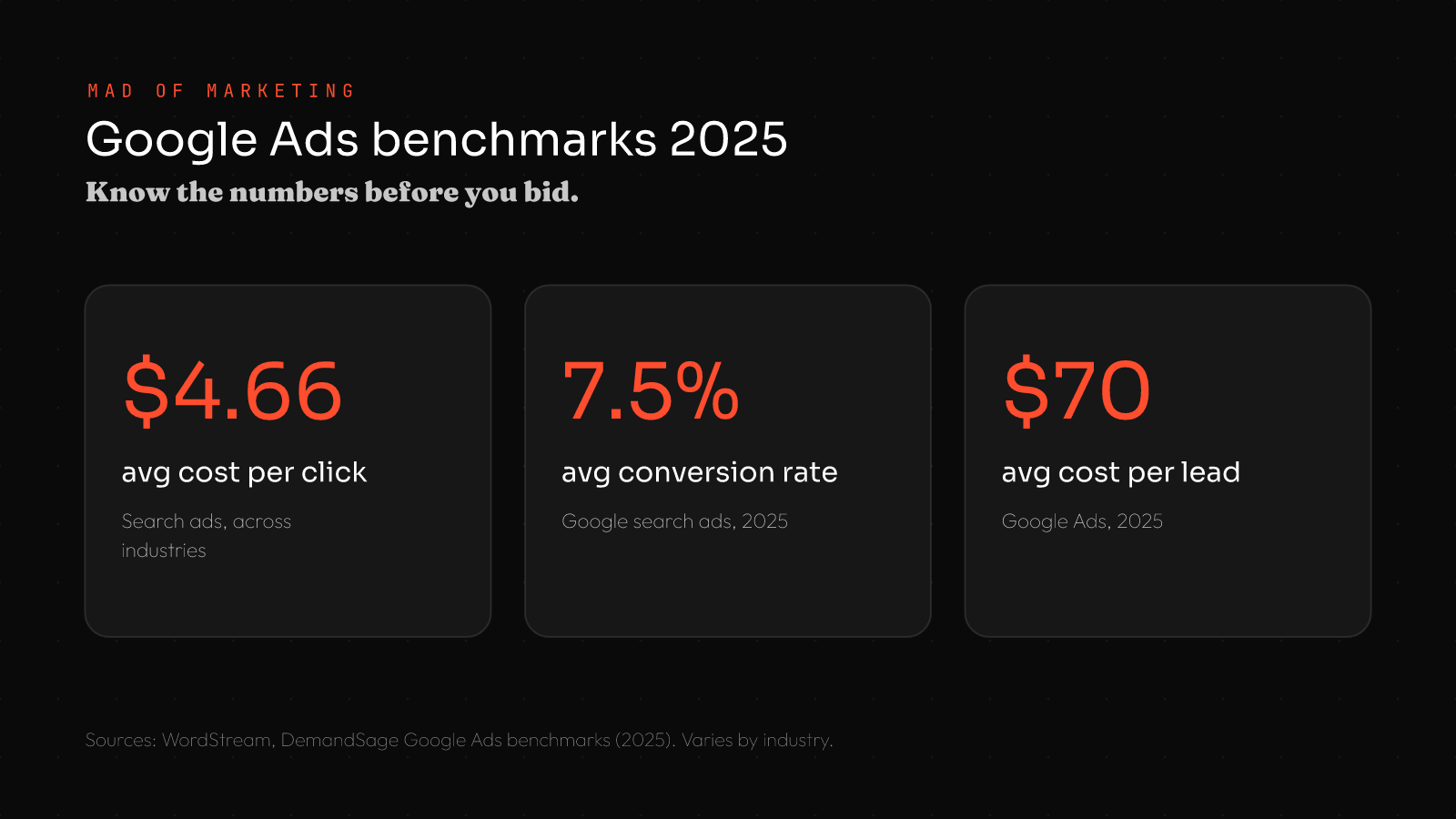
- Cost per click (CPC): averages about $4.66 for search ads, but ranges widely, $1–$4 in many industries, and $20+ in competitive ones like legal and insurance.
- Monthly budget: most small businesses start around $1,000–$2,000/month and scale once they see proven returns.
- Cost per lead: averages roughly $70 on Google Ads, though high-intent local campaigns often beat that.
Remember the management layer too: if an agency runs your ads, expect 10–20% of ad spend on top of the budget itself. For the full picture, see how much digital marketing costs.
Is Google Ads worth it? The benchmarks
The average Google Ads conversion rate sits around 7.5%, and healthy accounts typically see a 2–4× return on ad spend (ROAS), higher in dialed-in local or niche campaigns. Conversion rates swing hugely by industry: automotive repair and pet services convert above 13%, while finance and real estate sit nearer 3%. The takeaway isn’t “ads always work”, it’s that ads work when the intent is high and the setup is tight.
Set up a profitable Google Ads campaign in 5 steps
This is where the money is made or lost. Follow the order.
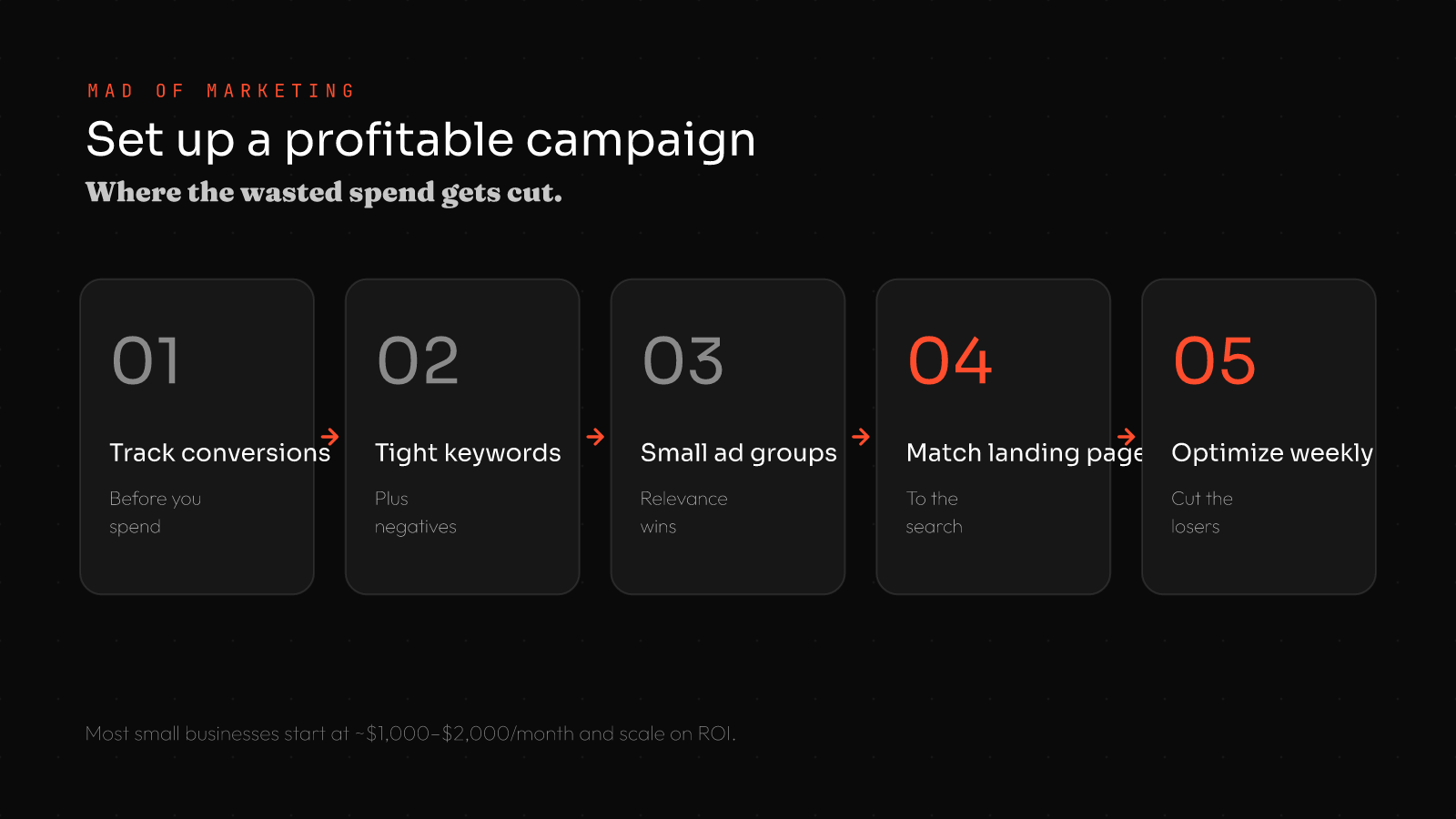
1. Set up conversion tracking first
Before you spend a cent, install conversion tracking so you can see which clicks become calls, forms, or sales. Running ads without it is flying blind, you’ll never know what’s working, which is how budgets quietly evaporate.
2. Choose tight keywords — and negatives
Target specific, high-intent keywords (“[service] in [city]”) rather than broad terms that attract tire-kickers. Just as important, build a negative keyword list to stop paying for irrelevant searches. Negatives are the single biggest lever on wasted spend.
3. Keep ad groups small and relevant
Group a handful of closely related keywords per ad group so your ad copy can match the search precisely. Tighter relevance lifts your Quality Score, which lowers your cost per click.
4. Match the landing page to the ad
The click is only half the battle. Send people to a page that delivers exactly what the ad promised, loads fast on mobile, and has one clear action. A great ad pointing at a weak page is money down the drain, and the most common reason “Google Ads didn’t work.”
5. Optimize every week
Ads aren’t set-and-forget. Review search terms, pause what’s not converting, shift budget to winners, and test new copy. Most profitable campaigns take a few weeks of tuning before they hit their stride.
Google Ads vs SEO: which should a small business choose?
It’s not either/or, they do different jobs. Google Ads buys immediate, controllable traffic but stops when you stop paying. SEO and content are slow to build but compound and keep paying.
The smart play for most small businesses is to use ads for quick wins and high-intent terms while building organic content and local SEO underneath. Ads fund the wait; organic lowers your long-term cost. The economics of both are covered in our guide to digital marketing ROI.
Google Ads campaign types explained
“Google Ads” isn’t one thing, it’s several campaign types, and picking the right one matters as much as the keywords. The main ones for a small business:
- Search. Text ads on the results page when someone searches your keywords. The highest-intent, best-starting-point campaign for most small businesses.
- Performance Max. Google’s automated, all-network campaign. Powerful with good data and conversion tracking, but it gives you less control, better once you’ve proven your offer converts.
- Display. Banner ads across millions of sites. Cheap clicks but low intent, best for retargeting people who already visited, not cold prospecting.
- Shopping. Product listings with images and prices, essential for e-commerce, irrelevant for most service businesses.
- Local Services Ads. The “Google Guaranteed” ads at the very top for local service businesses, where you pay per lead rather than per click. Often the best ROI for trades, clinics, and home services.
For most small businesses we start with Search (and Local Services Ads if eligible), prove it converts, then expand into automated campaigns once there’s enough data to feed them.
Quality Score: how to pay less per click
Here’s the lever most advertisers ignore. Google rewards relevance with a Quality Score (1–10) based on your expected click-through rate, ad relevance, and landing-page experience. A higher Quality Score means you pay less for the same position, sometimes dramatically less than a competitor bidding more. In other words, relevance is a discount.
To lift it: keep ad groups tightly themed, write ads that echo the exact keyword, and send clicks to a fast, on-message landing page. The same discipline that improves conversions also lowers your costs, which is why a well-built account can outperform one with twice the budget. This is the difference good management makes, and it ties straight back to your digital marketing ROI.
Common Google Ads mistakes that waste budget
- No conversion tracking. Spending without knowing what converts. The cardinal sin.
- Broad keywords, no negatives. Paying for clicks that were never going to buy.
- Sending clicks to the homepage. Generic landing pages tank conversion rates.
- Set-and-forget. Letting a campaign run for months without optimization.
- Judging too soon. Killing a campaign in week one before it has data to optimize on.
Setting and pacing your Google Ads budget
Your budget should be driven by goals and economics, not a number plucked from the air. Work backwards: if a customer is worth $1,500, your average cost per lead is $70, and roughly one in three leads closes, each customer costs about $210 in ad spend to acquire, comfortably profitable. That math tells you how much you can confidently spend.
A few pacing rules keep a small-business account healthy. Start with enough budget to gather real data, a trickle of clicks never produces reliable signals, so concentrate spend on a few high-intent keywords rather than spreading thin. Set a daily budget you’re comfortable with and let it run long enough to learn before judging.
And don’t let Google auto-apply every “recommendation”, some genuinely help, others just widen targeting and spend more. The aim isn’t to spend the most; it’s to spend where the return is provable, then scale that. For where ads fit your overall numbers, see how much digital marketing costs.
How to scale a winning campaign
Once a campaign is profitable, the temptation is to crank the budget overnight. Don’t, sudden jumps reset the algorithm’s learning and can spike your costs. Scale deliberately instead:
- Raise budgets gradually — 15–20% at a time, so performance stays stable.
- Expand on proven keywords. Add close variants and new high-intent terms that resemble your winners.
- Reinvest into what converts. Move budget from weak ad groups to strong ones before adding new spend.
- Add campaign types once data is solid. Layer in retargeting or Performance Max only after Search is reliably profitable.
The principle is simple: prove it small, then pour fuel on what’s already working. That’s how Google Ads for small business goes from a test to a dependable, scalable source of customers.
When to manage ads yourself vs hire help
If your budget is small and your market simple, you can absolutely run Google Ads yourself, the fundamentals in this guide will get you a long way, and staying close to the data teaches you a lot about your customers.
Where a specialist earns their fee is in competitive markets, larger budgets, and the ongoing optimization most owners don’t have time for: pruning wasted spend, lifting Quality Score, and testing relentlessly.
A rough rule of thumb, once you’re spending more than a couple of thousand a month, the efficiency a good manager adds usually more than covers their fee. Below that, learn the basics and keep it simple.
Frequently asked questions
How much do Google Ads cost for a small business?
The average cost per click is around $4.66, and most small businesses start with a monthly budget of $1,000–$2,000. Costs vary widely by industry, competitive fields like legal can exceed $20 per click. Add 10–20% of spend if an agency manages the account.
Are Google Ads worth it for small business?
Yes, when the intent is high and the setup is tight. Healthy accounts see a 2–4× return on ad spend and an average conversion rate around 7.5%. The value comes from targeting people actively searching for what you sell.
How long until Google Ads show results?
You can get clicks and leads within days, but expect a few weeks of optimization before the account reaches its best performance. Give a campaign at least 4–6 weeks before judging it.
Should I do Google Ads or SEO first?
If you need leads now, start with Google Ads for immediate, high-intent traffic, and build SEO and content in parallel for compounding, lower-cost results over time. Most successful small businesses run both.
The bottom line on Google Ads for small business
Google Ads for small business is a powerful, fast channel, but only if it’s set up to make money. Track conversions, target tight high-intent keywords, send clicks to a focused landing page, and optimize weekly. Get those right and ads become a dial you can turn up profitably; get them wrong and you’ll fund a lot of clicks that never call.
Want your ads built and managed to actually convert? Book a free strategy call or see our services.