A small business marketing strategy isn’t a binder, it’s a short, written answer to four questions: what’s the goal, who’s the buyer, which two or three channels reach them, and how will you measure it. Businesses with a documented plan are 6.7× more likely to report success. The rest mostly guess.
Here’s the uncomfortable part: 73% of small businesses aren’t even sure their current marketing is working. That’s not a talent problem, it’s a strategy problem. When you don’t decide up front what you’re trying to achieve and how you’ll know if it worked, every tactic feels equally urgent and nothing compounds.
A real small business marketing strategy fixes that. It’s not long, and it’s not complicated. This guide walks through the framework we actually use with clients, part of our broader playbook on digital marketing for small businesses.
Why a small business marketing strategy matters more than tactics
The data here is blunt. Small businesses with a written marketing plan are 6.7 times more likely to report success than those winging it. And yet most operate without one, which is exactly why so many feel busy but stuck.
Strategy beats tactics because it answers the question tactics can’t: should we even be doing this? A viral TikTok idea is a tactic. Whether short-form video is the right way to reach your buyer is strategy. Get the second part wrong and the first part doesn’t matter.

The 5-step small business marketing strategy framework
You can draft this in an afternoon. Each step decides the next, so do them in order.
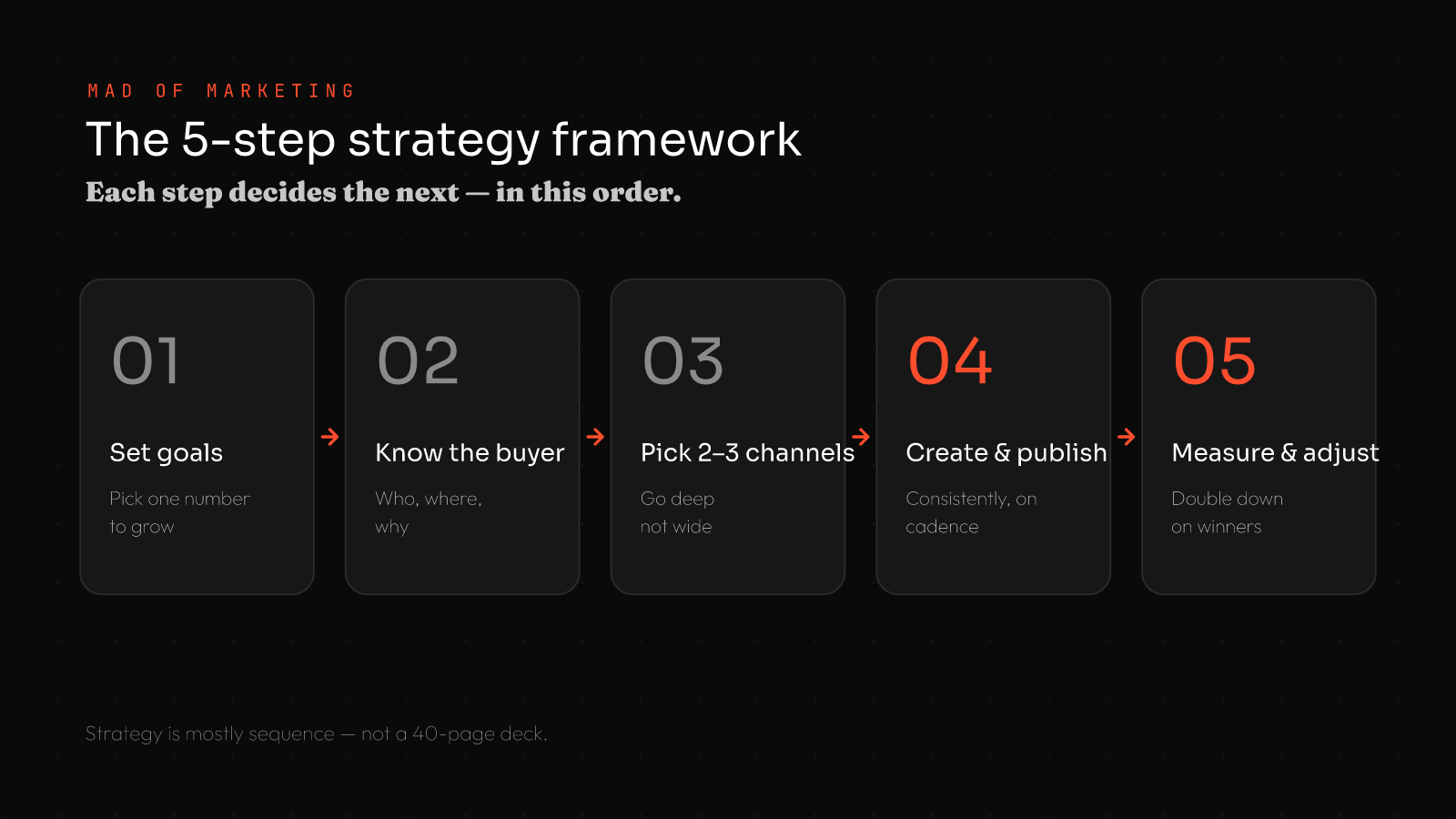
1. Set one clear goal
Pick a single number to move over the next 90 days, qualified leads per month, online sales, booked calls. “More awareness” isn’t a goal; “20 booked demos a month” is. Make it specific and time-bound. For reference, 55.6% of small business owners name increasing sales as their top objective, followed by lead generation (19.2%).
2. Know your buyer
Write down who you’re selling to: their problem, where they spend attention, and what makes them choose. You don’t need a 12-page persona, three honest sentences about your best customer beats a fictional avatar every time.
3. Pick two or three channels, and go deep
This is where most strategies fail. 81% of small businesses now use at least two channels, but using a channel and being good at it are different things. Match channels to your buyer: local service business → local SEO + Google Business Profile; visual/consumer brand → social media; considered B2B purchase → content + email. Two channels done well beat five done badly.
4. Create and publish consistently
Strategy dies without cadence. Decide what you’ll publish and how often, one strong blog post a month, three social posts a week, a monthly email, and protect that schedule. Consistency compounds; sporadic bursts don’t.
5. Measure and adjust
Set up basic tracking before you spend a cent, then review monthly: what’s driving leads, what’s quiet, what to double down on. Marketing without measurement is just spending. (See our guide to digital marketing ROI for the exact metrics to watch.)
Match your strategy to your budget
Strategy and budget aren’t separate conversations. A good plan tells you where the money goes; a realistic budget tells you how ambitious the plan can be.
- Under $1,500/month: One channel, done well. Usually website + local SEO.
- $1,500–$5,000/month: Two to three channels — add content/SEO and email, or managed social.
- $5,000+/month: Coordinated multi-channel with paid amplification and conversion optimization.
For the full breakdown, see how much digital marketing costs.
How to write your strategy on one page
A small business marketing strategy doesn’t need to be long to be effective, it needs to be decided. You can capture the whole thing on a single page with five short answers:
- Goal: “Book 20 qualified calls a month by [date].”
- Buyer: “Homeowners aged 35–60 within 20 miles who need [service] and value reliability over price.”
- Channels: “Local SEO + Google Ads + email.”
- Cadence: “One blog post a month, two Google Business posts a week, one email a fortnight.”
- Measurement: “Track calls and form fills in GA4; review the first Monday of each month.”
If you can fill in those five lines honestly, you’re ahead of the majority of small businesses who never write anything down, and, per the data, far more likely to succeed.
How to set marketing goals that actually work
Vague goals produce vague effort. The fix is to make goals SMART, specific, measurable, achievable, relevant, and time-bound. Compare:
- ❌ “Grow our social media.”
- ✅ “Add 30 qualified email subscribers a month from Instagram by Q3.”
The second version tells you what to do, how you’ll know it worked, and when to check. Tie every goal to a business outcome, revenue, leads, booked jobs, not a vanity metric like follower count. Remember the headline data: 55.6% of owners name increasing sales as their top objective, so most strategies should ladder up to revenue, not reach.
Choosing channels by business type
The “pick two or three channels” advice only helps if you pick the right ones. Match them to how your buyers actually decide:
| Business type | Best-fit channels | Why |
|---|---|---|
| Local service (plumber, clinic, salon) | Local SEO, Google Ads, reviews | High-intent “near me” demand |
| E-commerce / DTC | Paid social, SEO, email | Visual discovery + repeat purchase |
| B2B / professional services | Content, SEO, LinkedIn, email | Long, research-heavy buying cycle |
| Restaurant / hospitality | Instagram, TikTok, local SEO | Visual, impulse, location-driven |
For a deeper look at any of these, see our guides to local SEO and social media marketing.
The monthly marketing review
Strategy isn’t “set once and forget.” The businesses that compound treat it as a living document and run a short monthly review. Thirty minutes, four questions:
- What moved? Which channel drove leads or sales this month?
- What stalled? Where did effort go in without results coming out?
- What did we learn? One insight about the buyer or the message.
- What changes next month? Double down on a winner, cut or fix a loser.
This single habit is what separates a strategy that improves from one that quietly drifts. It’s also where measurement and your digital marketing ROI data turn into actual decisions.
Get your message right before your channels
A common reason a small business marketing strategy underperforms isn’t the channel mix, it’s the message. If a stranger lands on your site or profile, three things need to be obvious in five seconds: what you do, who it’s for, and why you over the alternative. Most small businesses fail that test. They lead with “welcome to our website” instead of the problem they solve.
Before you spend on any channel, nail one clear value proposition and one primary call to action. A sharp message on two channels beats a vague message on five, because every dollar you spend on traffic is wasted if the offer doesn’t land when people arrive.
A 90-day example strategy
Here’s what the framework looks like in practice for a local home-services business starting close to scratch:
- Days 1–30 — Foundation. Define the goal (15 booked jobs/month), tighten the website message, set up GA4 tracking, and fully complete the Google Business Profile.
- Days 31–60 — Activate. Launch local SEO and a small Google Ads budget, start collecting reviews from past customers, and send the first monthly email to existing contacts.
- Days 61–90 — Compound & review. Publish the first cornerstone blog post, double down on whichever channel produced the cheapest leads, and run the first monthly review to decide month-four moves.
Notice it’s sequenced, not simultaneous. Trying to launch everything in week one is exactly how small businesses overwhelm themselves and quit. Build, activate, then compound.
Common small business marketing strategy mistakes
- Chasing tactics with no goal. Jumping on every trend because it’s there, not because it serves the plan.
- Spreading too thin. Five channels at 40% effort lose to two at full strength.
- No measurement. The reason 73% can’t tell if marketing works.
- Quitting early. Killing SEO or content at month three, right before it compounds.
- Set-and-forget. A strategy is a living document, review it monthly, not annually.
Should you build the strategy yourself or get help?
You can absolutely draft a small business marketing strategy yourself, the one-page version above is designed for exactly that, and for many owners it’s the right starting point. Knowing your customer and your numbers better than any outsider is a real advantage.
Where outside help earns its fee is in two places: experience and execution. A seasoned strategist has seen what works across dozens of businesses and can skip you past expensive trial-and-error, which channel fits your model, what a realistic timeline looks like, where budgets get wasted.
And even a great plan fails without consistent execution, which is usually what owners run out of time for. A useful middle path: set the strategy yourself, then bring in help for the channels you can’t sustain. The plan stays yours; the heavy lifting gets done.
Frequently asked questions
What is a small business marketing strategy?
It’s a short, written plan that defines your goal, your target customer, the two or three channels you’ll use to reach them, and how you’ll measure results. It turns scattered tactics into a system that compounds.
How do I create a marketing strategy with a small budget?
Start with one goal and one or two channels you can execute consistently, typically a solid website plus local SEO. Add channels only as revenue grows. Focus beats breadth on a small budget.
What should a small business marketing strategy include?
Four things: a specific, time-bound goal; a clear picture of your buyer; two or three chosen channels with a publishing cadence; and a simple measurement plan you review monthly.
How long before a marketing strategy shows results?
Paid channels can move in weeks; SEO and content typically take 3–6 months to build momentum, then compound. Give the plan at least 90 days before judging it.
The bottom line on your small business marketing strategy
A small business marketing strategy is the difference between busy and effective. Decide the goal, know the buyer, pick a few channels, publish consistently, and measure, that’s the whole game. The owners who write it down are nearly seven times more likely to win, and it costs nothing but an afternoon.
Want a strategist to build that plan with you? Book a free strategy call or explore our services, we’ll map a strategy to your goals and budget.