A marketing plan for a small business isn’t a 40-page document it’s a one-page answer to five questions: what’s the goal, who’s the customer, which channels reach them, what’s the budget and who does the work, and how will you measure it. Businesses with a documented plan are 6.7× more likely to report success, yet most operate without one.
The phrase “marketing plan” scares small business owners into thinking they need a huge, formal document. They don’t. A marketing plan is simply a written decision about what you’re going to do and why and writing it down is exactly what separates businesses that grow deliberately from those that spend on whatever feels urgent that week. This guide shows you how to write a marketing plan for a small business you’ll actually use, in five simple parts.
This guide is part of our wider playbook on digital marketing for small businesses and a practical companion to our marketing strategy guide.
Why you need a marketing plan
The case for writing it down is backed by data:
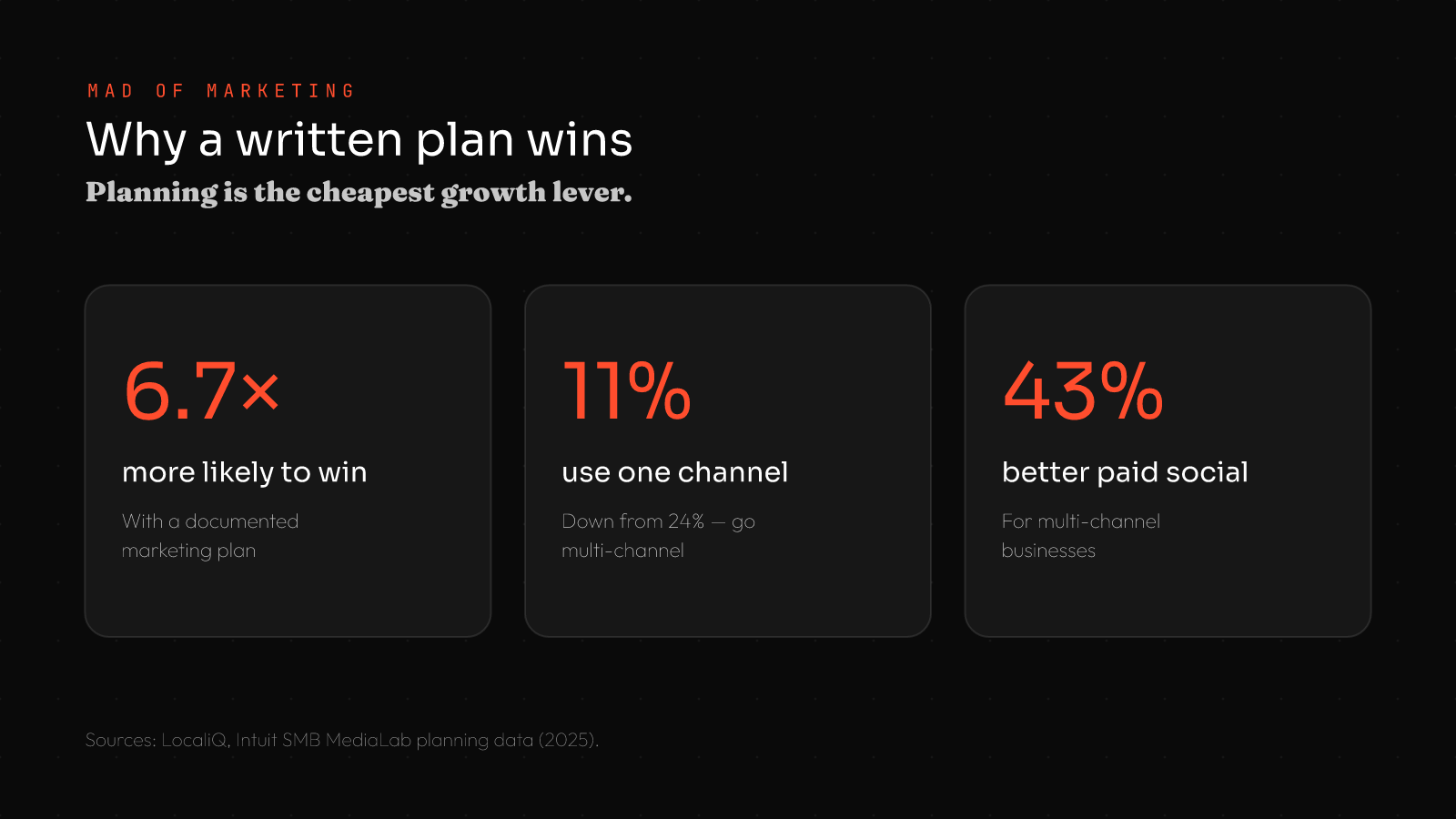
- Planning drives success: Businesses with a documented marketing plan are 6.7× more likely to report success than those without one.
- Multi-channel wins: Only 11% of SMBs now rely on a single channel (down from 24%), and multi-channel businesses perform 43% better in paid social and 21% better in search.
- Focus is scarce: With 56% of owners having an hour or less a day for marketing, a plan ensures that limited time goes to what matters.
A plan turns scattered effort into a system. Without one, every tactic feels equally urgent and nothing compounds; with one, you know exactly where your time and money should go.
How to write a marketing plan in 5 parts
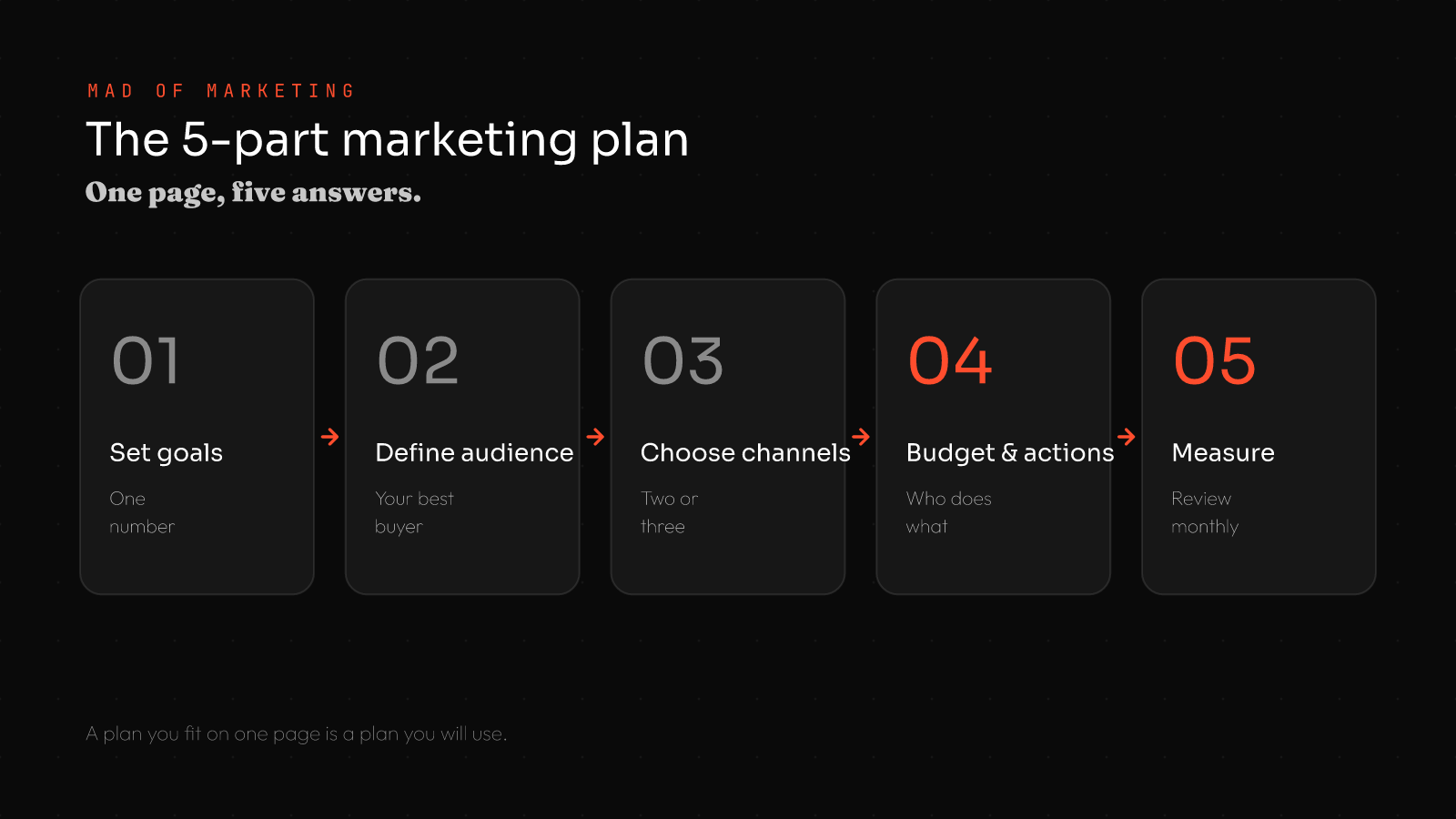
You can draft this on a single page in an afternoon. Each part answers one question.
1. Set your goals
Start with what you want to achieve, made specific and time-bound. “Get more customers” is a wish; “book 20 new consultations a month by June” is a goal. Pick one or two clear, measurable objectives tied to business outcomes revenue, leads, bookings and everything else in the plan will serve them.
2. Define your target audience
Write down exactly who you’re marketing to: their problem, where they spend attention, and what makes them choose. You don’t need a formal persona three honest sentences about your ideal customer beats a fictional avatar. Knowing your audience decides every other choice in the plan.
3. Choose your channels
Based on your goals and audience, pick the two or three channels you’ll focus on not every channel available. A local service business might choose local SEO and Google Ads; a B2B firm might choose LinkedIn and email. Going deep on a few beats spreading thin across many.
4. Set your budget and actions
Decide how much you’ll invest (a common benchmark is 5–10% of revenue), how it’s split across your chosen channels, and crucially who does what and when. Turn the plan into concrete actions: what you’ll publish, how often, and who’s responsible. A plan without actions is just a wish list.
5. Decide how you’ll measure success
Define the metrics that tell you whether the plan is working leads, sales, traffic, cost per customer and commit to reviewing them regularly (monthly is ideal). Set up basic tracking before you start. What gets measured gets improved.
A one-page marketing plan template
Here’s the whole thing you can fill in right now:
- Goal: “[Specific, measurable, time-bound objective].”
- Target audience: “[Who they are, their problem, where to reach them].”
- Channels: “[The 2–3 channels you’ll focus on].”
- Budget & actions: “[How much, split how, who does what and when].”
- Cadence: “[What you’ll publish/do, and how often].”
- Measurement: “[The metrics you’ll track and when you’ll review them].”
If you can fill in those six lines honestly, you have a real marketing plan and you’re already ahead of most small businesses.
Keep your plan alive
The biggest mistake with marketing plans is treating them as a one-time document that gets written, filed, and forgotten. A plan is only useful if it guides your actions and evolves with results. Build in a simple monthly review: half an hour to look at what’s working, what isn’t, what you learned about your customers, and what to adjust next month. Double down on the channels producing results and cut or fix the ones that aren’t.
Markets, competitors, and your own business change, so your plan should be a living document you revisit and refine, not a static one. This habit of regular review is what turns a plan from a nice idea into a system that compounds and it’s exactly where a good measurement and ROI process pays off.
An example marketing plan
To make it concrete, here’s what a filled-in one-page plan might look like for a local home-cleaning business.
Goal: “Book 25 new recurring clients in the next 90 days.”
Target audience: “Busy dual-income households aged 30–55 within 15 miles who value reliability and want to reclaim their weekends.”
Channels: “Local SEO and Google Business Profile, Google Ads for ‘house cleaning near me,’ and email for follow-up.”
Budget & actions: “$1,500/month — $800 to Google Ads, the rest to content and email; owner handles the profile and reviews, a freelancer writes two blog posts a month.”
Cadence: “Two blog posts and four Google Business posts a month, one email a fortnight.”
Measurement: “Track calls and form fills in GA4; review the first Monday of each month.”
That’s a complete, actionable marketing plan on a single page specific enough to guide daily decisions, short enough to actually use.
Notice how each part builds on the last: the audience shapes the channels, the channels shape the budget, and the measurement keeps it all honest. Your plan will look different, but the structure is the same.
Marketing plan vs marketing strategy
People often use these terms interchangeably, but they’re different and complementary. Your marketing strategy is the high-level thinking who you serve, how you’re positioned, and why customers should choose you. Your marketing plan is the practical execution the specific goals, channels, budget, actions, and timeline that put the strategy into motion.
Think of the strategy as the destination and direction, and the plan as the turn-by-turn route. You need both: a plan without a strategy is busy activity with no clear direction, while a strategy without a plan is a good idea that never gets executed.
In practice, define your strategy first your positioning and audience then write the plan that brings it to life. For a small business, both can be short; what matters is that the plan clearly serves the strategy, and that you actually act on it.
Tools to build and track your plan
You don’t need expensive software to create or run a marketing plan simple, free tools cover everything a small business needs. To write the plan, a basic document or spreadsheet is all it takes; the value is in the thinking, not the format. To track your goals and metrics, Google Analytics 4 and Google Search Console (both free) show you traffic, conversions, and search performance, while a simple spreadsheet can log leads, sales, and cost per customer month to month.
To manage your actions and cadence, a free content calendar or task tool keeps you on schedule and accountable. To keep the plan visible, put it somewhere you’ll actually see it a shared doc, a printed page on the wall because a plan out of sight is a plan out of mind.
The goal isn’t sophisticated tooling; it’s a plan you can write quickly, act on daily, and review easily. Start with free tools, and only add paid software once you have a clear reason. What matters is that the plan gets used and updated, not the tools you use to build it.
Common marketing plan mistakes
- Making it too long: A 40-page plan nobody reads beats no plan but a one-page plan you use beats both.
- Vague goals: “More sales” instead of a specific, measurable target.
- Too many channels: Trying to do everything instead of focusing on a few.
- No budget or actions: A plan with no numbers or owners never gets executed.
- No measurement: Not defining how you’ll know if it’s working.
- Set and forget: Writing it once and never reviewing or updating it.
Frequently asked questions
How do I write a marketing plan for a small business?
Answer five questions in writing: what’s your goal, who’s your target audience, which two or three channels will you use, what’s your budget and who does what, and how will you measure success. You can fit the whole plan on a single page and draft it in an afternoon.
What should a small business marketing plan include?
A specific, measurable goal; a clear description of your target audience; the two or three channels you’ll focus on; a budget with concrete actions and owners; and a measurement plan you review regularly. Keep it short enough that you’ll actually use it.
How long should a marketing plan be?
For most small businesses, one page is ideal. The goal isn’t length it’s clarity. A concise plan you refer to and act on is far more valuable than a long, detailed document that sits in a drawer.
How often should I update my marketing plan?
Review it monthly to check progress and adjust, and revisit the whole plan quarterly or when something significant changes. A marketing plan is a living document, not a one-time exercise regular review is what makes it work.
What’s the difference between a marketing plan and a marketing strategy?
Your strategy is the high-level thinking who you serve, your positioning, and why customers choose you. Your plan is the practical execution the goals, channels, budget, actions, and timeline that put the strategy into motion. Define the strategy first, then write the plan that brings it to life.
The bottom line on how to write a marketing plan for a small business
Writing a marketing plan for a small business is simpler than it sounds: answer five questions goal, audience, channels, budget and actions, and measurement on a single page, then review it monthly and adjust. Keep it short enough to actually use, focus on a few channels, and treat it as a living document. Do that and you’ll join the businesses that are nearly seven times more likely to succeed for the cost of an afternoon.
Want a strategist to build your marketing plan with you? Book a free strategy call or explore our services.
Sources: LocaliQ, Intuit SMB MediaLab small business marketing statistics (2025). Figures are industry averages and vary by source.