To advertise a small business effectively, set a clear goal and budget, target the right audience, choose channels that fit your buyer, lead with a strong offer, and track every dollar. Small businesses earn about $5 for every $1 on social ads, 83% use Facebook, and advertising makes up around 37% of the average marketing budget. The winners aren’t the biggest spenders they’re the ones who measure.
Advertising can feel like gambling pour money in and hope customers come out. But done right, it’s the opposite: a measurable, controllable way to put your business in front of the right people and turn spend into customers on demand.
The key is knowing how to advertise a small business strategically rather than throwing money at whatever’s in front of you. This guide covers the exact steps, channels, and mistakes to avoid.
This guide is part of our wider playbook on digital marketing for small businesses. Here we focus on advertising.
Small business advertising in 2025: the landscape
A quick picture of where things stand helps you spend smarter:
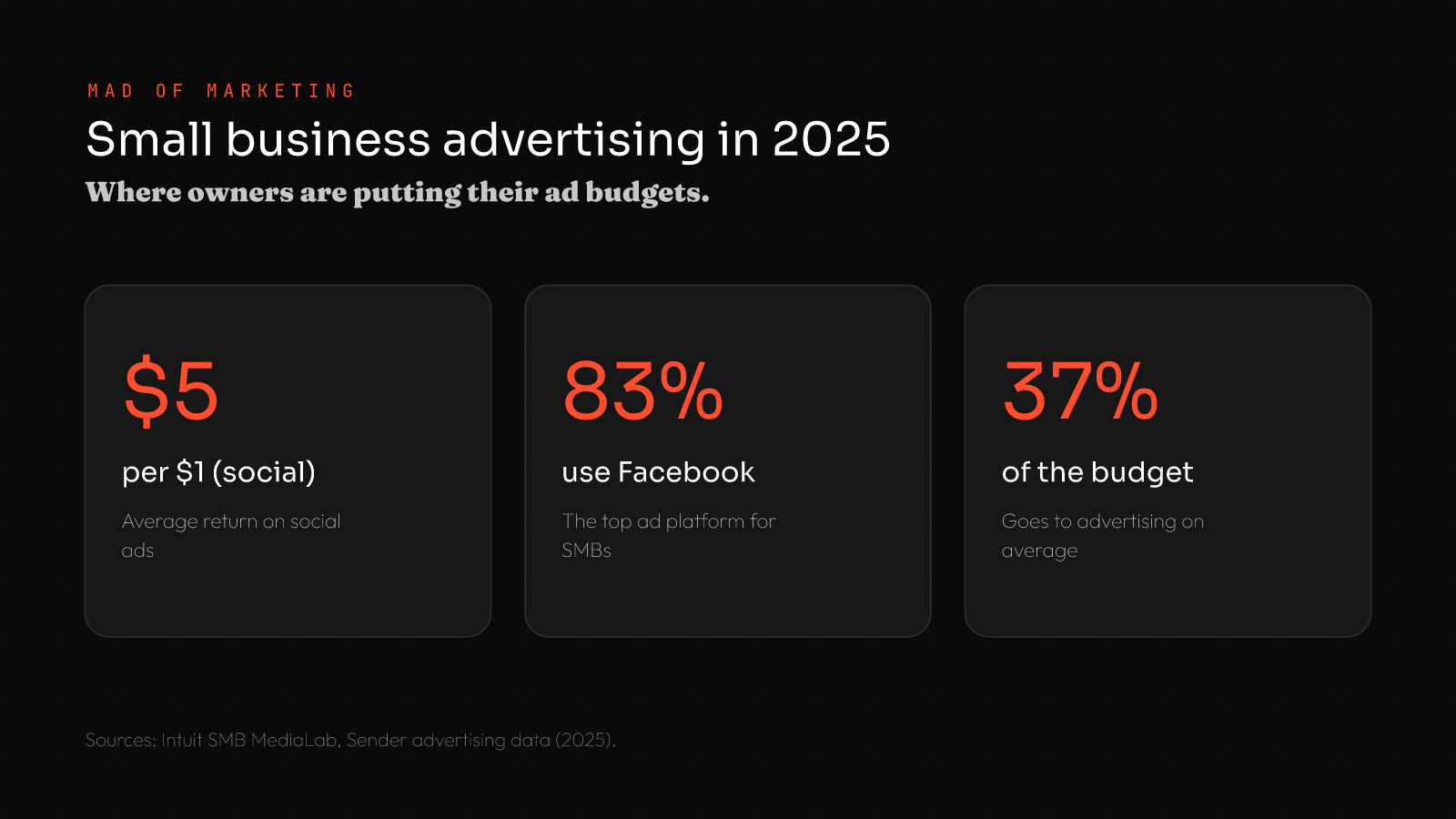
- Social leads the way: 83% of small businesses use Facebook and 60% use Instagram; social is the top advertising priority for those increasing spend.
- Ads are a big slice: Advertising makes up around 37% of the average marketing budget, and 92% of small businesses plan to maintain or increase ad spend.
- Returns are solid: Small businesses see an average of about $5 back per $1 spent on social advertising, and far more on channels like email.
- Multi-channel wins: Only 11% of SMBs now rely on a single channel (down from 24%), because multi-channel advertisers consistently outperform.
How to advertise a small business in 5 steps
Advertising works when it’s strategic. Follow this order and you’ll spend where it counts.
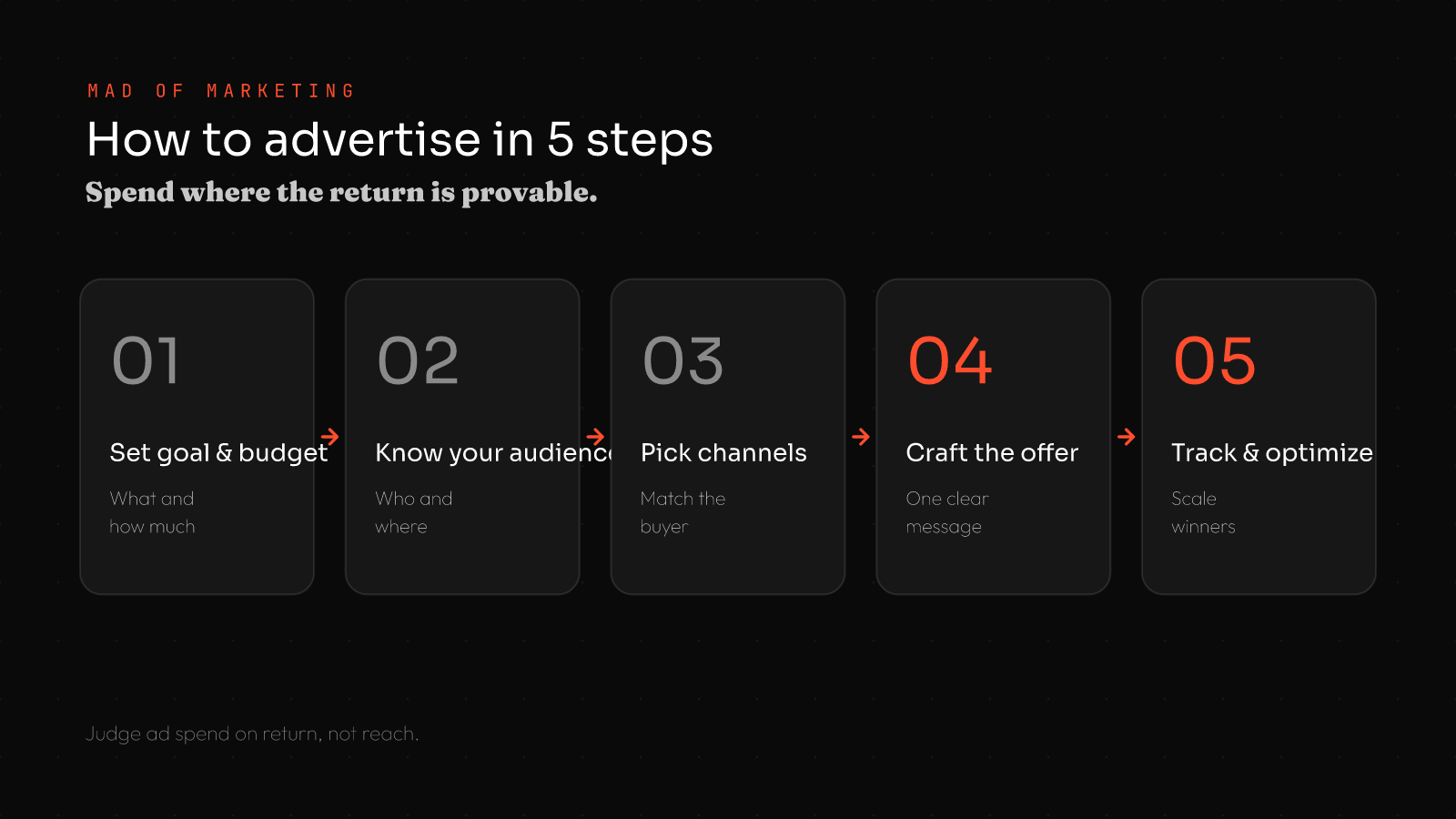
1. Set a clear goal and budget
Decide what you want the advertising to achieve leads, sales, bookings, awareness and how much you can invest. Work backwards from value: if a customer is worth $500 and you want ten more a month, you have a budget that pays for itself. A goal without a number is a wish; a goal with a budget is a plan.
2. Know your audience
Great advertising starts with knowing exactly who you’re trying to reach their age, location, interests, and the problem you solve for them. The more specific you are, the more precisely you can target and the less money you waste showing ads to people who’ll never buy.
3. Pick the right channels
Match channels to where your buyers are and how they buy. Google Ads catch people actively searching; Facebook and Instagram ads create demand and target precisely; local businesses lean on Google and local channels. Don’t advertise everywhere pick the two or three that fit your business.
4. Craft a compelling offer
Your ad has seconds to earn attention, so lead with one clear benefit and a strong reason to act now a discount, a free consultation, a limited offer. Pair it with attention-grabbing creative and send clicks to a focused landing page, not your homepage. A great offer on the wrong page still fails.
5. Track and optimize
This is what separates profitable advertising from wasted spend. Set up conversion tracking before you spend, watch which ads and channels actually produce customers, cut what doesn’t work, and put more budget behind winners. Advertising is a dial you tune, not a switch you flip.
The main advertising channels for small businesses
Here’s a quick rundown of your options and what each is best for:
- Google Ads (search): Best for capturing existing demand people searching for what you sell, with high intent.
- Facebook & Instagram ads: Best for creating demand and precise targeting, at a low cost per lead. (See Instagram marketing.)
- YouTube ads: Great for awareness and retargeting with video. (See YouTube marketing.)
- Local advertising: Local directories, sponsorships, and community channels for local reach.
- Email & SMS: Technically owned channels, but the highest-ROI “advertising” you can do to an existing audience.
- Traditional (radio, print): Still useful for some local audiences, though harder to measure.
How much should a small business spend on advertising?
There’s no single right number, but useful benchmarks help. Marketing overall typically runs 5–10% of revenue, and advertising makes up roughly a third of that. In practice, many small businesses start advertising with a few hundred dollars a month and scale as they see returns you can launch Facebook ads for $5–$10 a day and Google Ads on a modest budget.
The smartest approach isn’t to guess a number it’s to start with an amount you can afford to test, measure the return closely, and scale spend on whatever proves profitable. Let the results, not a fixed budget, decide how much you spend. For the full picture, see how much digital marketing costs.
Paid ads vs organic marketing
Advertising delivers speed; organic delivers staying power and you want both. Paid advertising puts you in front of customers immediately and predictably, which is ideal when you need results now or want to scale. But it stops the moment you stop paying. Organic marketing SEO, content, social, and referrals takes longer to build but compounds and keeps working for free.
The best strategy for most small businesses combines them: use advertising to drive immediate customers and test what resonates, while building organic channels that lower your long-term costs. As your organic presence grows, you rely less on paid but advertising remains the fastest lever when you need to grow quickly.
How to create ads that actually convert
The channel and budget matter, but the ad itself often decides whether you win or waste money. Strong small-business ads share a few traits. A clear, single message one benefit, not five, so people instantly grasp what’s in it for them.
An attention-grabbing hook the first line or image has to stop the scroll, whether that’s a bold statement, a question, or the problem you solve. A specific offer “20% off your first visit” or “free consultation” beats a vague “check us out.” Social proof a quick review or result builds instant trust. A clear call to action tell people exactly what to do next.
And crucially, a matching landing page send clicks to a focused page that delivers what the ad promised, loads fast on mobile, and makes the next step obvious. A brilliant ad pointing at a weak page is money down the drain, which is why the ad and the destination have to work as a pair. Test different versions, keep what performs, and your cost per customer steadily falls.
Advertising for local businesses
If you serve a local area, your advertising strategy looks a little different and often cheaper and more effective. Start with the basics that dominate local intent: a fully optimized Google Business Profile and strong local SEO, which capture the high-intent “near me” searches that convert fast.
Layer in local Google Ads targeting your service area, and Facebook or Instagram ads with tight geographic targeting to reach nearby customers. Local businesses also benefit from community-level advertising sponsoring a local event, partnering with nearby complementary businesses, or advertising in community groups and publications.
Because you’re targeting a smaller, specific area, local advertising budgets go further, and the customers you reach are close enough to actually visit or hire you. The winning local formula is usually a complete Google presence plus a modest, tightly-targeted paid budget reaching ready-to-buy customers in your area without wasting spend on people too far away to become customers.
Common small business advertising mistakes
- No conversion tracking: Spending without knowing what works — the cardinal sin.
- Targeting too broad: Wasting budget on people who’ll never buy.
- Weak offer or creative: Ads that don’t earn attention or give a reason to act.
- Sending clicks to the homepage: Generic pages that don’t match the ad and kill conversions.
- Quitting too soon: Pulling ads before they’ve gathered data to optimize.
- Advertising everywhere: Spreading a small budget too thin instead of focusing.
Frequently asked questions
How do I advertise my small business?
Set a clear goal and budget, define your target audience, choose channels that fit your buyers (like Google or Facebook ads), lead with a strong offer, and track results so you can optimize. Focus your budget on the two or three channels that work best rather than advertising everywhere.
What is the best way to advertise a small business?
It depends on your business, but for most, a mix of Google Ads (to capture people searching) and Facebook or Instagram ads (to create demand and target precisely) works well. The “best” channel is the one where your customers are and where you can measure a clear return.
How much does it cost to advertise a small business?
Many small businesses start with a few hundred dollars a month Facebook ads run from $5–$10 a day and Google Ads work on modest budgets. Advertising is typically about a third of a marketing budget of 5–10% of revenue. Start small, measure, and scale what works.
Is advertising worth it for a small business?
Yes, when it’s measured. Small businesses see around $5 back per $1 on social ads and far more on channels like email. Advertising becomes a problem only when you spend without tracking what each channel returns.
How can I advertise my business for free?
While paid ads cost money, you can promote your business at no cost through your Google Business Profile, organic social media, helpful content and SEO, local directories, and referrals. These free channels take effort rather than budget, and they complement paid advertising by building a foundation that lowers your long-term costs.
Where should a small business advertise?
Advertise where your customers are. For most, that means Google Ads to capture people searching, and Facebook or Instagram ads to create demand and target precisely with local businesses also leaning on their Google Business Profile. Start with the one or two platforms that best fit your buyers, measure results, and expand from there.
The bottom line on how to advertise a small business
Advertising a small business isn’t gambling it’s a measurable system. Set a clear goal and budget, target the right audience, pick channels that fit your buyer, lead with a strong offer, and track every dollar so you can scale what works.
Combine paid ads for speed with organic marketing for staying power, avoid the common mistakes, and advertising becomes a reliable, profitable engine for growth.
Want your advertising set up and managed to actually convert? Book a free strategy call or explore our services.
Sources: Intuit SMB MediaLab, Sender small business advertising statistics (2025). Figures are industry averages and vary by source.