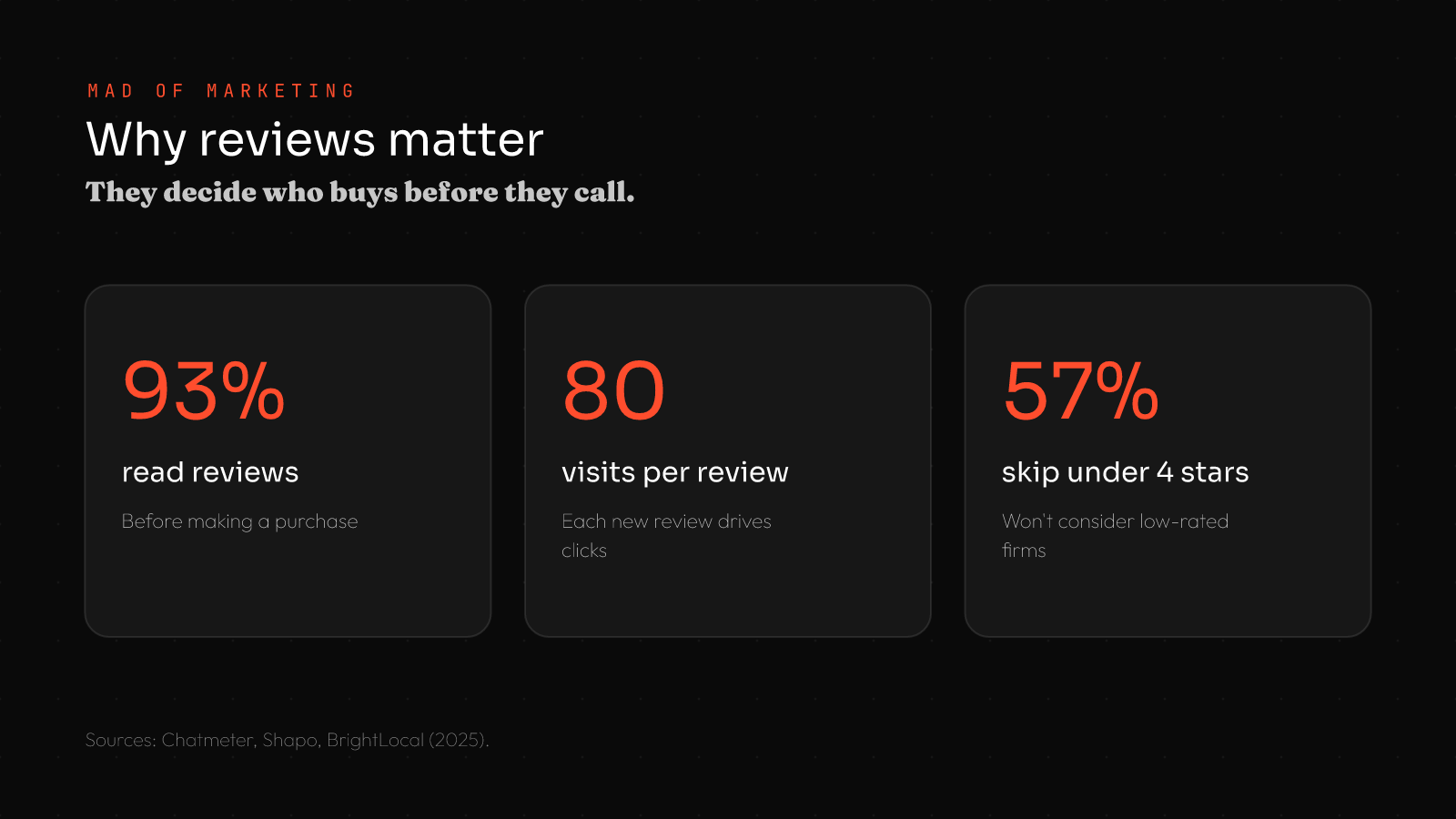
The fastest way to get more Google reviews is simple: ask every happy customer, make it one tap with a direct link, and time the ask for the moment they’re happiest. Reviews are worth the effort 93% of consumers read them before buying, each new review can drive around 80 website visits, and 57% of consumers won’t consider a business rated under 4 stars.
Google reviews are the modern word of mouth and one of the biggest factors in whether a customer chooses you or a competitor. They build trust, improve your local rankings, and drive real traffic and sales. Yet most small businesses have far fewer than they could, simply because they don’t ask. The good news: getting more Google reviews isn’t complicated. This guide shows you exactly how to get more Google reviews, consistently and the right way.
This guide is part of our wider playbook on digital marketing for small businesses and a companion to our guides on Google Business Profile optimization and reputation management.
Why Google reviews matter so much
The impact of reviews on your business is hard to overstate:
- They drive decisions: 93% of consumers read online reviews before making a purchase, and 81% use Google reviews to evaluate local businesses.
- They drive traffic: Each additional Google review can generate around 80 website visits, 63 direction requests, and 16 calls.
- Ratings are a filter: 57% of consumers won’t consider a business rated below 4 stars reviews decide whether you’re even in the running.
- They boost rankings: Reviews are a meaningful local search ranking factor, helping you appear in the map pack.
How to get more Google reviews in 5 steps
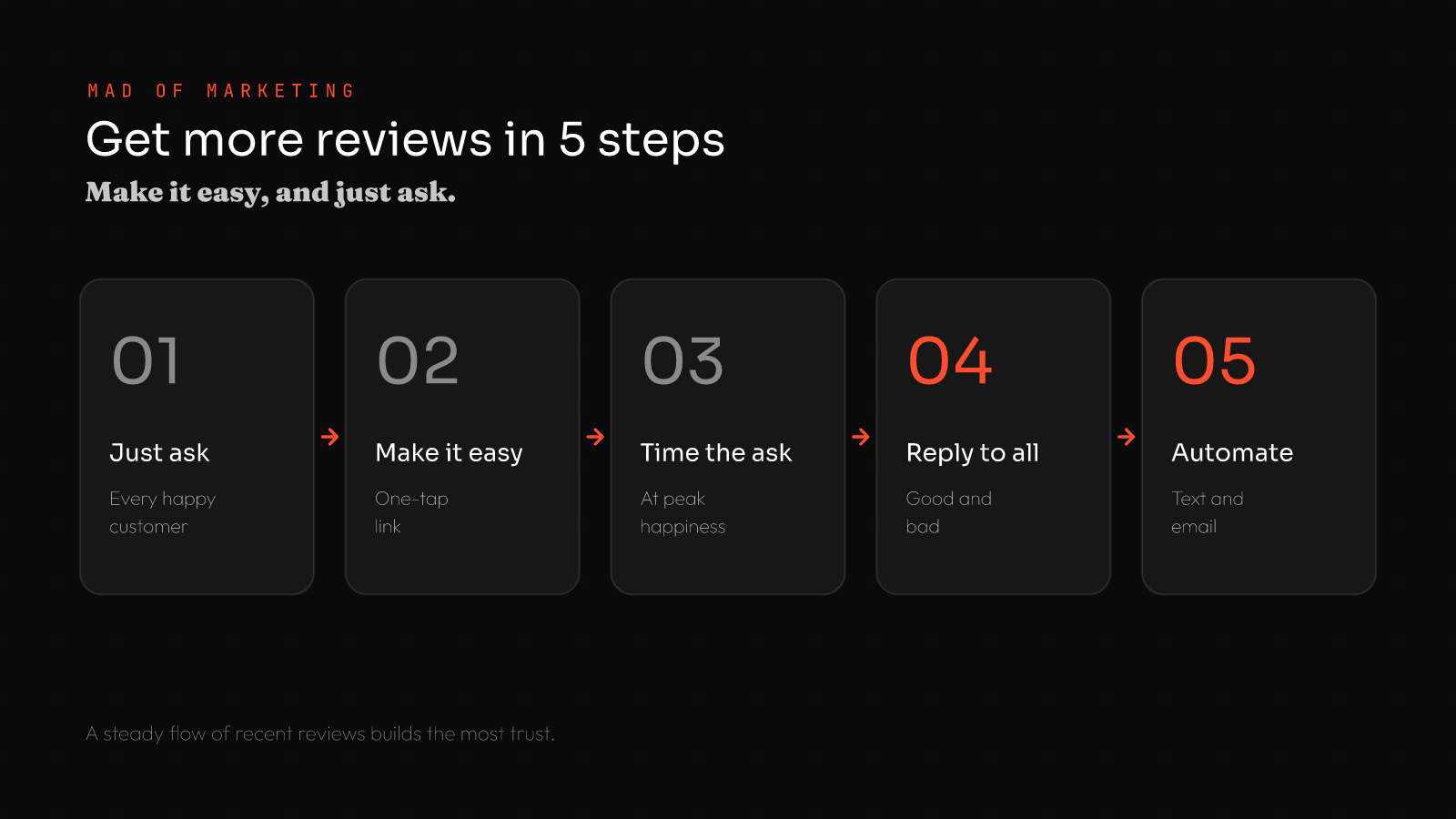
The whole strategy comes down to making it easy and simply asking. Here’s the process.
1. Just ask every happy customer
The number one reason businesses don’t have more reviews is that they don’t ask. Most satisfied customers are happy to leave a review, but they won’t think to unless prompted. Make asking a standard part of your process after every positive experience, and your review count will climb.
2. Make it effortless with a direct link
Every extra step loses reviews. Create your Google review short link and share it directly by text, email, receipt, or QR code so customers land straight on the review screen. The easier you make it, the more reviews you get. Reduce it to a single tap.
3. Time the ask for peak happiness
Timing matters. Ask when the customer is happiest right after a successful job, a great meal, a delivered result, or a positive interaction. A well-timed request at the moment of satisfaction converts far better than one sent days later.
4. Respond to every review
Replying to reviews encourages more of them and shows customers (and Google) you’re engaged. Thank positive reviewers warmly and respond to negative ones calmly and helpfully. Businesses that respond to reviews earn more revenue on average, and active engagement supports your rankings.
5. Automate your review requests
To get reviews consistently, build the ask into an automated system. Use email or SMS to automatically send a review request after each purchase or service. Automation turns reviews from an occasional afterthought into a steady, reliable stream.
Simple ways to make asking easier
The more channels and moments you use to ask, the more reviews you collect. Practical tactics:
- Text the link: A short, friendly SMS with your review link gets high response rates.
- Email after purchase: Include the review link in your follow-up or thank-you email.
- Add a QR code: On receipts, table cards, packaging, or in-store signage for instant access.
- Ask in person: A genuine verbal request at checkout, followed by the link, works well.
- Put it on your website: A “Leave us a review” button makes it easy for repeat visitors.
- Include it in your signature: Add the link to email signatures and social bios.
What you can’t do (Google’s rules)
Getting more reviews is about earning them, not gaming them and it’s important to stay within Google’s guidelines. Never buy fake reviews or post reviews of your own business; Google detects and penalizes this, and customers can usually tell.
Don’t offer incentives in exchange for reviews (like a discount for a 5-star rating) Google prohibits it, and it undermines trust. Don’t “review-gate” by only asking happy customers privately while filtering out unhappy ones; asking all customers is both fairer and compliant. The right approach is simple and sustainable: deliver a great experience, ask everyone, and make it easy.
A steady stream of genuine, recent reviews builds far more trust than a pile of suspicious perfect ones and 73% of consumers trust recent reviews most, so consistency beats a one-time push.
How to handle negative reviews
More reviews inevitably means the occasional negative one and that’s fine. A business with only flawless 5-star reviews actually looks suspicious; a few honest critical reviews make the positive ones credible. When you get a negative review, respond promptly and publicly, stay calm and professional, acknowledge the concern, and offer to make it right.
Prospects reading your response care more about how you handle problems than about the complaint itself. Keep earning fresh positive reviews and the occasional negative one gets outweighed naturally. Handled well, negative reviews become a chance to show your professionalism to everyone watching.
How reviews help you rank and get found
Getting more Google reviews doesn’t just build trust it directly helps you get found. Reviews are a meaningful factor in local search rankings, influencing whether you appear in Google’s local “map pack” the three businesses shown at the top of local results.
Google looks at your quantity of reviews, your average rating, the recency of reviews, and how you respond to them. A business with plenty of recent, positive, responded-to reviews sends strong signals that it’s active, trusted, and relevant exactly what Google wants to surface.
This creates a virtuous cycle: more reviews improve your ranking, a better ranking means more people see your profile, and more visibility leads to more customers who can leave even more reviews.
That’s why review generation is one of the highest-leverage things a local business can do it improves trust and visibility at the same time, and both compound. Pair a steady review flow with a fully optimized Google Business Profile, and you give yourself the best possible chance of winning the map pack in your area.
Turn your reviews into marketing
Once you’re collecting reviews, don’t let them sit only on Google put them to work across your marketing.
Your best reviews are powerful social proof you can reuse everywhere: feature them on your website, especially near calls to action where they reassure hesitant visitors; share standout reviews as social media posts; include them in email campaigns; and use them in ads, where genuine customer quotes lift trust and conversions.
A glowing review is a testimonial you didn’t have to write, from a voice customers trust more than your own. By amplifying your reviews beyond Google, you extend their impact and get more marketing value from every one you earn. This turns review generation from a local-SEO task into a broader trust-building engine that strengthens your reputation across every channel.
Common mistakes when getting reviews
- Not asking: The biggest reason businesses have too few reviews.
- Making it hard: Not providing a direct link, so customers give up.
- Asking at the wrong time: Long after the experience, when enthusiasm has faded.
- Buying fake reviews: Against Google’s rules and obvious to customers.
- Ignoring reviews: Never responding, which discourages more and hurts rankings.
- Asking once and stopping: Reviews need a steady, ongoing flow to stay recent and trusted.
Tools to automate review requests
Getting reviews consistently is much easier when the asking runs on autopilot rather than depending on you remembering. A range of tools can help.Your Google Business Profile provides a free, shareable review link and a QR code you can print anywhere.
Email and SMS platforms let you set up automated follow-up messages that send a review request a day or two after each purchase or service the single most effective way to keep reviews flowing. Dedicated review management tools go further, automatically requesting reviews, centralizing them from multiple sites, and alerting you to new ones so you can respond quickly.
You don’t need to invest in expensive software to start: a simple automated email or text after each sale, with your Google review link, covers the essentials and costs almost nothing. As your volume grows, dedicated tools save time and ensure no opportunity slips through.
The goal either way is the same turn review requests from an occasional, easy-to-forget task into a reliable, automated system that steadily grows your review count without ongoing effort from you.
Frequently asked questions
How do I get more Google reviews?
Ask every happy customer, make it one tap with a direct review link, time the ask for the moment they’re happiest, respond to every review, and automate requests via email or SMS. Consistently asking is the single biggest driver of more reviews.
Can I offer a discount for a Google review?
No, Google prohibits incentivizing reviews, and it undermines trust. You can ask everyone and make it easy, but the review itself must be given freely without a reward attached to it.
How many Google reviews should a business have?
More is better, but recency and staying above 4 stars matter most 57% of consumers avoid businesses below 4 stars, and most trust recent reviews more. Aim for a steady, ongoing flow rather than a one-time burst.
Should I respond to negative reviews?
Yes, always. Respond promptly, calmly, and professionally, acknowledge the concern, and offer to make it right. Prospects judge you on how you handle problems, and responding also supports your local rankings.
How do I get my Google review link to share?
You can generate a direct review link and a QR code from within your Google Business Profile dashboard look for the “Ask for reviews” or “Get more reviews” option. Share that link by text, email, receipt, or signage so customers land straight on the review screen in one tap.
The bottom line on how to get more Google reviews
Getting more Google reviews comes down to a simple, repeatable habit: ask every happy customer, make it effortless with a direct link, time it for peak satisfaction, respond to every review, and automate the process. Stay within Google’s rules, handle the occasional negative review gracefully, and keep the flow steady. Do that and your review count and the trust, traffic, and rankings that come with it will grow steadily.
Want help building a review and reputation system that runs itself? Book a free strategy call or explore our services.
Sources: Chatmeter, Shapo, BrightLocal Google review statistics (2025). Figures are industry averages and vary by source.