YouTube marketing for small business is a rare opportunity: it reaches 2.5 billion users, doubles as the world’s second-largest search engine, and 90% of marketers use it yet only about 9% of small businesses do. That gap is your opening. Post helpful, searchable video consistently and you build an asset that keeps earning views and customers for years.
Most small businesses treat YouTube as “too much effort” and leave it to big brands. That’s exactly why it’s such an opportunity. Unlike a social feed where posts vanish in hours, a YouTube video keeps getting found through search months and years after you upload it and with so few small businesses bothering, the competition for local and niche topics is thin.
YouTube marketing for small business isn’t about going viral; it’s about answering the questions your customers are already searching and being there when they do.
This guide is part of our wider playbook on digital marketing for small businesses, and a companion to our video marketing guide. Here we focus on YouTube.
What is YouTube marketing for small business?
YouTube marketing for small business is using YouTube through videos, Shorts, and ads to reach, educate, and convert customers by publishing content people search for and watch. It combines the reach of social video with the staying power of search: your videos can appear both in YouTube’s own results and in Google, driving traffic long after you publish.
For a small business, it’s a way to build authority, demonstrate expertise, and get discovered by people actively looking for what you offer.
Why YouTube marketing works for small businesses
The scale and the opportunity are both huge:
- Massive reach: YouTube has around 2.5 billion monthly users and is the second most-visited website and search engine in the world.
- Marketers rely on it: 90% of marketers use YouTube for video, and most consider it their most effective video channel.
- Wide-open opportunity: Only about 9% of small businesses currently market on YouTube — far less competition than crowded social feeds.
- It grows businesses: 83% of small businesses with a YouTube channel say it helps them reach new audiences and grow.
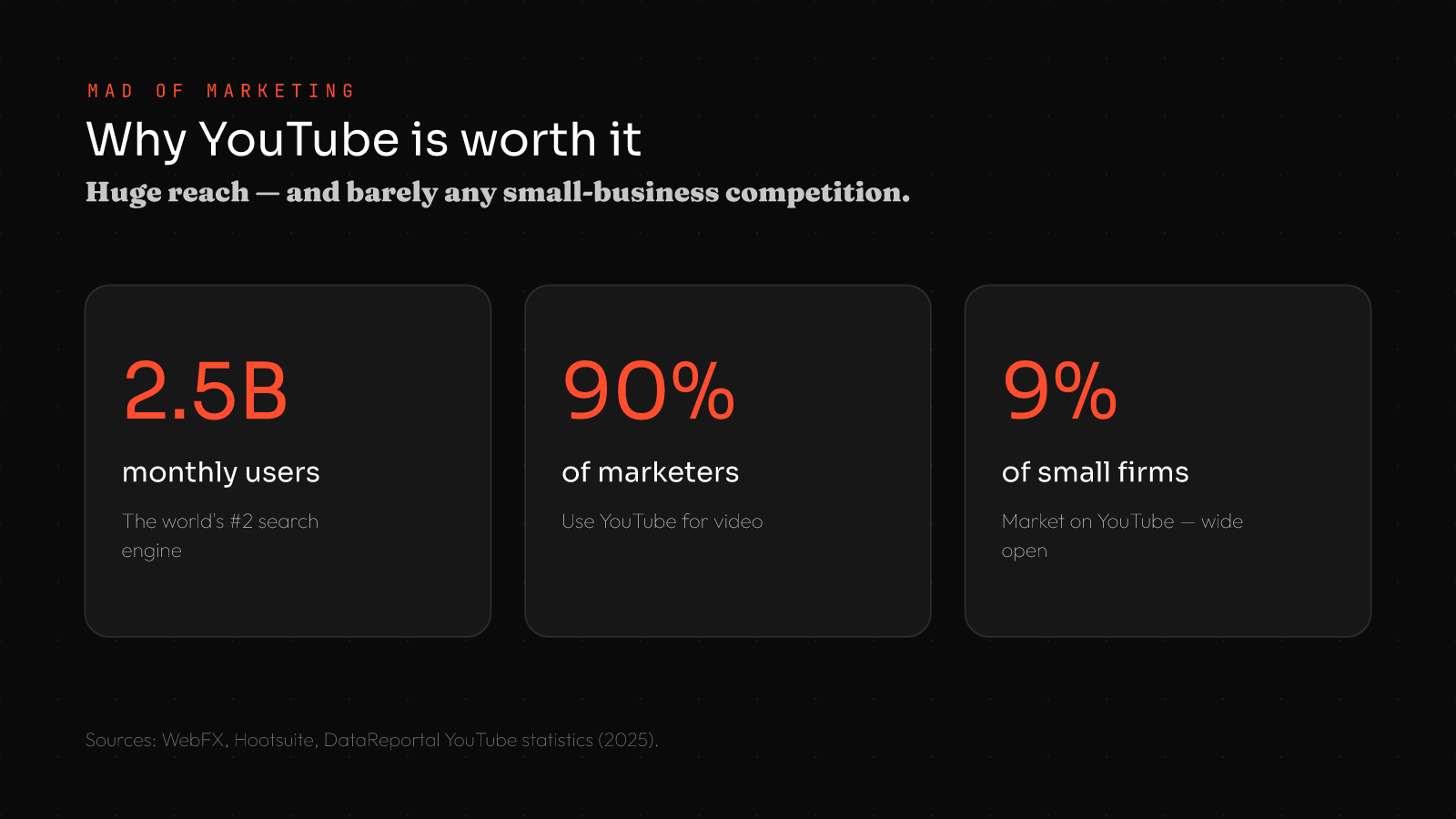
The biggest advantage is compounding. Because YouTube is a search engine, a well-titled how-to video keeps surfacing for relevant searches indefinitely the closest thing to an appreciating asset in video, much like SEO is for your website.
What to post on YouTube
You don’t need Hollywood production you need helpful, findable content. The formats that work for small businesses:
- How-to and tutorials: Answer the questions customers search before they buy. These rank and earn views for years.
- Explainer videos: Show what you do or how your product works.
- Behind-the-scenes: Build trust by showing the real people and process.
- Customer stories and testimonials: Social proof that persuades.
- YouTube Shorts: Short vertical videos that drive discovery, with over 200 billion daily views.
- FAQs: Turn your most common customer questions into a searchable library.
How to do YouTube marketing in 5 steps
Treat YouTube like search, and follow this order.
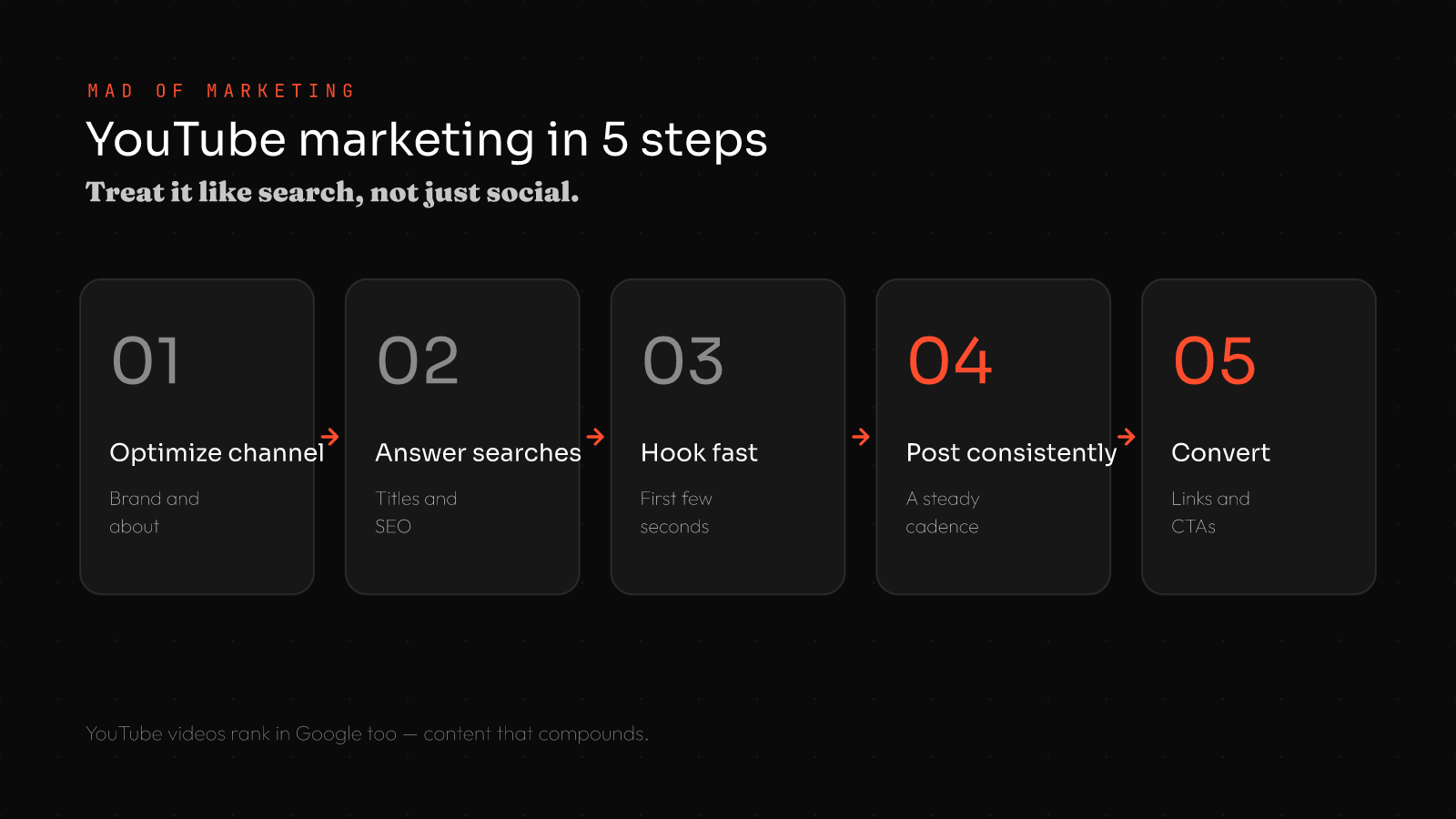
1. Optimize your channel
Set up your channel properly: clear branding, a banner that says what you do, a compelling “About” section with your website link, and a channel trailer. First impressions matter make it obvious what viewers get by subscribing.
2. Answer what people search (YouTube SEO)
This is the heart of YouTube marketing for small business. Research what your customers search, then create videos that answer those queries. Put your keyword in the title, write a detailed description, add relevant tags, and use a custom thumbnail. Optimized videos get found; unoptimized ones disappear.
3. Hook viewers fast
The first 15 seconds decide whether people stay. Open with the payoff or the problem you solve skip long intros. Watch time is a key ranking signal, so earning those early seconds matters enormously.
4. Post consistently
Consistency signals to YouTube that you’re active and gives you more chances to be found. A sustainable cadence even one quality video a week or two a month beats sporadic bursts. Batch-film to keep it manageable.
5. Convert viewers into customers
Views only matter if they lead somewhere. Add clear calls to action, link to your website in descriptions and cards, use end screens to promote offers, and guide viewers to the next step. Track which videos actually drive traffic and enquiries.
YouTube and SEO: the compounding advantage
YouTube’s biggest gift to small businesses is search longevity. A video optimized around a real customer question can rank in both YouTube and Google, appearing in results and even in video carousels sending you free, targeted traffic month after month with no ongoing spend.
This is why YouTube pairs so well with your written content marketing: you can turn a blog post into a video and a video into a blog post, covering both how people search. Add a transcript and a keyword-rich description to each video, and you give search engines everything they need to send you viewers for years.
YouTube ads for small business
Beyond organic videos, YouTube ads let you reach a targeted audience for a controlled budget. You can show ads before or during videos, target by interests, demographics, and search behavior, and with skippable formats often pay only when someone actually watches. For small businesses, YouTube ads work best for building awareness and retargeting people who’ve engaged with you.
Start small, test your creative, and scale what converts, exactly as you would with Google Ads (YouTube ads run through the same platform). As always, judge spend on results, not views.
How to get more views on YouTube
Getting found on YouTube comes down to a few things you can directly influence. Master these and your videos earn views long after you upload:
- Nail the title and thumbnail: Together they decide whether anyone clicks. Write clear, keyword-relevant titles and design bold, readable thumbnails this pairing drives more views than almost anything else.
- Target searchable topics: Make videos people actively search for (“how to…”, “best…”, “[service] explained”), so YouTube and Google keep surfacing them.
- Maximize watch time: Hook viewers early and keep them watching watch time is one of YouTube’s strongest ranking signals.
- Write rich descriptions: Include your keywords, useful context, and links so the algorithm understands your video.
- Use playlists and end screens: Keep viewers on your channel by guiding them to the next video, which boosts overall watch time.
- Encourage engagement: Likes, comments, and subscribes all signal quality simply asking often works.
None of this requires a big budget just intention. Optimize every upload and your library compounds into a steady source of discovery.
YouTube Shorts for small business
If long-form video feels daunting, Shorts are the easiest way in. These short vertical videos rack up over 200 billion views a day and get pushed hard to non-subscribers, making them a powerful discovery tool for small accounts. Repurpose the same vertical clips you make for Instagram Reels and TikTok, and you cover three platforms with one video.
Use Shorts to answer quick questions, share tips, and give bite-sized behind-the-scenes looks then point viewers toward your longer videos or website. Shorts get you discovered; long-form builds the deeper authority and search presence. Using both, a small business can grow reach quickly while still building the compounding, searchable library that makes YouTube so valuable in the first place.
Common YouTube marketing mistakes
- Ignoring search: Posting videos nobody searches for, instead of answering real queries.
- Weak titles and thumbnails: The two things that decide whether anyone clicks.
- Slow intros: Losing viewers before the value starts.
- Inconsistency: Uploading twice then going quiet.
- Over-producing: Waiting for perfect gear instead of starting with your phone.
- No call to action: Earning views but never guiding viewers to act.
How YouTube fits your wider marketing
YouTube is both a social channel and a search engine, which makes it a powerful hub. Its videos feed your Instagram and other social channels, support your SEO, embed on your website to lift conversions, and build the authority behind your brand. Build it into a focused marketing strategy and one video can work across your entire funnel.
How much does YouTube marketing cost?
Organic YouTube marketing is essentially free your investment is the time to plan, film, and edit videos, plus a phone and basic tools you likely already own. That’s what makes it so appealing for small businesses: you can build a valuable, searchable video library without ad spend.
If you want to accelerate results, YouTube ads (run through Google Ads) start at a small daily budget and you often pay only when someone actually watches. Some businesses invest in better equipment or editing help as they grow, and hiring a videographer or agency adds cost but plenty of successful channels are built entirely on phone footage.
The real “cost” of YouTube isn’t money; it’s consistency. For where video fits your wider budget, see how much digital marketing costs.
Frequently asked questions
What is YouTube marketing for small business?
It’s using YouTube videos, Shorts, and ads to reach, educate, and convert customers by publishing searchable content. It blends social video’s reach with search’s staying power, so your videos keep earning views long after you post them.
Is YouTube marketing worth it for a small business?
Yes. YouTube reaches 2.5 billion users, 90% of marketers use it, and only about 9% of small businesses do a wide-open opportunity. Videos also compound in search, making it one of the few channels that keeps paying off over time.
How often should a small business post on YouTube?
Consistency matters more than volume even one quality video a week or two a month works if you keep it up. A steady cadence signals activity to YouTube and gives you more chances to be found in search.
Do I need expensive equipment for YouTube?
No. A modern smartphone, good lighting, clear audio, and helpful content are enough to start. Value and consistency matter far more than production quality authentic, useful videos routinely outperform polished ones.
The bottom line on YouTube marketing for small business
YouTube marketing for small business is a rare mix of massive reach and thin competition. Optimize your channel, answer the questions your customers search, hook viewers fast, post consistently, and guide them to act.
Because YouTube doubles as a search engine, the videos you make keep working for years building authority, traffic, and customers while most of your competitors sit it out.
Want help building a YouTube channel that drives real customers? Book a free strategy call or explore our services.
Sources: WebFX, Hootsuite, DataReportal YouTube marketing statistics (2025). Figures are industry averages and vary by source.