Video marketing for small business is the most persuasive, most-shared format online and it’s never been cheaper to make. 89% of businesses now use video, adding it to a landing page can lift conversions by up to 80%, and viewers retain 95% of a message from video versus 10% from text. You don’t need a studio a phone, good light, and a clear point will do.
People would rather watch than read, and the platforms know it every major channel now pushes video hardest. For a small business that means video marketing isn’t a “nice to have”; it’s the format most likely to get seen, remembered, and acted on. The barrier used to be cost and equipment.
Today the best-performing videos are often the simplest: authentic, helpful, and shot on a phone. Video marketing for small business has never been more accessible or more effective.
This guide is part of our wider playbook on digital marketing for small businesses. Here we focus on video.
What is video marketing for small business?
Video marketing for small business is using video content short social clips, explainers, testimonials, demos, and ads to attract, engage, and convert customers across platforms like Instagram, TikTok, YouTube, and your own website. It ranges from a 15-second Reel to a customer testimonial to a product demo, all aimed at communicating faster and more persuasively than text or images alone.
The reason it works comes down to how people absorb information: video combines sight, sound, and motion, making it more engaging and far more memorable than any other format.
Why video marketing works for small businesses
The data is overwhelming:
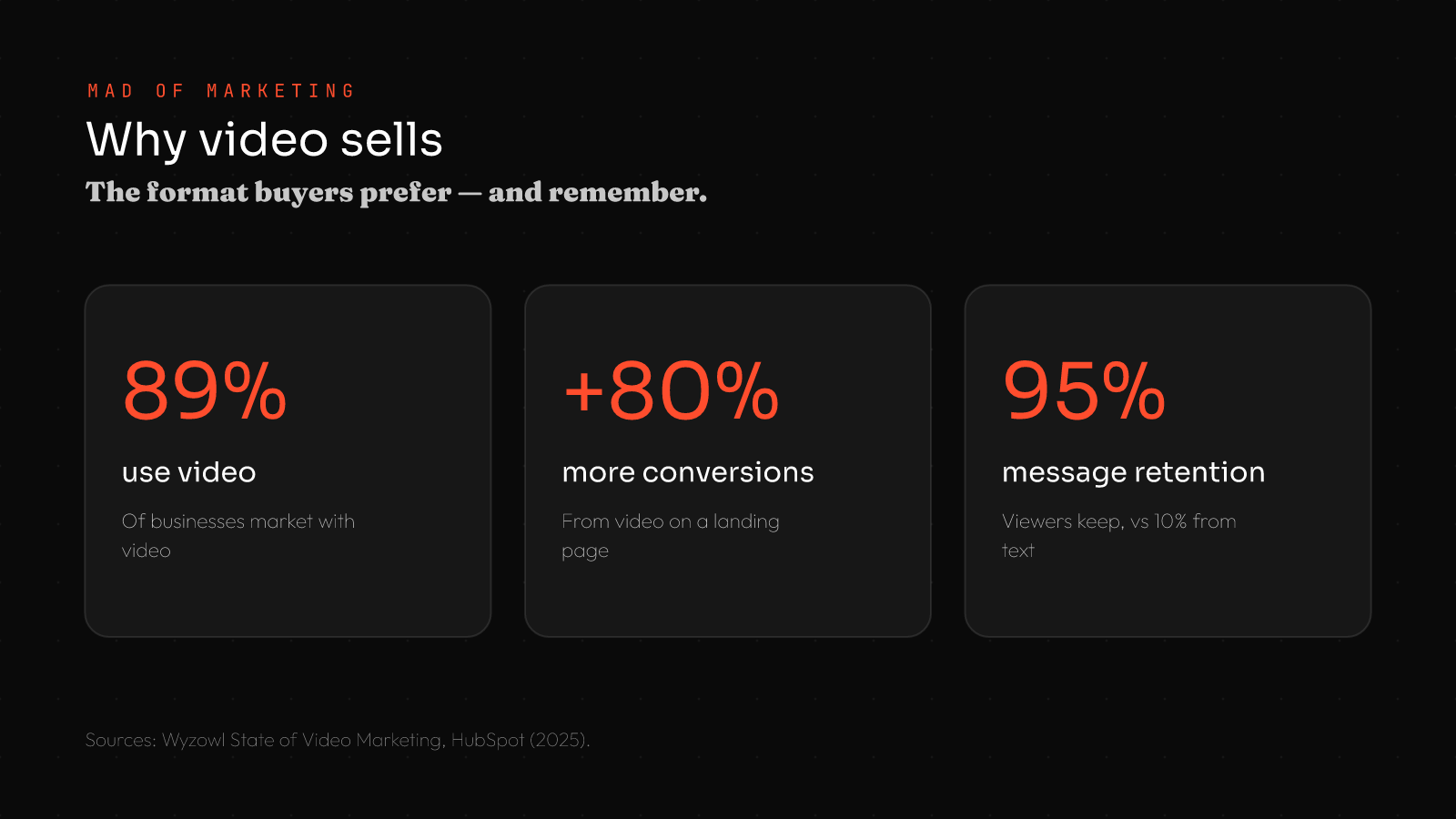
- It’s near-universal: 89% of businesses use video as a marketing tool, and the vast majority say it gives them a positive ROI.
- It converts: Adding video to a landing page can increase conversions by up to 80%, and including video in emails can lift click-through rates significantly.
- It sticks: Viewers retain 95% of a message when they watch it in a video, compared with just 10% when reading it in text.
- People want it: Around 91% of consumers want more online video from brands, and short-form video delivers the highest ROI of any content format.
The types of video that work for small businesses
You don’t need to make every kind. Pick the formats that fit your business and goals:
- Short-form social video: Reels, TikToks, and Shorts the best for reach and discovery. (See Instagram marketing.)
- Explainer videos: Quickly show what you do or how your product works great on your homepage.
- Testimonials and reviews: Real customers telling their story some of the most persuasive content you can make.
- Behind-the-scenes: Humanizes your business and builds trust.
- How-to and educational: Answer customer questions and build authority.
- Product demos: Show the product in action, which sells far better than describing it.
How to make video that converts in 5 steps
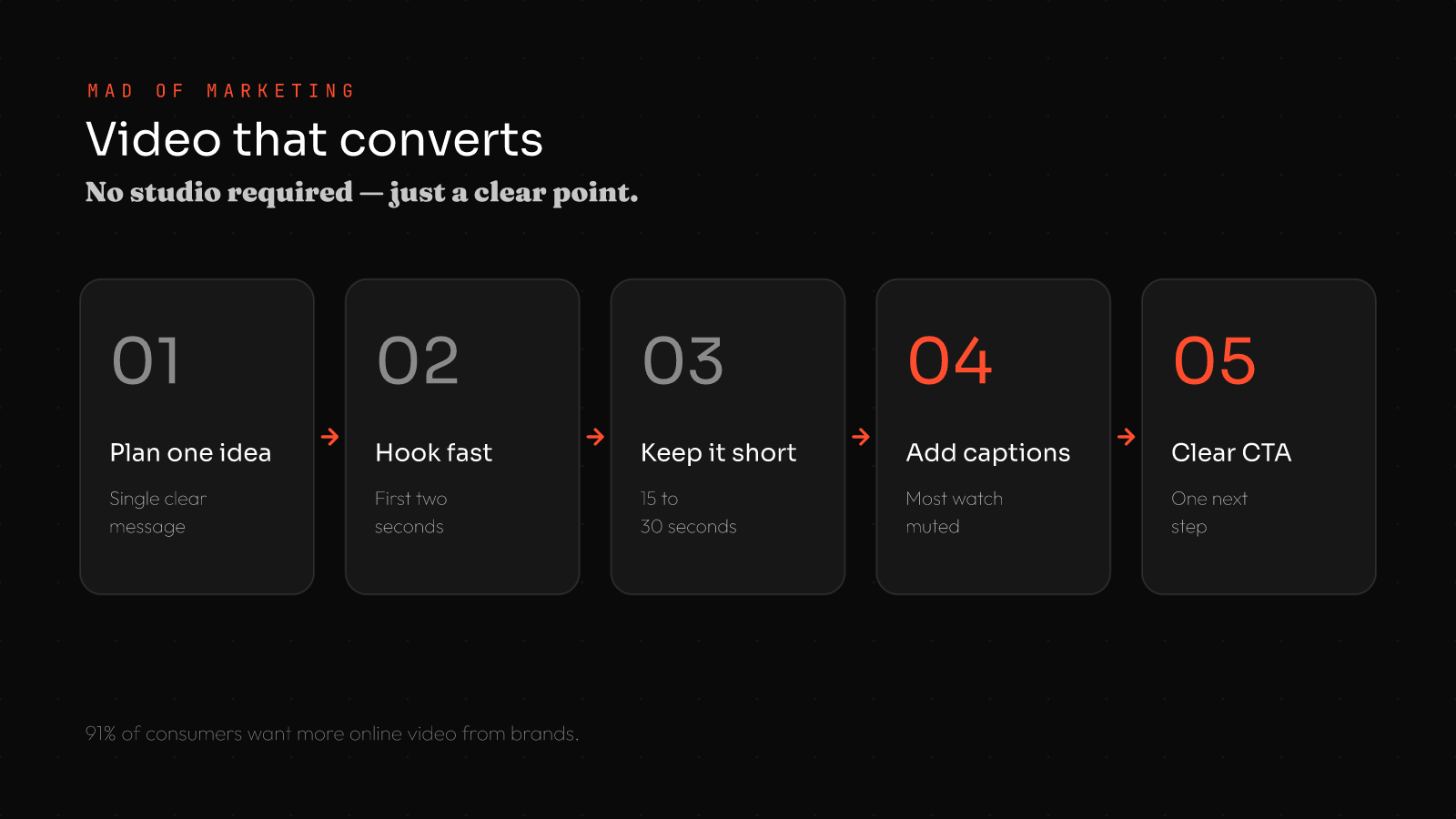
Great video isn’t about budget it’s about clarity. Follow these.
1. Plan one clear idea
Each video should make a single point. Decide the one thing you want viewers to learn or feel before you film clarity beats production value every time. A focused 20-second video outperforms a rambling two-minute one.
2. Hook in the first two seconds
Attention is won or lost instantly. Open with the payoff, a bold statement, or the problem you solve not a slow logo intro. Most viewers decide within seconds whether to keep watching, so front-load the value.
3. Keep it short
For social video, 15–30 seconds is the sweet spot. One idea, tightly told. You can make longer content for YouTube or explainers, but short-form is where the reach and ROI are.
4. Add captions
The majority of social video is watched on mute, so on-screen captions are essential they dramatically increase watch time and completion. Most phone and editing apps add them automatically.
5. End with a clear call to action
Tell viewers exactly what to do next “follow for more,” “link in bio,” “DM us to book.” A great video with no direction is a missed opportunity. Guide the attention you earned toward an action.
You don’t need a big budget
The biggest myth in video marketing is that it requires expensive gear and a production crew. It doesn’t and often the polished, “ad-looking” videos perform worse than authentic phone footage that feels real. All you truly need is a modern smartphone, good natural light (face a window), clear audio (record somewhere quiet or use a cheap clip-on mic), a simple editing app, and a clear message.
Start with what you have, publish consistently, and improve as you go. Done beats perfect especially when authenticity is exactly what audiences respond to.
Where to use your videos
One video can work in many places. Post short-form clips on Instagram, TikTok, and YouTube Shorts for reach; embed explainer and testimonial videos on your website and landing pages to lift conversions; include video in your email marketing to boost click-through; and use video in your paid ads, where it consistently outperforms static images. Create once, then repurpose across every channel.
How to come up with video ideas
“I don’t know what to film” is the biggest thing that stops small businesses from doing video and it’s the easiest to solve. Your customers hand you ideas every day; you just have to notice them. A few reliable sources:
- Frequently asked questions: Every question a customer asks before buying is a video. Answer one per clip.
- Common objections: Address the reasons people hesitate, and you remove them at scale.
- Behind-the-scenes: How you make it, pack it, or do it people love seeing the work.
- Customer stories: Results, transformations, and testimonials sell better than anything you say about yourself.
- Tips and quick wins: Share useful knowledge from your expertise it builds authority and earns saves.
- Trends: Put your own spin on a current format to ride its reach.
Keep a running list on your phone, and you’ll never face a blank screen. One good idea often becomes a whole series.
Measuring video performance
Video is measurable, so don’t fly blind. The metrics that matter depend on your goal, but watch a few key signals: watch time and retention (do people stay, or drop off and where?), engagement (likes, comments, and especially shares and saves, which signal genuinely useful content), reach (how many new people you’re getting in front of), and click-throughs and conversions (the actions that lead to revenue).
Use the analytics built into each platform, look for patterns in what performs, and make more of what works. If a certain style, length, or topic consistently outperforms, that’s your roadmap lean into it. Tie video back to your overall digital marketing ROI so it earns its place on results, not view counts alone.
Common video marketing mistakes
- Over-producing: Waiting for perfect gear instead of starting with your phone.
- Slow starts: Burning the crucial first seconds on intros instead of a hook.
- Too long: Rambling when a tight 20 seconds would land better.
- No captions: Losing the majority of viewers who watch on mute.
- No call to action: Earning attention but never directing it.
- Posting once and quitting: Video, like all content, rewards consistency.
Video and SEO: a powerful pair
Video doesn’t just engage people it helps you get found. Video can boost your search visibility in several ways: pages with video tend to keep visitors longer (a positive ranking signal), video results often stand out in search, and YouTube is itself the world’s second-largest search engine, giving your content a second place to be discovered. Embedding a helpful video on a key page can improve both conversions and time-on-page, which supports your broader SEO.
For the best results, add a clear title and description, include a transcript or captions so search engines can read the content, and host strategically on YouTube for reach, or directly on your site for engagement. Treat video and SEO as partners, and each makes the other stronger: video earns the click and the dwell time, while SEO and YouTube put the video in front of more people searching for exactly what you offer.
Frequently asked questions
What is video marketing for small business?
It’s using video short social clips, explainers, testimonials, demos, and ads to attract, engage, and convert customers across social platforms, your website, and email. It’s the most engaging and memorable content format available.
Is video marketing worth it for a small business?
Yes. 89% of businesses use video, it can lift landing-page conversions by up to 80%, and viewers retain 95% of a message from video versus 10% from text. It’s now affordable enough for any small business to do well.
Do I need expensive equipment to make marketing videos?
No. A modern smartphone, good natural light, clear audio, and a simple editing app are enough. Authentic phone footage often outperforms polished, expensive-looking videos because it feels more genuine.
How long should a marketing video be?
For social media, 15–30 seconds works best one clear idea, tightly told. Explainer and educational videos can run longer, but short-form video delivers the most reach and the highest ROI.
Which platform is best for video marketing?
It depends on your audience and goals. Instagram Reels and TikTok are best for discovery and younger audiences; YouTube is ideal for searchable, longer-form content that compounds over time; and your own website and email are where video converts. The good news is one video can be repurposed across all of them.
How often should a small business post video?
Consistency matters more than volume. Even one or two quality short videos a week, posted reliably, will outperform a burst of content followed by silence. Start with a cadence you can sustain and increase it as video becomes part of your routine.
How do I get more views on my videos?
Hook viewers in the first two seconds, keep videos short and focused, add captions for muted viewing, and post consistently so the algorithm learns to surface you. Riding current trends and making content worth sharing useful, surprising, or relatable are the fastest ways to expand reach beyond your existing audience.
The bottom line on video marketing for small business
Video marketing for small business is the most persuasive, most-shared format online and you can do it with the phone in your pocket. Plan one clear idea, hook fast, keep it short, add captions, and end with a call to action. Use each video across social, your site, email, and ads. Authentic and consistent beats polished and occasional, every time.
Want help building a video strategy that converts? Book a free strategy call or explore our services.
Sources: Wyzowl State of Video Marketing, HubSpot video marketing statistics (2025). Figures are industry averages and vary by source.