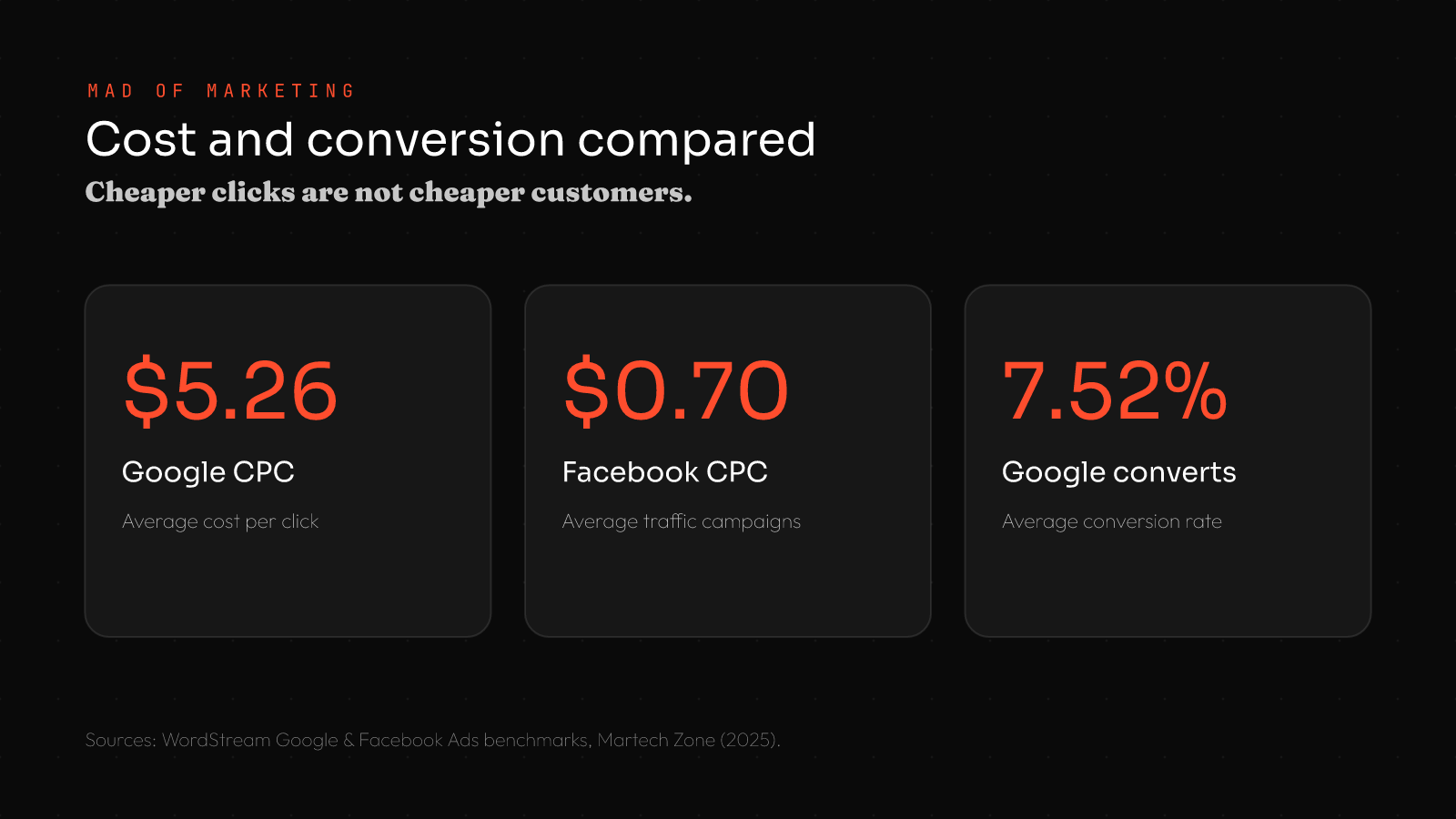
Google Ads captures demand that already exists; Facebook Ads creates demand that doesn’t. Google’s average cost per click is $5.26 against roughly $0.70 for Facebook traffic campaigns but Google converts at an average of 7.52% because you’re reaching people actively searching. If someone is already looking for what you sell, start with Google. If they don’t know they need you yet, start with Facebook.
Google Ads vs Facebook Ads is the wrong fight to pick, and most businesses waste money learning that the hard way. They aren’t competitors doing the same job at different prices they’re two fundamentally different mechanisms. One puts you in front of people who have already decided they want something and are typing it into a search bar. The other puts you in front of people who were looking at photos of their friends’ weekends. Both can be excellent. Choosing badly is expensive, and the deciding factor is almost never budget.
This guide is part of our wider playbook on digital marketing for small businesses. Here we compare the two biggest paid channels.
Google Ads vs Facebook Ads: the core difference
Everything else follows from one distinction intent:
- Google is intent-based: Someone searches “emergency plumber near me” and you appear. The need already exists; you’re competing to be the answer.
- Facebook is interruption-based: You appear in a feed based on who someone is, not what they want right now. You have to create the interest.
- Cost reflects that: Google’s average CPC is $5.26; Facebook traffic campaigns average around $0.70, and Facebook lead ads around $1.92.
- So does conversion: Google Ads averages a 7.52% conversion rate, while Facebook lead campaigns typically sit nearer 3% — you pay more per click for warmer traffic.
How to choose between them
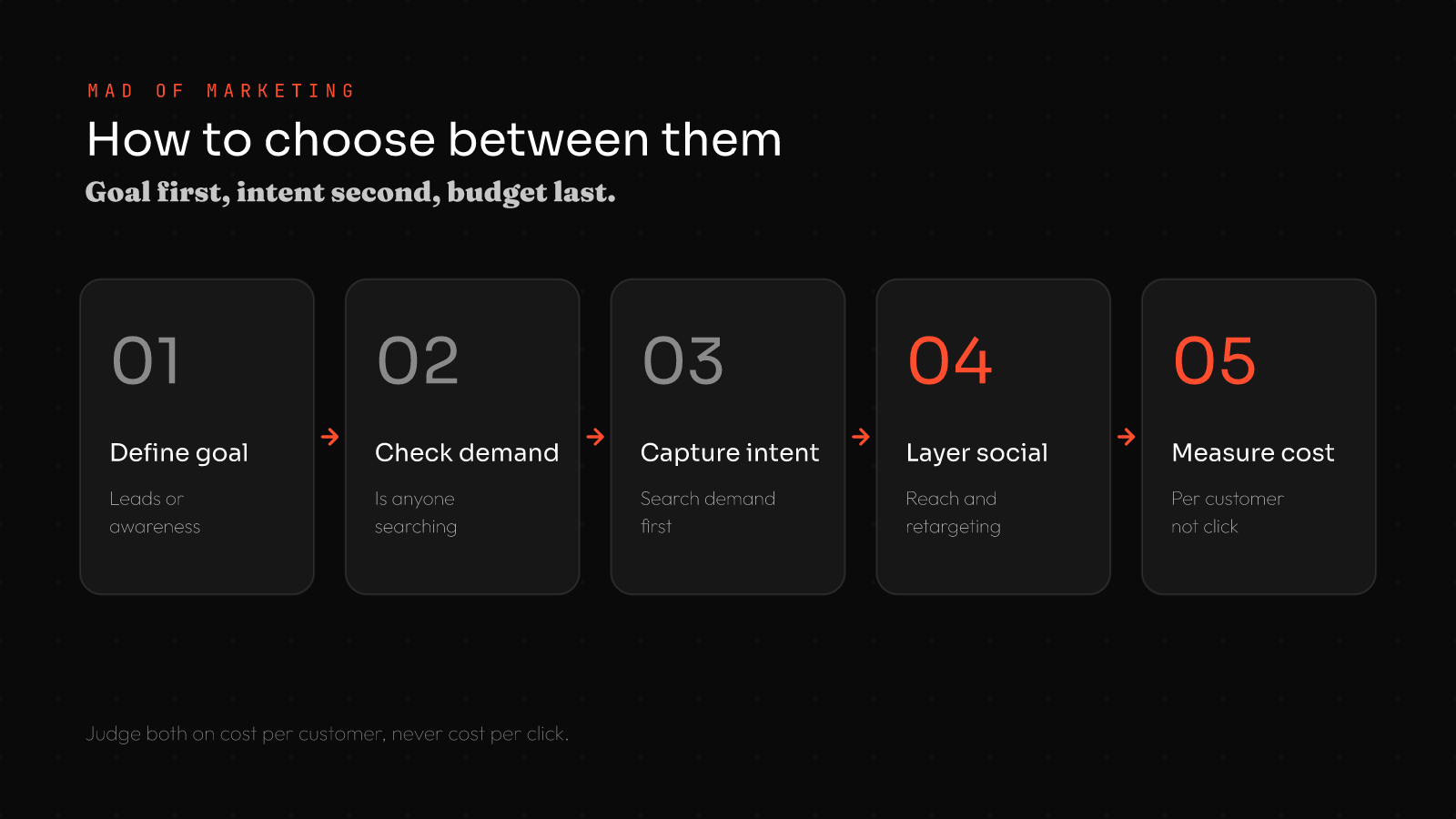
Work through these five questions and the answer usually becomes obvious.
1. Define the goal, not the channel
“We should try Facebook Ads” isn’t a goal. Booked calls, qualified leads, product sales, or brand awareness are goals, and each favors a different platform. Decide what a win looks like and what it can cost you before you open either ad account.
2. Check whether search demand exists
Are people actively searching for what you sell? A locksmith, a dentist, a plumber, an accountant yes, and in volume. A new product category nobody knows exists yet no, and no amount of Google budget will conjure searches that aren’t happening. This single check settles most cases.
3. Capture existing demand before creating new demand
If search volume exists, take it first. Demand capture is nearly always cheaper per customer than demand creation, because you aren’t paying to convince anyone they have a problem. Our guide to Google Ads for small business covers how to start without overspending.
4. Layer social in once search is working
Once you’re capturing the people already looking, Facebook and Instagram widen the funnel reaching people who’d never search for you, and retargeting those who visited but didn’t act. Retargeting is where Facebook is genuinely unbeatable on cost. See Facebook Ads for small business for the setup.
5. Measure cost per customer, not cost per click
This is where most comparisons go wrong. A $0.70 click that converts at 1% costs $70 per conversion; a $5.26 click converting at 7% costs $75. Suddenly the “expensive” platform looks even. Judge both on cost per acquired customer and on the revenue those customers produce see our guide to digital marketing ROI.
When to choose Google Ads
Google is usually the right first move when:
- People actively search for what you sell: services, repairs, local trades, professional help.
- The need is urgent: emergencies, breakdowns, time-sensitive problems.
- You sell a considered purchase: people research before buying.
- You need leads quickly: and can afford a higher cost per click for better-qualified traffic.
- Your local competitors are already bidding: and taking the calls you’re missing.
- You have a strong landing page: ready to convert the traffic you buy.
When to choose Facebook Ads
Facebook and Instagram tend to win when:
- Nobody is searching for your category yet because the product is new or impulse-driven.
- Your product is visual food, fitness, beauty, fashion, interiors, events.
- You know exactly who your customer is demographically and by interest.
- You want cheap reach for awareness, launches, or building an audience.
- You’re retargeting people who already visited your site the highest-return use of the platform.
- Your budget is small and you need volume to learn what messaging works.
Which is cheaper — and why that’s the wrong question
On the surface Facebook wins on price by a wide margin: roughly $0.70 per click for traffic campaigns against $5.26 on Google, which makes Google look seven times more expensive. But cost per click is a vanity metric, because you don’t bank clicks you bank customers. Google’s higher price reflects what you’re buying: a person who typed your service into a search bar minutes ago and is comparing options right now.
That intent is why Google Ads averages a 7.52% conversion rate while Facebook lead campaigns typically land nearer 3%. Run the arithmetic and the gap narrows sharply, and in high-intent local services it often reverses entirely, because a search-driven lead is more likely to answer the phone and buy.
Facebook’s cheap clicks are genuinely valuable for awareness, for testing creative at scale, for retargeting, and for categories where nobody is searching but they arrive colder and need more nurturing before they turn into revenue. The honest answer to “which is cheaper” is that Facebook is cheaper per click, Google is frequently cheaper per customer, and only your own numbers settle it.
Track cost per acquired customer on both, and see our breakdown of what digital marketing actually costs for realistic budgeting.
Why most businesses should eventually run both
Framing this as a permanent either-or costs businesses money, because the two platforms do complementary jobs and get better when they work together. The sequence that works for most small businesses is straightforward: start where the intent already is. If people search for what you sell, capture that demand first with Google, because it’s the shortest path from spend to revenue and it tells you quickly whether your offer converts at all.
Once that’s producing customers at a cost you can live with, add Facebook and Instagram to do the things Google can’t reaching people who don’t yet know your category exists, showing a product that needs to be seen rather than described, and above all retargeting. That last point deserves emphasis: a large share of people who click a Google ad don’t convert on the first visit, and putting them back in front of your brand on social for pennies is one of the highest-return moves in paid media.
Run this way and the channels stop competing for the same budget line and start compounding Google captures the demand that exists, Facebook creates the demand that doesn’t and rescues the traffic Google paid for. Whichever you lead with, both depend on where you send the click, so get your landing pages and conversion rate right before scaling spend on either.
Common mistakes with both platforms
- Judging on cost per click: Cheap traffic that never converts is the most expensive kind.
- Sending ads to a homepage: Paid traffic needs a page built for one action.
- No conversion tracking: Without it you’re optimizing blind on both platforms.
- Expecting Facebook to behave like search: Cold audiences need nurturing, not a hard close.
- Giving up in week two: Both need data and iteration before they stabilize.
- Splitting a small budget in half: Two underfunded campaigns beat neither. Pick one, prove it, then expand.
Frequently asked questions
Google Ads vs Facebook Ads — which is better?
Neither is universally better; they do different jobs. Google captures people already searching for what you sell, making it stronger for high-intent services and urgent needs. Facebook reaches people who aren’t looking yet, making it stronger for visual products, new categories, awareness and retargeting. If search demand exists for your offer, start with Google.
Which is cheaper, Google Ads or Facebook Ads?
Facebook is far cheaper per click around $0.70 for traffic campaigns versus $5.26 on Google. But Google converts at roughly 7.52% on average compared with nearer 3% for Facebook lead campaigns, so cost per acquired customer is often similar and frequently better on Google for high-intent categories. Compare cost per customer, not cost per click.
Should a small business use Google Ads or Facebook Ads first?
Start with whichever matches your customer’s behavior. If people search for your service trades, local professionals, repairs, healthcare begin with Google, because capturing existing demand is the shortest route to revenue. If your product is visual, impulse-driven, or in a category nobody searches for yet, begin with Facebook. Prove one channel before adding the second.
Can I run Google Ads and Facebook Ads at the same time?
Yes, and most established businesses eventually should but not with a small starting budget split down the middle. Get one channel producing customers profitably first, then add the other. The strongest combination is Google capturing search demand while Facebook handles awareness and retargets the visitors Google paid for.
What budget do I need to start?
Enough to gather meaningful data rather than a token amount. On Google, budget for a realistic number of clicks at your category’s cost per click at an average of $5.26, a handful of dollars a day won’t generate enough conversions to learn from. Facebook can start smaller because clicks are cheaper, but still needs enough volume for the platform to optimize. Underfunding either produces noise, not insight.
Why are my Facebook Ads getting clicks but no sales?
Usually because the traffic is colder than search traffic and the page it lands on assumes otherwise. People scrolling a feed weren’t looking for you, so a hard close often fails. Fix the landing page for a single clear action, lower the commitment you’re asking for, add retargeting to reach people more than once, and check that your targeting matches actual buyers rather than a broad interest group.
Is Google Ads worth it for local businesses?
For most local service businesses, yes often more than any other paid channel. Local searches carry high, immediate intent, the competitor set is small, and geographic targeting keeps spend tightly focused. The prerequisites are a page built to convert and call tracking so you can see which clicks became customers.
The bottom line on Google Ads vs Facebook Ads
Stop comparing them on price and start comparing them on intent. Google Ads costs more per click because it reaches people who already want what you sell, and that’s usually worth paying for it’s why it converts at more than twice the rate. Facebook Ads costs a fraction as much and reaches people who don’t know you exist yet, which is invaluable for visual products, new categories, and retargeting the traffic you’ve already bought.
If people search for what you do, start with Google and add Facebook once it’s working. If they don’t, start with Facebook. Then judge both on the only number that matters: what a customer actually costs you.
Not sure which channel your budget belongs in? Book a free strategy call or explore our services.
Sources: WordStream Google Ads benchmarks, WordStream Facebook Ads benchmarks, Martech Zone (2025). Figures are cross-industry averages and vary significantly by sector.