Customer retention strategies for small business are how you turn one-time buyers into repeat customers the cheapest, most profitable growth there is. Keeping a customer is about 5× cheaper than winning a new one, a 5% lift in retention can raise profits 25–95%, and loyal customers spend around 65% more. Most businesses chase new customers while quietly losing the ones they have.
Marketing advice obsesses over acquisition more leads, more traffic, more ads. But the fastest path to profit for most small businesses isn’t finding new customers; it’s keeping the ones they already have. Retained customers cost less to serve, buy more often, spend more, and refer others. Yet most small businesses pour their budget into the top of the funnel and let existing customers drift away. Customer retention strategies for small business fix that leak and the math is hard to beat.
This guide is part of our wider playbook on digital marketing for small businesses. Here we focus on keeping customers.
What is customer retention?
Customer retention is a business’s ability to keep its existing customers coming back over time, rather than losing them to competitors or inactivity. Retention strategies are the deliberate actions you take to build loyalty and encourage repeat business great service, ongoing communication, loyalty rewards, and consistently delivering value. Where acquisition is about winning a first sale, retention is about earning the second, tenth, and hundredth.
Why customer retention beats acquisition
The economics are overwhelming:
- It’s far cheaper: Acquiring a new customer costs about 5× more than retaining an existing one.
- It compounds profit: Increasing retention by just 5% can boost profits by 25–95%, according to Bain & Company research.
- Loyal customers spend more: Repeat customers spend around 65% more than new ones, and are far likelier to try new offerings.
- They’re easier to sell to: The odds of selling to an existing customer are 60–70%, versus 5–20% for a new prospect.
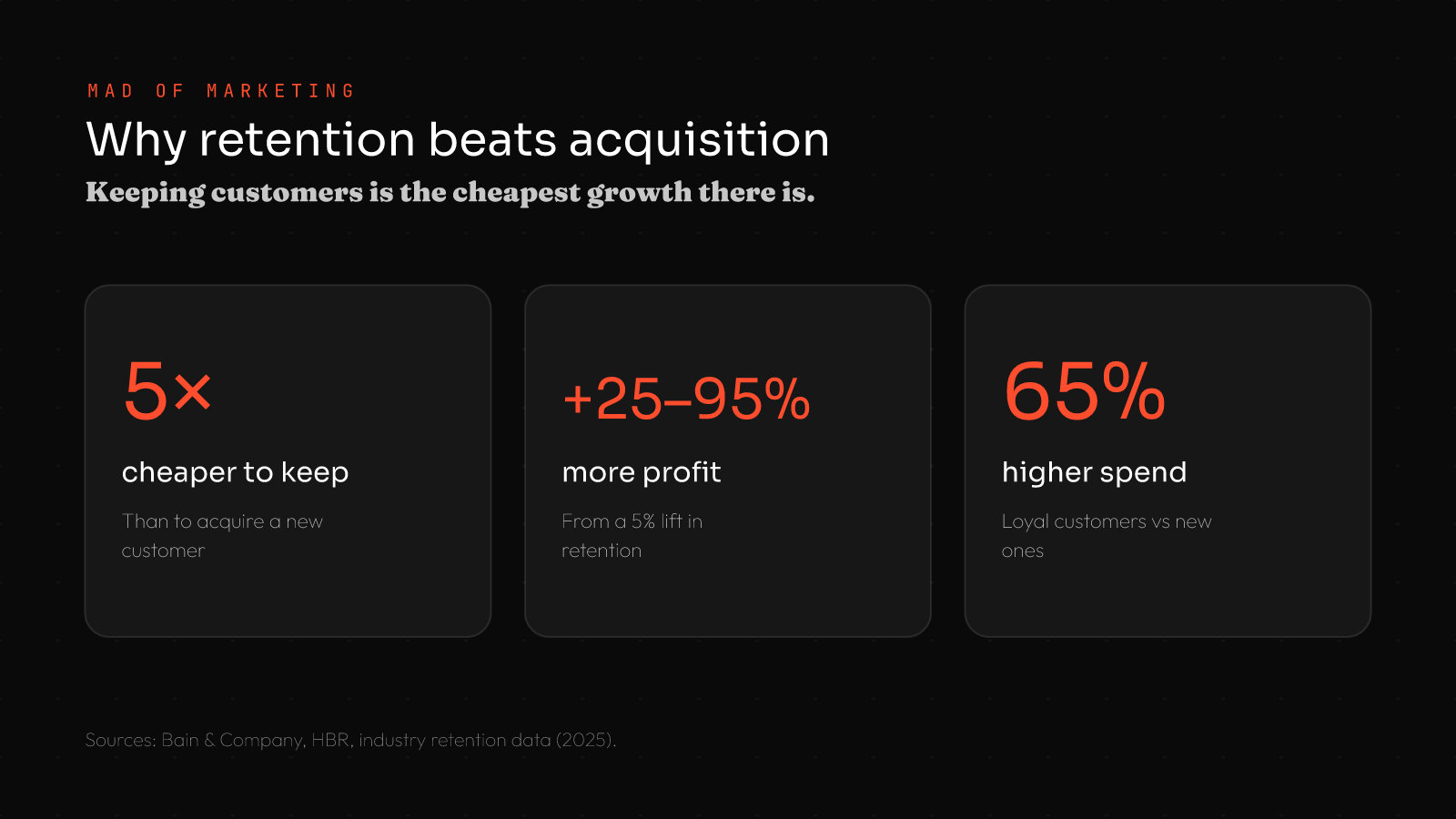
The takeaway isn’t to stop acquiring customers it’s to stop ignoring the ones you have. A business that retains well grows faster and more profitably than one that constantly replaces churned customers.
5 customer retention strategies that work
Retention isn’t luck it’s a set of deliberate habits. Here are five that consistently keep customers coming back.
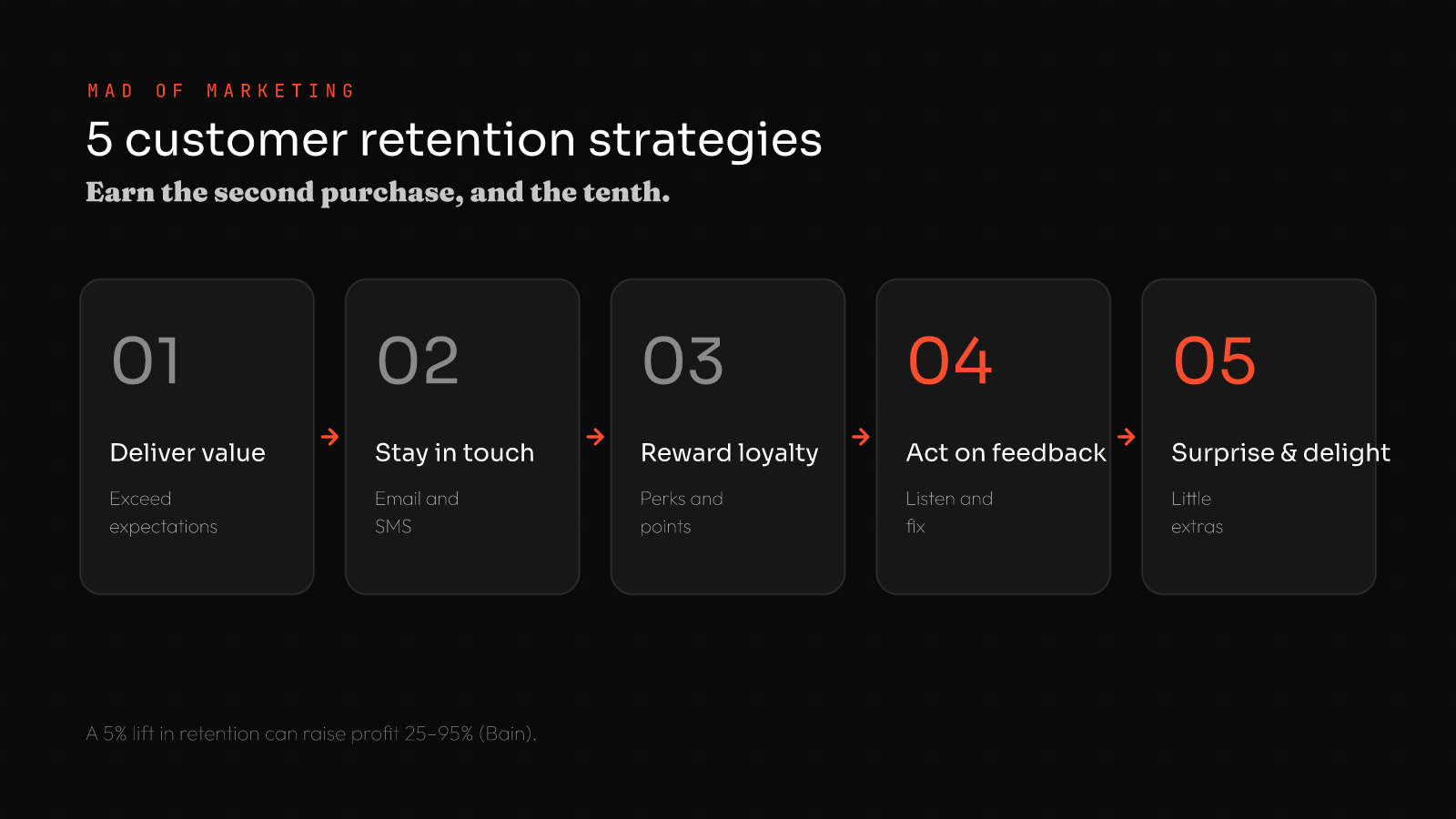
1. Deliver consistent value and great service
The foundation of retention is simple: consistently deliver on your promise and treat customers well. A great product and reliable, friendly service are what earn repeat business in the first place. Fix problems fast and fairly how you handle issues often matters more than the issue itself.
2. Stay in touch
Customers forget businesses that go quiet. Keep in regular, valuable contact through email and SMS helpful tips, updates, and offers that keep you top of mind. Marketing automation makes this effortless with welcome, post-purchase, and win-back sequences.
3. Reward loyalty
Give customers a reason to keep choosing you. A loyalty program, points, exclusive perks, or member discounts make repeat business feel rewarded and build a habit. Even simple recognition of your best customers goes a long way.
4. Ask for and act on feedback
Customers leave when they feel unheard. Regularly ask for feedback, take it seriously, and visibly act on it. Catching and fixing dissatisfaction early prevents churn, and showing customers you listen deepens loyalty. Recurring complaints are a free roadmap to a better business.
5. Surprise and delight
Small, unexpected gestures create outsized loyalty a handwritten thank-you, a surprise upgrade, a birthday perk, or remembering a regular’s usual order. These moments turn satisfied customers into genuine fans who stay and refer others.
How to measure customer retention
You can’t improve what you don’t measure, so track a few key metrics. Customer retention rate the percentage of customers you keep over a period is the headline number. Churn rate is its opposite: the percentage you lose. Repeat purchase rate shows how many customers buy again, and customer lifetime value (LTV) captures the total worth of a customer over the whole relationship the number retention most directly grows.
Watch these over time, and you’ll see exactly whether your retention efforts are working and where customers are slipping away. Rising LTV and a falling churn rate are the clearest signs you’re building a durable, profitable business, and they feed directly into your overall digital marketing ROI.
Turn loyal customers into advocates
The ultimate payoff of retention is advocacy: loyal customers who actively refer others. Word-of-mouth referrals are among the most trusted and highest-converting sources of new business and they cost you almost nothing. Make referrals easy and rewarding: ask happy customers to spread the word, offer a referral incentive, and make it simple to share.
Your most loyal customers are also your best source of reviews, which strengthens your online reputation and brings in more customers. In this way retention and acquisition connect: the better you keep customers, the more they help you win new ones a compounding cycle that lowers your overall cost of growth.
Customer experience: the foundation of retention
Every retention tactic rests on one thing: the experience you deliver. Loyalty programs and follow-up emails won’t save you if the core experience disappoints and they’re barely needed if it delights. Customer experience is the sum of every interaction someone has with your business, from the first visit to post-purchase support. To retain customers, make that experience consistently smooth, pleasant, and reliable: easy to buy, quick to get help, and free of friction.
Small frustrations a slow response, a confusing process, a broken promise quietly push customers to competitors, while consistently good experiences build the trust that keeps them. Map your customer’s journey, find the friction points, and fix them. When the fundamental experience is excellent, retention becomes far easier and every loyalty effort works better on top of it.
Retention looks different by business type
The principles are universal, but the tactics vary with your model:
- Local service businesses: (salons, clinics, trades) retain through appointment reminders, follow-ups, membership plans, and consistent, personal service that earns rebookings.
- Ecommerce stores: retain with post-purchase sequences, loyalty points, replenishment reminders, and exclusive subscriber offers via email and SMS.
- Subscription and membership businesses: live and die by retention onboarding, ongoing value, engagement nudges, and win-back offers for lapsing members are essential.
- B2B and professional services: retain through relationships, regular check-ins, delivering measurable results, and proactive account management.
Whatever your model, the goal is the same: keep delivering value and stay connected so customers have every reason to return and no reason to leave.
Common customer retention mistakes
- All acquisition, no retention: Spending everything on new customers while ignoring existing ones.
- Going silent after the sale: Losing touch until the customer forgets you.
- Ignoring complaints: Letting dissatisfaction fester into churn.
- Taking loyal customers for granted: Reserving your best deals for new customers only.
- Not measuring retention: Never tracking churn or repeat rates, so you can’t improve.
- Inconsistent experience: Delivering greatness once but not every time.
How to win back lost customers
Not every customer who drifts away is gone for good and winning back a former customer is often easier and cheaper than finding a brand-new one, because they already know and (presumably) liked you. The key is a deliberate win-back effort rather than hoping they return on their own. Start by identifying lapsed customers those who haven’t bought in a while then reach out with a reason to come back: a genuine “we miss you” message, a special offer, or news of something new that addresses why they may have left.
Email and SMS automation make this easy with triggered win-back sequences. It also pays to understand why customers leave: if you can, ask, and fix the root cause so you stop the churn at its source. Even a modest win-back rate is pure upside you’re recovering revenue you’d already written off, from customers who cost you nothing new to acquire.
Frequently asked questions
What are customer retention strategies for small business?
They’re the deliberate actions a business takes to keep existing customers coming back delivering consistent value and service, staying in touch, rewarding loyalty, acting on feedback, and surprising customers. The goal is turning one-time buyers into repeat, loyal customers.
Why is customer retention important?
Because it’s the cheapest, most profitable growth available. Keeping a customer costs about 5× less than acquiring one, a 5% retention lift can raise profits 25–95%, and loyal customers spend around 65% more than new ones.
How do I improve customer retention?
Deliver consistent value and great service, stay in regular, valuable contact via email and SMS, reward loyalty, ask for and act on feedback, and add small surprise-and-delight moments. Measure your retention and churn rates to track progress.
How do I measure customer retention?
Track your customer retention rate, churn rate, repeat purchase rate, and customer lifetime value over time. Rising lifetime value and falling churn are the clearest signs your retention efforts are working.
What is a good customer retention rate?
It varies widely by industry subscription businesses aim high, while some sectors naturally see more churn. Rather than chasing a universal number, focus on improving your own rate over time; even small gains compound, since a 5% lift in retention can raise profits 25–95%.
How do I reduce customer churn?
Deliver a consistently good experience, stay in regular contact, act quickly on complaints and feedback, reward loyalty, and reach out to customers before they lapse. Understanding why customers leave and fixing those root causes is the most durable way to cut churn.
Is it cheaper to keep customers or find new ones?
Keeping them, by a wide margin acquiring a new customer costs about five times more than retaining an existing one. Existing customers also buy more often and spend more, which is why even a small improvement in retention has such an outsized effect on profit.
The bottom line on customer retention strategies for small business
Customer retention strategies for small business are the most overlooked, most profitable growth lever you have. Deliver consistent value, stay in touch, reward loyalty, listen and act on feedback, and delight customers in small ways. Measure your retention, turn loyal customers into advocates, and you’ll build a business that grows faster and more cheaply than one forever chasing new customers to replace the ones it lost.
Want help building loyalty and retention into your marketing? Book a free strategy call or explore our services.
Sources: Bain & Company, Harvard Business Review, TextMagic customer retention statistics (2025). Figures are industry averages and vary by source.