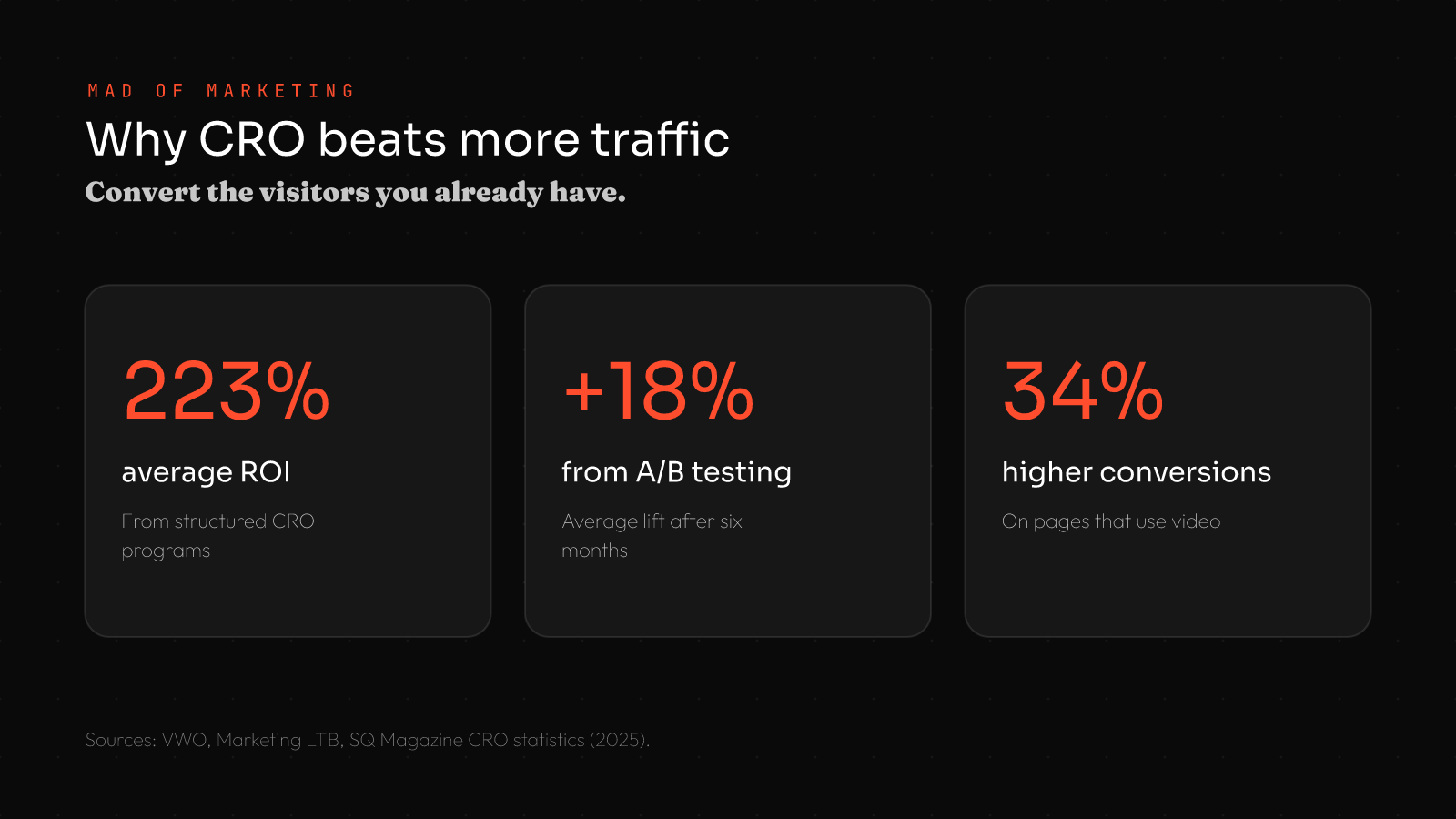
Conversion rate optimization for small business is the art of turning more of your existing visitors into customers instead of paying for more traffic. Structured CRO programs return about 223% ROI, A/B testing lifts conversions by roughly 18%, and simple fixes like shorter forms or adding video can boost conversions 20–35%. It’s the cheapest growth lever most businesses ignore.
Most small businesses obsess over getting more traffic. But if 100 visitors become two customers, doubling that to four without spending a cent more on traffic is often faster and cheaper than doubling your visitors. That’s conversion rate optimization for small business: systematically improving your site so more of the people already arriving take action. It quietly multiplies the return on every other channel you run.
This guide is part of our wider playbook on digital marketing for small businesses. Here we focus on conversions.
What is conversion rate optimization for small business?
Conversion rate optimization (CRO) for small business is the process of improving your website and marketing so a higher percentage of visitors take a desired action buying, booking, calling, or signing up. Your conversion rate is simply conversions divided by visitors: if 1,000 people visit and 20 buy, that’s a 2% conversion rate. CRO is the disciplined practice of nudging that number up through testing and improvement.
The beauty of CRO is its leverage. Because you’re improving results from traffic you already have, every gain drops almost straight to the bottom line and it compounds across every visitor, forever.
Why CRO matters more than more traffic
The data is compelling:
- Strong ROI. Structured CRO programs see an average 223% ROI, and marketers who prioritize CRO are 3.5× more likely to report revenue growth.
- Testing works. A/B testing lifts conversions by an average of 18% after six months, with winning tests improving conversions by ~11% each.
- Small fixes, big gains. Cutting form fields from 7 to 3 can boost conversions 20–35%, pages with video convert 34% higher, and free shipping lifts ecommerce conversions ~28%.
- There’s room to grow. The average website converts at just 2–3%, so most small businesses have significant upside.
Quick CRO wins that move the needle
Some of the highest-impact changes are also the simplest. These common fixes consistently lift conversions:
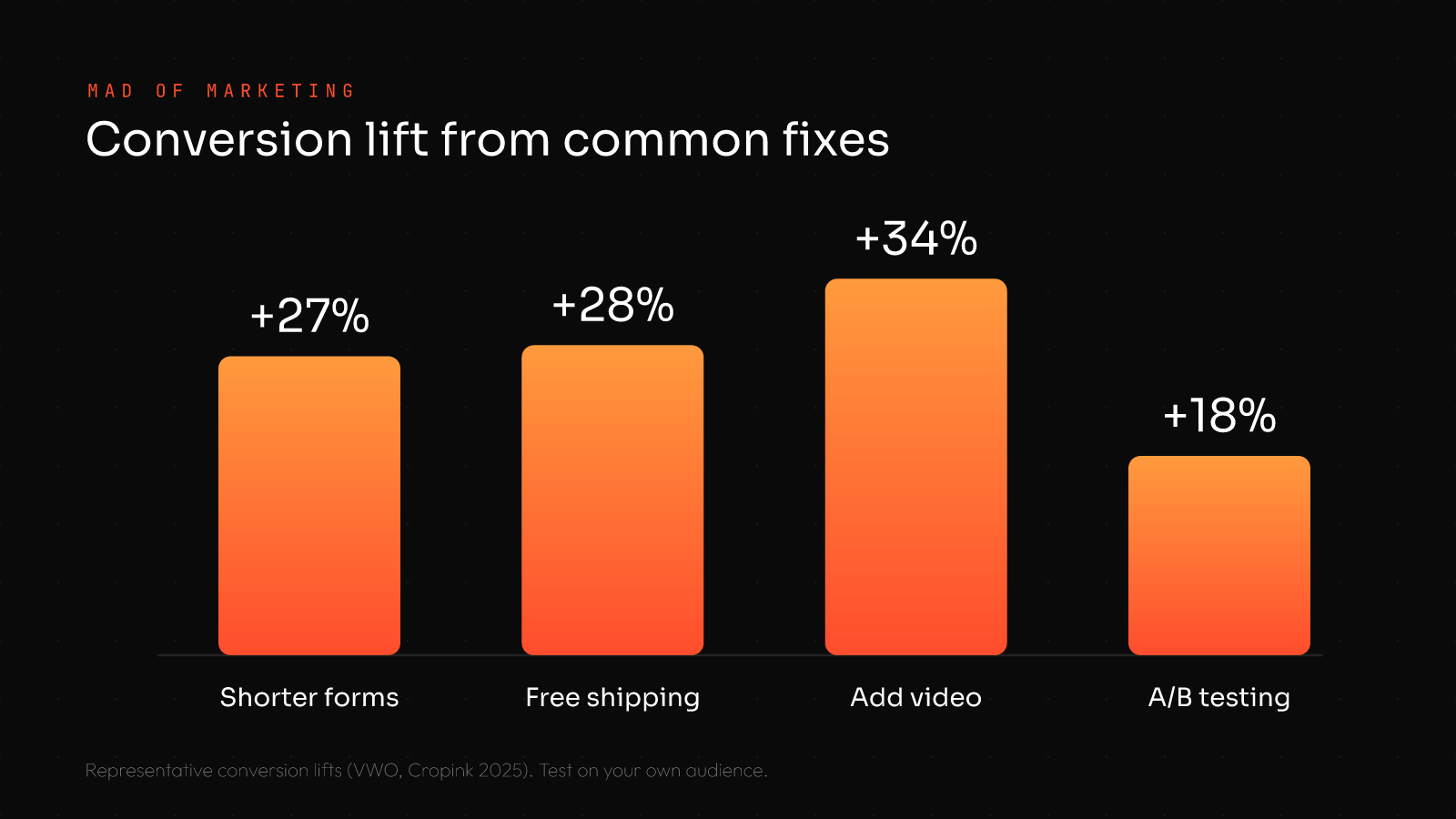
- Shorten your forms: Ask only for what you truly need fewer fields can lift conversions 20–35%.
- Add video: A short explainer or testimonial video can lift conversions by around 34%.
- Clarify your call to action: One obvious, benefit-driven button beats several competing links.
- Speed up the page: Faster pages convert far better speed is a conversion factor, not just an SEO one.
- Add trust signals: Reviews, guarantees, and real photos reassure hesitant visitors.
- Reduce friction: Remove steps, distractions, and anything that makes acting harder than it needs to be.
The CRO process in 5 steps
CRO isn’t guesswork it’s a repeatable loop of measure, hypothesize, test, and improve.
- Measure: Set up analytics and establish your current conversion rate. You can’t improve what you don’t track.
- Find the leaks: Use analytics, heatmaps, and session recordings to see where visitors drop off the pages and steps losing the most people.
- Form a hypothesis: Based on the data, decide what to change and why (“a shorter form will lift sign-ups because the current one asks for too much”).
- Test it: Run an A/B test show half your visitors the change and half the original and let the data decide.
- Roll out winners: Implement what wins, then start the loop again on the next biggest leak.
Only about 42% of businesses test regularly, so a consistent testing habit is itself a competitive edge.
Where to focus your CRO efforts
Not all pages are equal. Prioritize the ones where conversions happen and where traffic is highest:
- Landing pages. Where your ads and campaigns send people small lifts here pay back fast. (They tie directly into your paid ads.)
- Your homepage. Often the most-visited page and a key first impression.
- Product or service pages. Where buying decisions are made.
- Checkout or enquiry forms. The final step, where friction costs you the most.
Strong CRO depends on solid website design speed, clarity, and mobile-friendliness are the foundation every test builds on.
The tools you need for CRO
You don’t need an expensive stack to start optimizing just enough to see what visitors do and test changes. The essentials:
- Analytics (Google Analytics 4): Free, and the foundation it shows your conversion rate, top pages, and where people drop off.
- Heatmaps and session recordings: Tools like Hotjar or Microsoft Clarity (free) show where people click, scroll, and get stuck — often revealing problems analytics alone can’t.
- A/B testing tool: To run controlled experiments and prove which version wins, rather than guessing.
- Feedback tools: Simple on-site surveys or polls that ask visitors what’s stopping them sometimes the fastest insight of all.
Start with the free analytics and heatmap tools; they’ll surface more than enough to act on before you ever pay for anything.
How long should you run a test?
One of the most common CRO mistakes is calling a test too early. A change that looks like a winner after 20 visitors can easily reverse after 200 early results are noise, not signal. As a rule of thumb, run a test until you’ve gathered enough conversions to be confident (most tools will tell you when a result is statistically significant) and across at least one to two full weeks to account for differences between weekdays, weekends, and traffic sources.
Resist the urge to peek and declare victory early. Patience is what separates real, repeatable gains from random luck and it’s exactly why a steady, disciplined testing habit beats a flurry of rushed experiments.
Common CRO mistakes
- Guessing instead of testing: Changing things on opinion rather than data.
- Testing too many things at once: Making it impossible to know what worked.
- Calling tests too early: Stopping before you have enough data to trust the result.
- Ignoring mobile: Optimizing desktop while most visitors are on phones.
- Chasing traffic only: Pouring money into ads while ignoring the leaky site they point to.
- Copying others blindly: What works for another business may flop with your audience always test.
How CRO multiplies your other marketing
CRO is a force multiplier. Every visitor your SEO, ads, and content work to attract becomes more valuable when more of them convert so improving your conversion rate lifts the ROI of every channel at once. Doubling your conversion rate effectively doubles the return on all your traffic without spending more to get it. That’s why CRO belongs alongside lead generation and ROI in any growth-focused marketing strategy.
CRO for ecommerce vs lead-generation sites
Conversion rate optimization looks a little different depending on what counts as a “conversion.” For an ecommerce store, the conversion is a purchase, so CRO focuses on product pages, cart, and checkout: clear product photos and reviews, transparent pricing and shipping (free shipping alone can lift conversions ~28%), a frictionless checkout, and abandoned-cart recovery.
For a lead-generation or service site, the conversion is an enquiry or booking, so CRO focuses on your offer, your forms (shorter forms can lift conversions 20–35%), trust signals like reviews and guarantees, and making it effortless to contact you. The process is the same measure, test, improve but the pages and levers differ. Know which type of site you’re optimizing, and focus your tests where the actual decision happens.
Start with your biggest opportunity
When everything looks improvable, prioritize by impact. Find the page with high traffic but low conversions that’s where a small percentage lift produces the most customers.
A checkout page that 1,000 people reach but only 2% complete is worth far more attention than a blog post nobody converts from. Fix the biggest leak in your highest-traffic funnel first, then work down the list. CRO compounds fastest when you start where the money already flows.
Frequently asked questions
What is conversion rate optimization for small business?
It’s the process of improving your website and marketing so a higher percentage of visitors take a desired action buying, booking, or signing up. Instead of buying more traffic, you get more value from the visitors you already have.
What is a good conversion rate for a small business?
The average website converts at around 2–3%, and landing pages average ~4.4%. “Good” depends on your industry and traffic quality, but most small businesses have room to improve well beyond the average with focused CRO.
Is CRO worth it for a small business?
Very. Structured CRO programs average 223% ROI, and because it improves results from existing traffic, the gains compound across every visitor and lift the ROI of all your other channels.
How do I start with conversion rate optimization?
Measure your current conversion rate, find where visitors drop off using analytics and heatmaps, form a hypothesis, run an A/B test, and roll out the winners then repeat. Start with your highest-traffic and highest-value pages.
Do I need a lot of traffic to do CRO?
You need enough traffic for tests to reach reliable results, which is why formal A/B testing suits higher-traffic sites. But lower-traffic businesses can still optimize using heatmaps, session recordings, customer feedback, and clear best practices to fix obvious friction even without statistically significant tests.
How much can CRO improve my conversion rate?
It varies, but the upside is real: A/B testing lifts conversions by around 18% on average over six months, and individual fixes like shorter forms or adding video can add 20–35%. Because gains compound across all your traffic, even modest improvements meaningfully grow revenue.
What’s the difference between CRO and SEO?
SEO brings more visitors to your site; CRO turns more of those visitors into customers. They’re complementary SEO grows the top of the funnel while CRO improves the bottom. Doing both means more traffic and a higher share of it converting, which multiplies your results.
The bottom line on conversion rate optimization for small business
Conversion rate optimization for small business is the highest-leverage, lowest-cost growth lever you have and the one most owners overlook while chasing more traffic. Measure, find the leaks, test deliberately, and roll out what wins. Improve your conversion rate and you make every ad, every blog post, and every visitor worth more without spending an extra dollar to acquire them.
Want us to find and fix the leaks in your funnel? Book a free strategy call or explore our services.
Sources: VWO, Marketing LTB, Cropink CRO statistics (2025). Figures are industry averages and vary by source.