Marketing agency vs freelancer comes down to scope. A freelancer (~$50–$120/hour, often $1,000–$3,000/month) is ideal for one well-defined channel when you’ll manage the strategy. An agency ($2,000–$15,000/month) makes sense when you want coordinated strategy across channels and one team accountable for results. In-house costs far more $90,000–$140,000 salary before benefits and tools.
Once you decide to get marketing help, the next question is what kind. Freelancer, agency, or in-house hire each has a real case, and the wrong choice wastes money and months. The good news is the decision isn’t complicated once you’re honest about three things: how much you need done, how much you can invest, and how much of it you’re willing to manage yourself. This guide breaks down marketing agency vs freelancer (and in-house) so you can choose confidently.
Fair warning: we’re an agency, so we have a stake in this. We’ve written it straight including the many situations where a freelancer is genuinely the better call. It’s part of our playbook on digital marketing for small businesses.
The cost comparison
Money is usually the starting point, so here’s how the options compare on typical monthly cost:
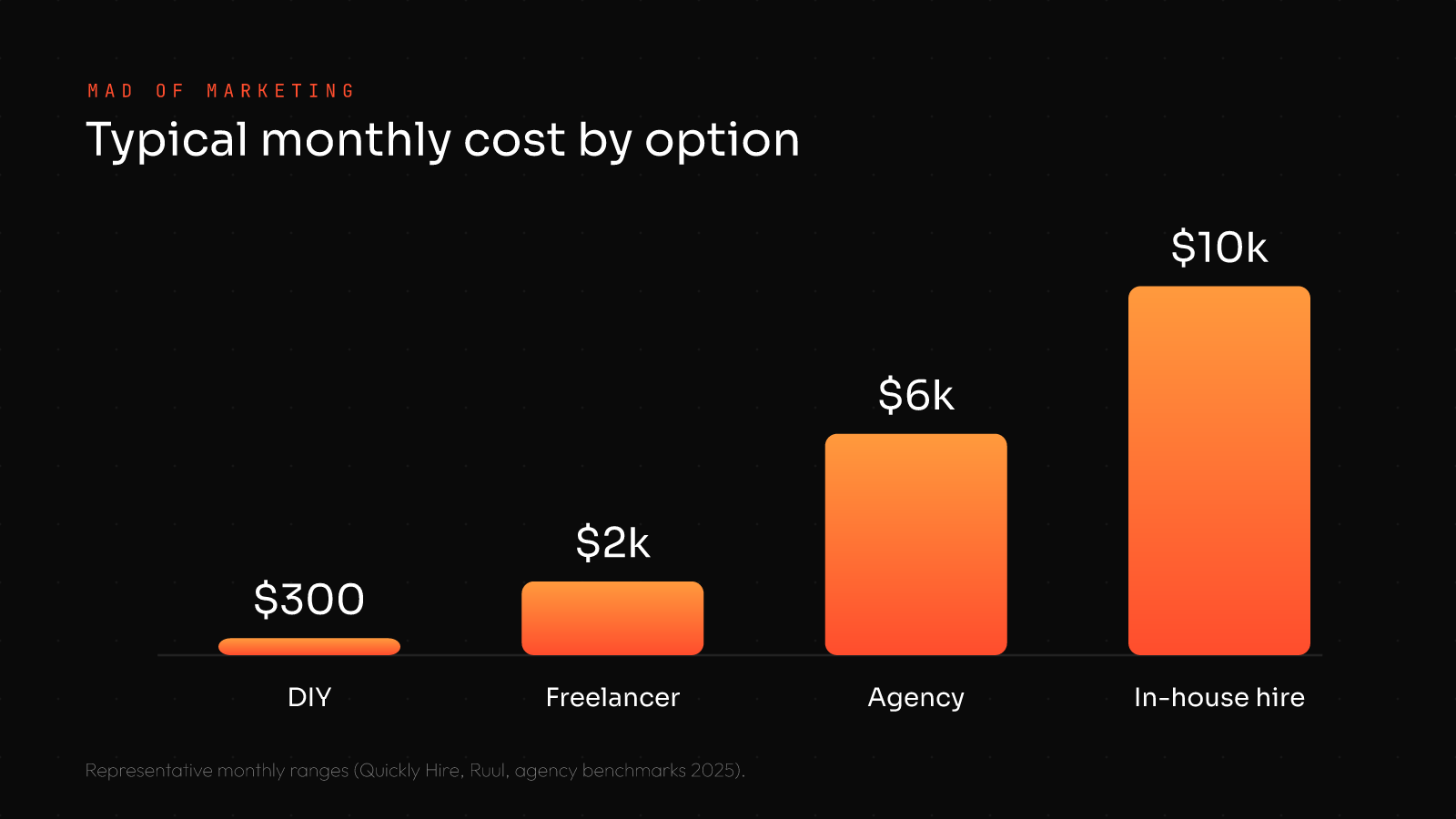
- DIY: mostly tool costs often under $300/month, plus a lot of your time.
- Freelancer: roughly $50–$120/hour for mid-level marketers (average around $48–$100), commonly $1,000–$3,000/month for an ongoing scope.
- Agency: typically $2,000–$15,000/month depending on scope and channels.
- In-house hire: a marketing manager runs $90,000–$140,000 in salary alone, plus benefits, taxes, and $20,000+ a year in tools.
Note the trap in that last one: in-house looks like “one salary,” but a single person can’t cover strategy, SEO, paid ads, design, and content the disciplines an agency provides as a team.
Freelancer: when it’s the right call
A freelancer is a specialist you hire directly for a defined scope, and for many small businesses they’re the smart first step.
Freelancers are best when: you need one clearly-defined channel handled (someone to run your ads, write your content, or manage your social); your budget is limited but you want expertise; you have the time and knowledge to direct the strategy yourself; or you need a specific one-off project like a website or a logo. The advantages are real lower cost, direct access to the person doing the work, flexibility, and often deep expertise in their niche.
The trade-offs: a freelancer covers one discipline, so you’re the one connecting the dots across channels and owning the overall strategy. Capacity is limited if they’re sick, on holiday, or take a bigger client, your marketing stops. And as you grow, coordinating three or four freelancers becomes a management job in itself, which is often what pushes businesses toward an agency.
Agency: when it’s the right call
Agencies are best when: you want coordinated strategy across several channels; you want a team of specialists rather than one generalist; you don’t have time to manage the marketing yourself; you want one partner accountable for results; or you’re scaling and need capacity that doesn’t depend on one person’s availability. The advantages are breadth (strategy, SEO, ads, creative, and analytics under one roof), reliability (a team means continuity), and accountability (one throat to choke, as the saying goes).
The trade-offs: agencies cost more than a single freelancer, and at some firms you’re sold by a senior and served by a junior which is why asking who actually does the work matters so much when you’re choosing an agency. Smaller boutique agencies typically avoid this problem, which is why 75% of small businesses prefer them.
How to decide
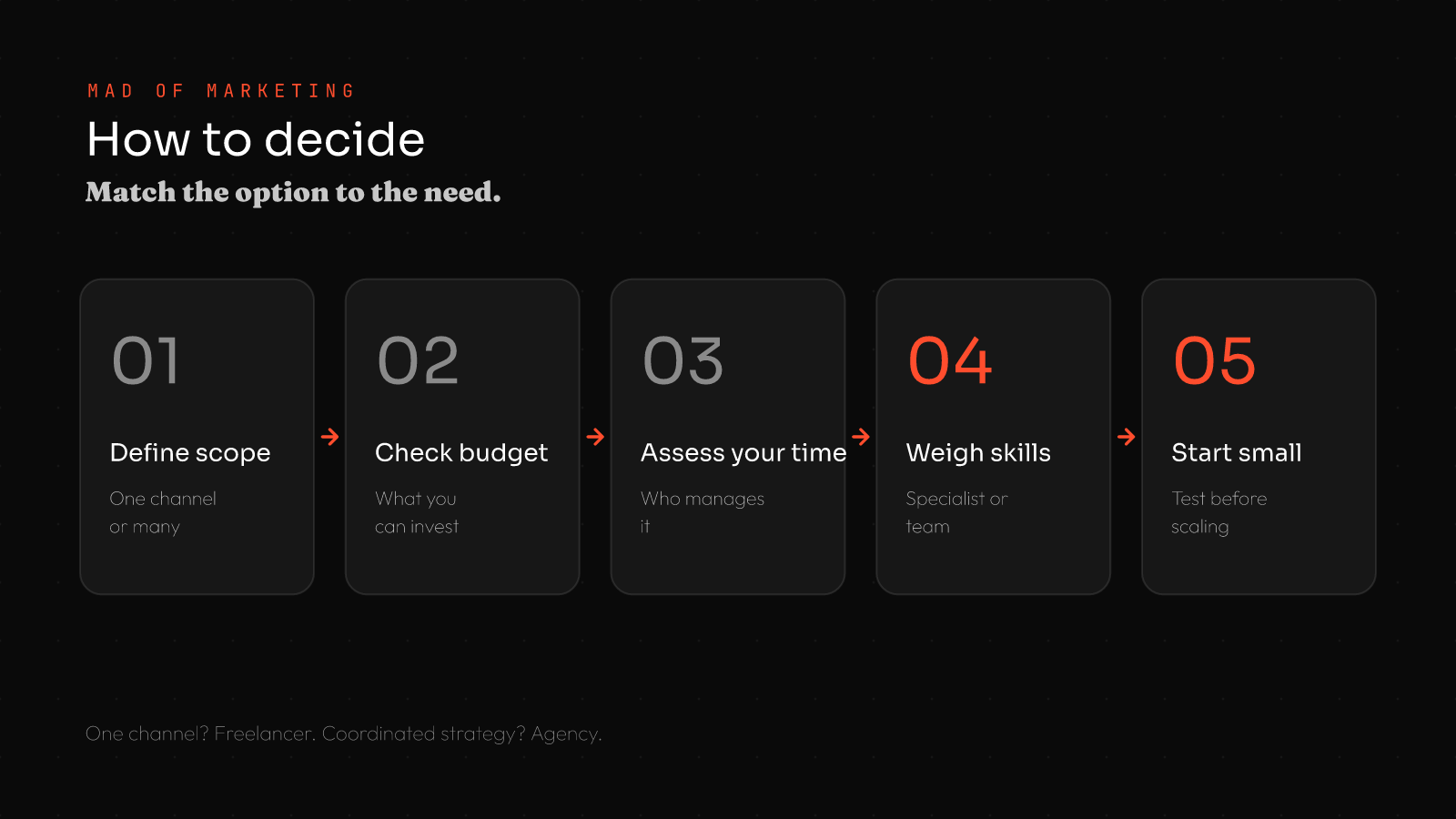
Work through these five questions and the answer usually becomes obvious.
1. Define the scope
Do you need one channel handled, or a coordinated program across several? One channel points to a freelancer; multiple channels needing to work together points to an agency.
2. Check your budget honestly
Under about $1,500/month, a freelancer (or DIY with a strategy session) usually delivers more actual work per dollar. Above that, an agency’s breadth starts to pay for itself.
3. Assess your own time
Who will own the strategy and manage the work? If you can direct a specialist, a freelancer works. If you need someone to own it entirely, that’s an agency.
4. Weigh the skills needed
One specialism (great content, great ads) suits a freelancer. Multiple specialisms technical SEO plus paid media plus creative plus conversion optimization suits a team.
5. Start small either way
Whichever you choose, begin with a smaller engagement to test communication, quality, and results before committing to a long contract. Good freelancers and good agencies alike are happy to prove themselves.
The hybrid approach
It’s worth knowing that this isn’t strictly either/or, and many small businesses land on a blend that works better than a pure choice. A common and effective setup: engage an agency for strategy and the technical heavy lifting the plan, SEO, paid media, and analytics while using a freelancer or in-house person for ongoing execution like social posting, community management, or content writing.
Another version: buy a one-off strategy engagement or audit from an agency to get a clear plan, then hire a freelancer to execute it under that plan. This gives you senior strategic thinking without a full-service retainer, and affordable execution without needing to direct it yourself.
As you grow, the balance typically shifts more work moves to the agency or in-house team, and the setup evolves with your needs. The right structure is whichever gets the work done well within your budget, and it’s perfectly reasonable to change it as your business changes.
Reliability, capacity, and risk
Cost gets the attention, but reliability is often what actually decides the outcome and it’s where agencies and freelancers differ most. With a freelancer, you’re depending on one person. If they get sick, go on holiday, take on a larger client, or simply move on, your marketing pauses. That’s a manageable risk for a defined project and a real one for ongoing, business-critical work.
Freelancer capacity is also finite: a great freelancer may not be able to scale with you when you want to add channels or move faster. With an agency, you’re buying a team, which means continuity when someone is away and the capacity to scale work up or down. The trade-off is that you may not have the same direct, personal relationship with the individual doing the work, and at larger firms the senior person who sold you may not be the one delivering.
There’s also a quality spread on both sides excellent and poor freelancers exist, as do excellent and poor agencies which is why references and starting small matter regardless of which route you take. Think about how critical the work is: for something your revenue depends on month after month, continuity is worth paying for.
How to work well with either
Whichever you choose, the same handful of habits determine whether the relationship succeeds. Be clear about expectations up front scope, deliverables, deadlines, and what success looks like, written down. Ambiguity is the root of most disappointing engagements. Give context, not just tasks share what you know about your customers, what’s worked before, and what your business goals actually are; the more context they have, the better their work will be.
Communicate on a rhythm a regular check-in (weekly for freelancers, monthly for agencies is typical) keeps things on track without micromanaging. Give honest, timely feedback if something isn’t right, say so early rather than quietly growing frustrated. Own your accounts and data always keep your website, ad accounts, and analytics in your own name so you can change providers without losing anything.
And be patient but not passive allow a fair timeline for results while still holding the work to clear standards. Clients who engage as partners consistently get better outcomes than those who hand everything over and disappear, whether they hired one person or a whole team.
Common mistakes when choosing
- Choosing on price alone:The cheapest option that doesn’t deliver is the most expensive.
- Hiring an agency for one small task: Overkill a freelancer is more cost-effective.
- Hiring a freelancer for a full program: One person can’t cover every discipline well.
- Expecting a freelancer to own strategy: Most are specialists, not strategists clarify expectations.
- Not defining scope: Vague briefs produce vague results, whoever you hire.
- Committing long-term too fast: Always test the working relationship first.
Frequently asked questions
Should I hire a marketing agency or a freelancer?
Hire a freelancer if you need one well-defined channel handled and can direct the strategy yourself, especially on a tighter budget. Hire an agency if you need coordinated strategy across multiple channels, a team of specialists, and one partner accountable for results.
Is a freelancer cheaper than an agency?
Usually yes, freelancers typically charge $50–$120/hour or roughly $1,000–$3,000/month, versus $2,000–$15,000/month for agencies. But an agency covers more disciplines, so compare cost against scope rather than headline price.
Is it cheaper to hire in-house or outsource marketing?
Outsourcing is usually cheaper for small businesses. An in-house marketing manager costs $90,000–$140,000 in salary before benefits and $20,000+ in tools and still can’t cover every discipline that an agency team provides.
Can I use both an agency and a freelancer?
Yes, and many businesses do. A common hybrid is an agency for strategy and technical work (SEO, paid media, analytics) with a freelancer or in-house person handling day-to-day execution like social posting and content.
What are the risks of hiring a freelancer?
The main risks are capacity and continuity you’re relying on one person, so illness, holidays, or a bigger client can pause your marketing. Freelancers also cover one discipline, meaning you own the overall strategy. For business-critical, ongoing work, a team offers more reliability.
When should I switch from a freelancer to an agency?
Usually when you’re managing several freelancers at once, when coordinating them has become a job in itself, or when you need coordinated strategy across channels rather than isolated tasks. If your marketing has outgrown one person’s capacity, that’s the signal to move to a team.
The bottom line on marketing agency vs freelancer
Marketing agency vs freelancer isn’t about which is better it’s about which fits your scope, budget, and available time. One channel and you’ll steer the strategy? Freelancer. Coordinated strategy across channels with one accountable team? Agency. Tight budget and time to learn? Start DIY with the free fundamentals. Consider a hybrid if it suits you, start small whichever way you go, and be willing to change the structure as your business grows.
Want an honest opinion on which option fits your situation? Book a free strategy call we’ll tell you if a freelancer would serve you better. Or explore our services.
Sources: Ruul, Quickly Hire, Keevee freelance and agency rate data (2025). Figures are industry averages and vary by source.