To choose a digital marketing agency, define your goals and budget first, shortlist agencies with relevant experience, check real proof of results, ask hard questions about scope and reporting, and start with a smaller engagement to test the fit. 70% of businesses see better ROI with the right agency and the wrong one is an expensive lesson. Transparency matters more than the lowest price.
Choosing a marketing agency is one of the higher-stakes decisions a small business makes. Get it right and you gain a partner who grows your business; get it wrong and you lose months and thousands of dollars. The problem is that every agency’s website says the same things “results-driven,” “data-led,” “trusted partner” so it’s hard to tell them apart. This guide shows you how to choose a digital marketing agency by looking past the pitch at what actually predicts a good partnership.
We’re an agency ourselves, so treat our bias as declared. We’ve written this to be genuinely useful including the red flags you should walk away from, whoever you’re talking to. It’s part of our playbook on digital marketing for small businesses.
What makes a good agency partner
Before comparing agencies, know what actually correlates with success:
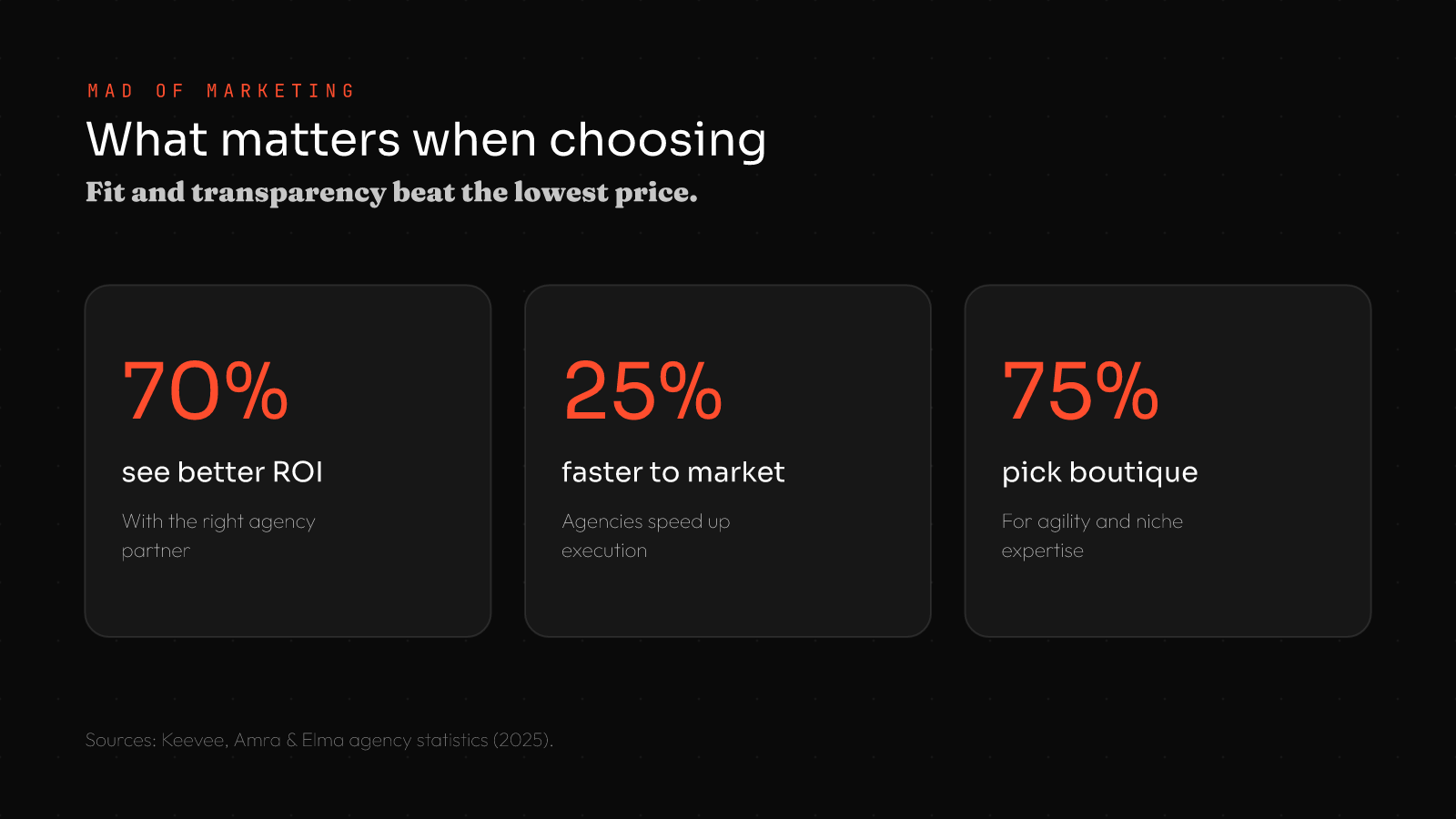
- The right fit drives returns: 70% of businesses report improved ROI after hiring an agency when the fit and expertise match their needs.
- Speed matters: Agencies cut time-to-market by around 25%, but only if they actually execute consistently.
- Smaller is often better: 75% of small businesses prefer boutique agencies for agility, senior attention, and niche expertise over big-firm bureaucracy.
How to choose a digital marketing agency in 5 steps
Do the homework before you sign anything. This process takes a couple of weeks and saves months.
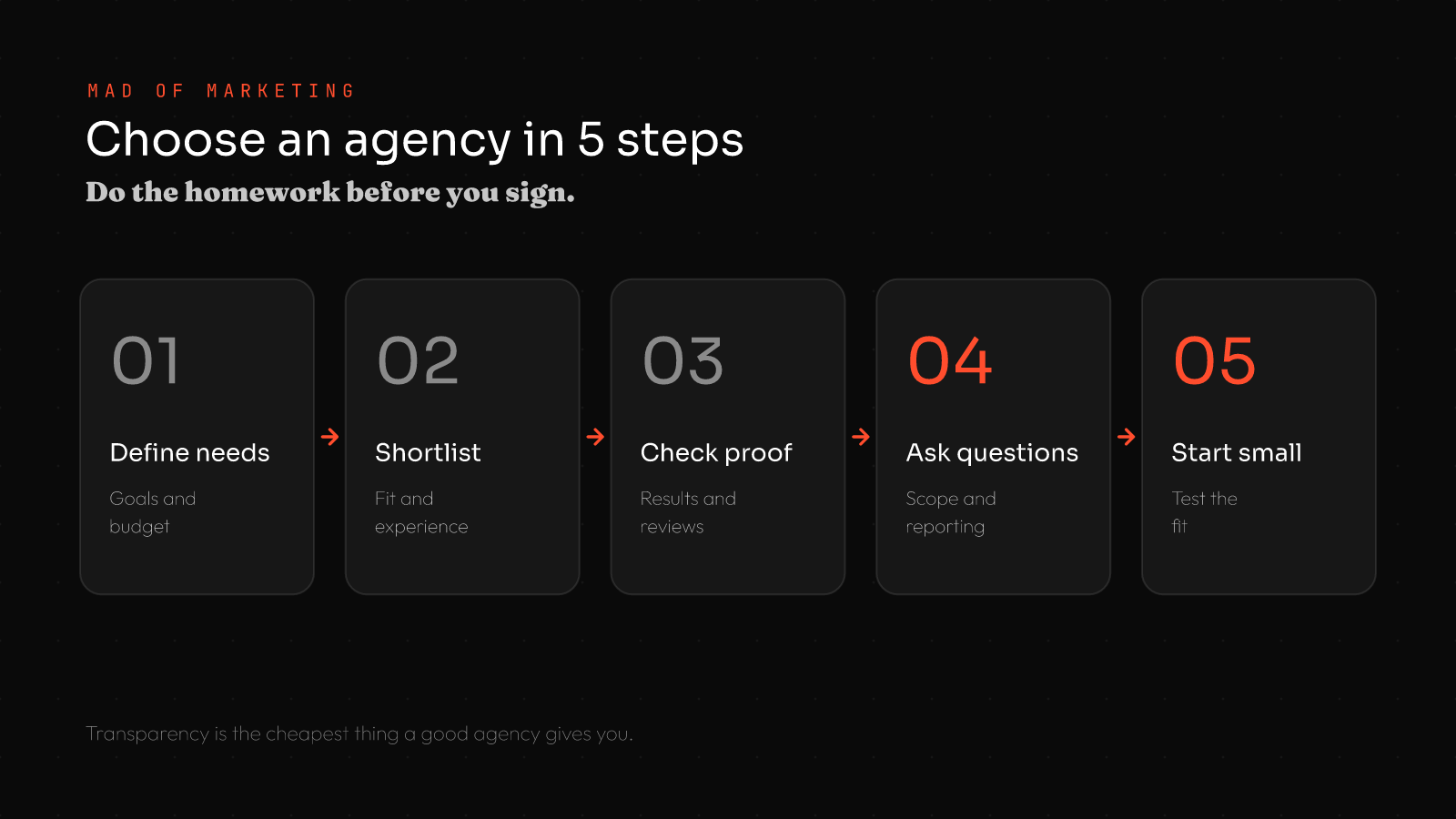
1. Define your needs and budget first
Before talking to anyone, get clear on what you actually need: your goal, which channels matter, and what you can invest. An agency can help refine this, but walking in with vague expectations invites a vague (and expensive) proposal. Knowing your budget also filters out agencies that aren’t a fit.
2. Build a shortlist
Look for agencies with genuine experience in your industry or with businesses your size a firm used to enterprise budgets often can’t serve a small business well. Ask for referrals, check reviews, and look at their own marketing: an agency that markets itself poorly is a warning sign.
3. Check the proof
Move past claims to evidence. Ask for case studies with real numbers, client references you can actually speak to, and examples of work for similar businesses. Be skeptical of vanity metrics impressions and followers aren’t results. Ask what happened to leads and revenue.
4. Ask the hard questions
This is where you separate good agencies from good salespeople. Ask exactly what’s included and what costs extra, who will actually do the work (senior strategist or junior?), how and how often they report, what the contract length and exit terms are, and how they define and measure success. Vague answers now mean problems later.
5. Start small and test the fit
Where possible, begin with a smaller engagement or a shorter initial term a focused project, an audit, or a single channel before committing to a large long-term retainer. This lets you test communication, quality, and results with limited risk. Good agencies are usually happy to prove themselves.
Questions to ask before you hire
Bring this list to every conversation:
- What exactly is included in the fee and what costs extra?
- Is ad spend separate from your management fee?
- Who will do the work day to day, and who’s my point of contact?
- Have you worked with businesses like mine? Can I see results and speak to a client?
- How do you measure success, and how often will I get reports?
- What does month one look like versus month six?
- What’s the contract length, and how do I exit if it isn’t working?
- Who owns the accounts and data the ad accounts, website, and analytics?
That last one matters more than people realize: always insist that you own your ad accounts, website, and analytics, so you can leave with your data intact.
Red flags to walk away from
Some warning signs should end the conversation regardless of how good the pitch sounds. Guaranteed rankings or results nobody can legitimately guarantee a #1 Google ranking, and anyone promising it is either naive or dishonest. Vague deliverables if they can’t tell you specifically what they’ll do each month, they probably don’t know.
No clear reporting an agency unwilling to show you numbers is hiding something. Suspiciously cheap pricing real work costs real money; rock-bottom fees usually mean automated, low-quality output that can actively harm your site. Long lock-in contracts with no exit SEO needs runway, but a 12-month contract with no performance review or exit clause is a trap.
Pressure to sign immediately good agencies don’t need high-pressure tactics. And owning your accounts if they insist on holding your ad accounts or website in their name, you’ll be held hostage later. Any one of these is reason enough to keep looking.
Agency vs freelancer vs in-house
An agency isn’t always the right answer the alternative might suit you better. A freelancer is cost-effective for one well-defined channel, but you manage the strategy and coverage is narrow. In-house gives you dedicated focus but costs far more once you account for salary, benefits, and tools and one person rarely covers every discipline.
An agency makes sense when you want coordinated strategy across multiple channels, senior expertise without senior salaries, and one team accountable for results. Many small businesses use a hybrid: an agency for strategy and the heavy lifting, with in-house staff handling day-to-day content or community management. For a fuller comparison, see our guide to marketing agency vs freelancer and when to hire a marketing agency.
How to compare proposals fairly
Once you have two or three proposals, comparing them is harder than it looks agencies package things differently, so the headline prices are rarely like-for-like. To compare fairly, break each proposal down along the same lines. What’s actually included? List the deliverables side by side: how many blog posts, which channels, how many hours, what reporting. A cheaper proposal often simply includes less.
Is ad spend separate? One agency may quote a fee that includes media budget while another quotes management only a huge difference. Who does the work, and how senior are they? What’s the commitment contract length, notice period, and any setup fees? What’s the reporting cadence, and what metrics will they report on? Build a simple comparison table with these rows and the proposals become genuinely comparable.
Then weigh the intangibles: which team understood your business best, gave the straightest answers, and felt like people you’d want to work with for a year. The cheapest proposal is rarely the best value, and the most expensive isn’t automatically the best either the right choice is the one offering the most relevant work, at a fair price, from people you trust to deliver it.
What good onboarding looks like
How an agency starts tells you a lot about how the rest will go.
Good onboarding is thorough and structured: a proper discovery session to understand your business, customers, and goals; requests for access to your analytics, ad accounts, and website (which should remain in your ownership); an audit of your current marketing to establish a baseline; a documented strategy you review and approve; clear agreement on communication who you contact, how often you’ll meet, and when reports arrive; and defined success metrics you both sign off on.
If an agency starts running campaigns without any of this, they’re guessing rather than strategizing. Conversely, if onboarding is well-organized and they ask genuinely intelligent questions about your business, that’s a strong signal about the quality of everything that follows. Pay attention during these first weeks they’re the most reliable early indicator of whether you chose well.
Common mistakes when choosing an agency
- Choosing on price alone: The cheapest option is often the most expensive in wasted months.
- Not defining goals first: Vague expectations produce vague results.
- Believing guarantees: Promised rankings and “guaranteed leads” are red flags.
- Skipping references: Not speaking to actual clients before signing.
- Ignoring who does the work: Being sold by seniors and served by juniors.
- Not reading the contract: Missing lock-in terms, exit clauses, and account ownership.
Frequently asked questions
How do I choose a digital marketing agency?
Define your goals and budget first, shortlist agencies with relevant experience, verify their results with case studies and references, ask detailed questions about scope, team, reporting, and contracts, and start with a smaller engagement to test the fit before committing long-term.
What questions should I ask a marketing agency?
Ask what’s included and what costs extra, whether ad spend is separate, who does the work day to day, how they measure and report success, what month one versus month six looks like, the contract length and exit terms, and who owns your accounts and data.
What are red flags in a marketing agency?
Guaranteed rankings or results, vague deliverables, no clear reporting, suspiciously cheap pricing, long contracts with no exit or review, high-pressure sales tactics, and insisting on owning your ad accounts or website. Any of these is reason to walk away.
How long should I commit to an agency?
Give any engagement enough runway to work SEO and content need 3–6 months but avoid long lock-ins with no exit. A 3–6 month initial term with clear performance reviews is reasonable; 12 months with no way out is not.
How do I compare agency proposals?
Break each one down the same way: exactly what’s included, whether ad spend is separate, who does the work, contract length and notice period, and the reporting cadence and metrics. A comparison table makes very different-looking proposals genuinely comparable then weigh which team best understood your business.
The bottom line on how to choose a digital marketing agency
Choosing a digital marketing agency comes down to doing your homework before you sign. Define your goals and budget, shortlist on relevant experience, demand real proof rather than claims, ask hard questions about scope, team, reporting, and contracts, and start small to test the fit. Walk away from guarantees, vagueness, and lock-ins. Get this right and you gain a partner that grows your business 70% of businesses do see better ROI with the right agency.
Want a straight conversation about whether we’d be a good fit with honest answers to every question above? Book a free strategy call or explore our services.
Sources: Keevee, Amra & Elma marketing agency statistics (2025). Figures are industry averages and vary by source.